

The Crowned and the Conquered: Five Films About Monarchy and the Second World War
World War Wednesday

Welcome to World War Wednesday, a weekly dive into the continuous, thirty-year epoch of global conflict from 1914 to 1945. Here, I strip away popular myths to analyze the dynamics of industrial warfare, institutional behaviors, and the ideologies that shaped the world we inherited.
When I teach the Second World War these days, one of the things I focus on is that the age of kings was only a century ago. We are not that far removed from kaisers, tsars, and sultans reigning from Vienna to Berlin, Saint Petersburg and Constantinople. Even today the most stable and functional countries in Europe are the constitutional monarchies, and the basket cases tend to be the republics. The United States, uniquely, has made a presidential republic work long term until recently, a lesson that the Americans should think carefully on.
However, what this means is that the World Wars were very much wars that involved ancient monarchies. The fate of the war would in part hinge on the decisions of the crowned heads of Europe. Winston Churchill was never elected to lead the Conservative Party in 1940, he was chosen by the king, George VI using his emergency reserve powers and with some misgivings, and yet, that was still Churchill’s only mandate and the one he lawfully needed. Yet, that was the difference between the resistance of Britain and the Empire, or a deal with the German Fuhrer. The king mattered.
Some films have captured this reality, and they deserve to be mentioned this week. I have decided based on your feedback on my review of Pressure1, that I should review each one. Let me know the order in which I should do so as I have seen them all before, but I will rewatch them for my Substack subscribers.
The King's Speech (2010), starring the brilliant Colin Firth as Prince Albert who would become George VI and the always captivating Helena Bonham Carter as Elizabeth Bowes-Lyon, captures the rise of a monarch wrestling with intense personal vulnerability and painful family trauma while having to rise to the occasion as the British Empire his father helped preserve is forced into World War II.
Director: Tom Hooper
Emperor (2012) starring the American acting giant Tommy Lee Jones as General Douglas MacArthur is focused on MacArthur’s subordinate’s investigation into Japan's imperial household to determine whether Emperor Hirohito—played by Takatarō Kataoka—should face execution as a Class-A war criminal or be protected to ensure national stability.
Director: Peter Webber
A Royal Night Out (2015) starring Canadian actress Sarah Gadon as Princess Elizabeth and English actress Bel Powley as Princess Margaret. This mostly imagined account is set on V-E Day in 1945, focusing on the future Queen and her sister as young women; the pair go incognito for the night, reveling in the heady feeling of youths who had won and survived the war.
Director: Julian Jarrold
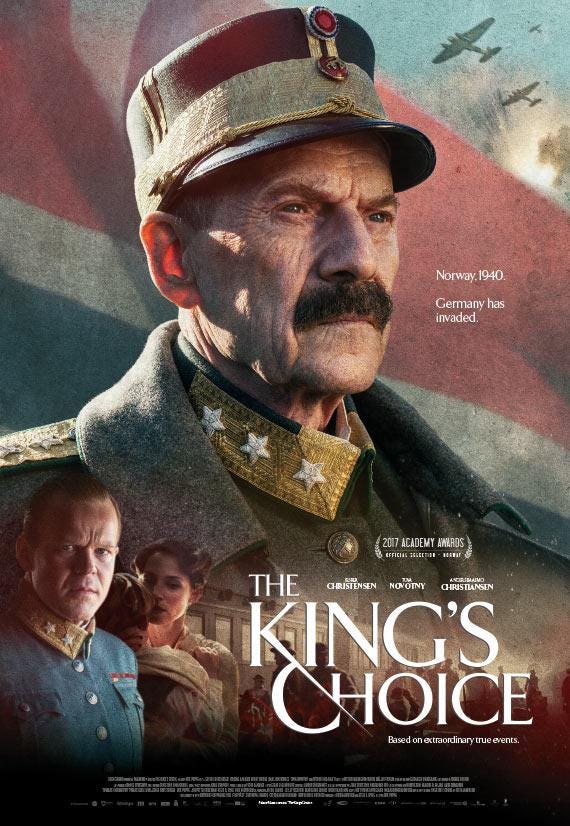
The King's Choice (2016) starring Jesper Christensen as King Haakon VII of Norway, who faces the hardest choice of his reign, whether or not to surrender to the advancing Nazis or risk it all and resist.
Director: Erik Poppe
Finally, The Exception (2016) starring the legendary Canadian actor Christopher Plummer as the deposed and exiled Kaiser Wilhelm II living out his final days in the Netherlands which has just been conquered by Germany, his former realm. What do the Nazis have planned for the former German emperor?
Director: David Leveaux
These films are worth considering alongside traditional world war films because so much happened off the battlefield that shaped what would occur on it and after the guns fell silent. Those stories matter too and that is why I teach an expansive history of the wars.
So let me know which I should review first.
(Update: Apparently you can do polls on Substack…)
If this essay was worth your time, the heart button below costs nothing and means a lot. And if you’d like to support more writing like this, becoming a paid subscriber keeps it coming.

The last two are intriguing. Norway’s dilemma and the story of Kaiser Wilhelm would be fresh explorations for me.