

Missed 30 under 30? That's okay. You are in life for the long haul. Most success comes later.

The obsession with youth has been around for a while, but its current form is a symptom of a uniquely boomer/early Gen-X media apparatus—one that has spent decades marketing and catering to a form of perpetual immaturity. This worship of youth and early success (often measured in possessions) has harmed the public spirit, but I tell you there are no people more disappointed in our boomer elites than the Quiet Boomers. We have not been led by the quiet boomers.
A quiet boomer is one of those Americans who got on with their lives by trying to do their best in their communities and families, often serving in the military or other positions where what was called for was sober-mindedness rather than a fixation on the self. They are our unassuming institutionalists who never gave much concern to the so-called "30 under 30" type of measuring contests that became popular in the 2010s. Such lists, marketing tools to capture the youth market in unhelpful ways, embraced a prodigy myth; they focused overly on early success—often celebrity success—rather than the more ordinary grind and grit of the average American. These citizens often have to wait until their forties or fifties, the so-called sandwich years of greatest family responsibility, to see the fruits of their labor honored, if at all.
That age for most is the Goldilocks moment, when they are mature and still have the energy to undertake major responsibility and creative reforms and innovations. In the Roman Republic high responsibility was supposed to follow the seasoning of your life that came with age and having to deal with failure as well as success. It is why the minimum age for a Roman consul was 42 and that is if you had been elected to the qualifying lower ranking offices previously. They wanted to see a history of duty and maturity before celebrating someone’s accomplishments with high office. This often meant experiencing setbacks and rising to the occasion. I think of how George Washington became president at 57 and his accomplishments are ultimately greater than the prodigy Alexander's. Abraham Lincoln became president at 52 and F.D.R. at 51, ready for hard tasks. For most, success comes later in life, and in the past this was understood and received the appropriate respect. And for some, even later achievement was the norm, but it was still achievement. Today it seems like if you are not early then you have failed. But the prodigy fixation is not only unhealthy, it is often illusory, and lacks the depth of the long-haul effort, the sort that builds, shapes, and sustains the institutions of civilization. There’s a particular biography that keeps this in focus for me, and the numbers to keep in mind are: 1884, 1917, 1919, 1924, 1934, and 1945.
Harry S. Truman was born in 1884, to a humble family with two grandfathers named Shipp and Solomon so he got an “S.” that stood for both of them rather than a full middle name. Nothing came easy to Truman, or early. He was smart but could not afford university, and could not get into West Point because he had poor eyesight; he was the last president to never finish college. In 1905 he joined the Missouri National Guard and served until 1911, the same year he proposed to a woman named Bess Wallace. She shut him down. He wanted to prove himself and thought that she didn't want to marry a poor farmer, but she did not have a mind to marry anyone she said. Truman tried his hand at various business ventures, he was a hard worker, and was willing to do tasks that needed doing, as the old saying goes. He was not a quitter.
His life went on and Truman's chance to finally serve his country as a combat soldier came in 1917 with the Great War; he was 33 years old, rejoined the Missouri National Guard which was federalized and sent overseas to fight the Kaiserreich. He was a trad Protestant who was known for his ability to get along with Catholics and Jews, the "new immigrant" groups of 19th century America. In fact Truman took over the Battery D, 129th Field Artillery Regiment, the so-called Battery D-Boys, or the Dizzy D. Rough, and rowdy—and apparently hungover when Truman first mustered them—they had a rep that made commanders shy away. Not Truman; he did not have the time for it and whipped them into shape. They tried to rattle him, he rattled right back after regaining his composure because the first sight of his new unit unnerved him for a moment. A moment.
“I didn’t come over here to get along with you. You’ve got to get along with me. And if there are any of you who can’t, speak up right now and I’ll bust you right back now.”
He demoted several non-commissioned officers and privates first-class on day two of his command.
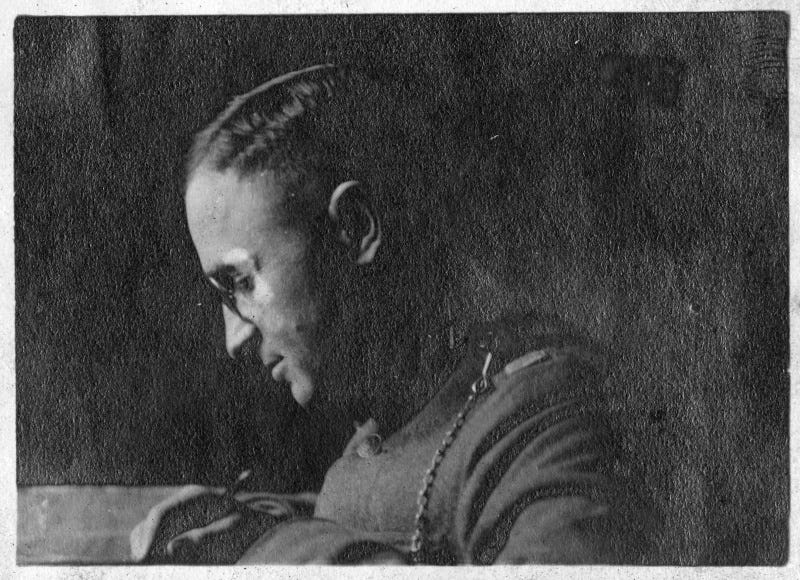
He eventually made this group of mostly Irish and German American Catholic lads from Missouri love his old Baptist and Presbyterian inflected discipline. A month before the massive Meuse-Argonne Offensive, Truman won them over in an incident known as the “Battle of Who Run”1 on a hill in the Vosges Mountains, when his horse went down after a German shell exploded nearby, Truman’s men ran. But Truman got up after being helped by a soldier and let loose with, shall we say, words of encouragement, to get back in the fight. The sight of the 34 year-old captain, more mature than previous commanders, wearing his glasses, and standing tall after they all saw his horse collapse, smartened the boys up really quick as to who this man was.
The Battery D-Boys never ran again and the Germans were the first ones Truman gave hell to. Truman left the US Army as a respected Captain and local war hero, and in 1919, now a veteran he shot his shot, and married his bride for life, Elizabeth Virginia Wallace. He never gave up courting her and she was glad to have him back.
I felt that I was a Galahad after the Grail and I’ll never forget how my love cried on my shoulder when I told her I was going. That was worth a lifetime on this earth —Truman reflecting on Bess’ reaction to the news he had enlisted in 1917.
He joined the Army Reserves, was promoted and eventually reached the rank of colonel in 1932, and stayed in until retiring as an inactive reservist the day he left the White House in 1953.
Finally, in 1924 at the age of 40 he became a father to Mary Margaret and would remain a doting Dad all his life, famously taking to task a Washington Post critic who did not like Margaret Truman's singing after she embarked on a musical career as a young woman:
Mr. Hume:
I’ve just read your lousy review of Margaret’s concert. I’ve come to the conclusion that you are an “eight ulcer man on four ulcer pay.”
It seems to me that you are a frustrated old man who wishes he could have been successful. When you write such poppy-cock as was in the back section of the paper you work for it shows conclusively that you’re off the beam and at least four of your ulcers are at work.
Some day I hope to meet you. When that happens you’ll need a new nose, a lot of beefsteak for black eyes, and perhaps a supporter below!
Pegler, a gutter snipe, is a gentleman alongside you. I hope you’ll accept that statement as a worse insult than a reflection on your ancestry.
H.S.T.
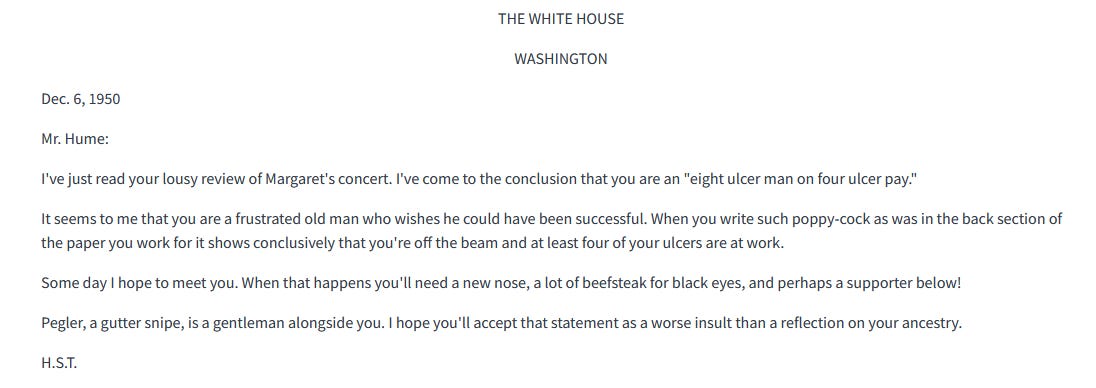
Big Dad Energy from POTUS.
Truman entered local politics and was elected a US Senator from Missouri at the age of 50 in 1934. An honest man he lived thriftily, and as head of the Select Senate Committee to Investigate the National Defense Program Truman gained respect and admiration for exposing war profiteering and substandard work by some firms taking advantage of the World War Two emergency. Then at the age of 60 he was asked to be FDR’s vice presidential running mate in 1944, and when FDR died suddenly in April 1945 Truman became president a month before his 61st birthday. When Truman left office in 1953 the world was transformed.
This ordinary American concluded the end of the Second World War, succeeding after the death of the great Franklin Delano Roosevelt. Truman helped set up the United Nations, supervised the Marshall Plan to rebuild Europe, democratized Japan, established NATO, recognized the State of Israel, resisted the communists in Korea, initiated the desegregation of the United States Armed Forces, and ensured that the civilian leadership of the United States would control atomic weapons.
In his last presidential news conference he was asked about his financial future after leaving office. I’ll let you get the measure of the man from his answer.
[30.] Q. Mr. President, when a 5-star general is put on the inactive list, I think he gets a pension and a salary of about $19,000 a year.
THE PRESIDENT. They are never put on the inactive list. They are not put on the inactive list. It was provided that they would be the eider statesmen of the military, that they would be on active duty at the call of the President all the time.
Q. My question was, does the President of the United States get any such pension as that?
THE PRESIDENT. No. The President of the United States is going to have to commence begging meals after the 20th. [Laughter] He is getting a lot of invitations, so I don't believe he will go hungry.
Q. Mr. President, if you don't mind this question--as a result of what has been done about the President's salary, will you be in a position so that you won't have to--oh, say, join an insurance company or become an editor, or something like that?
THE PRESIDENT. Yes, Eddie, but I wouldn't do that under any circumstances. I think-as I told you time and again, this Presidential Office--now remember I am talking about the office--is the greatest and most powerful office in the history of the world. It's the greatest honor that can come to any man in the world. And no man, I am sure, would want to exploit it. And under no circumstances would I do anything that would appear to use the great office which I have had the honor to hold as a means for exploitation.
—January 15, 19532
Truman received a regular income of just over $100 from his army pension, but contrary to myth, he and Bess were moderately comfortable because of his nature; he had saved much of his presidential salary and like U.S. Grant, sold his memoirs for a high advance payment on his autobiography to provide for his family. He refused jobs that would demean the office and carried on as a private citizen. But with concern that this situation might be unsustainable for himself or his successors, Truman, thinking of the institution, privately lobbied Congress for the Former Presidents Act. Passed in 1958 and signed by President Dwight David Eisenhower, the legislation provided Truman, his only living predecessor Herbert Hoover, and their successors a pension—later amended to add lifetime Secret Service protection—with the goal of ensuring that former presidents would be better able to preserve the dignity of the republic as disinterested elder statesmen.
Was he late or did Truman arrived on time?
How about you?
And let us not grow weary of doing good, for in due season we will reap, if we do not give up. Galatians 6:9
Very powerful and inspiring