

Looking back on 2025
History does not play favorites

If you are waiting for an American civilizational postmortem, the patient is still alive. I write about the history of the American social order—what it took to build a 20th century superpower and what it will take to repair our institutions and secure a better American future, for all of us. Subscribe to support this project of learning from our shared history to find our pathway forward.
This year Outside the Academy has grown from 100 to over 270 subscribers. Thank you for your support. Based on what resonated with you, it appears I have so far achieved my goal of writing pieces that speak across the political tribes.
Back in 2018, the group More in Common produced a report called “The Hidden Tribes of America”1 Their research divided the US electorate into seven groups:
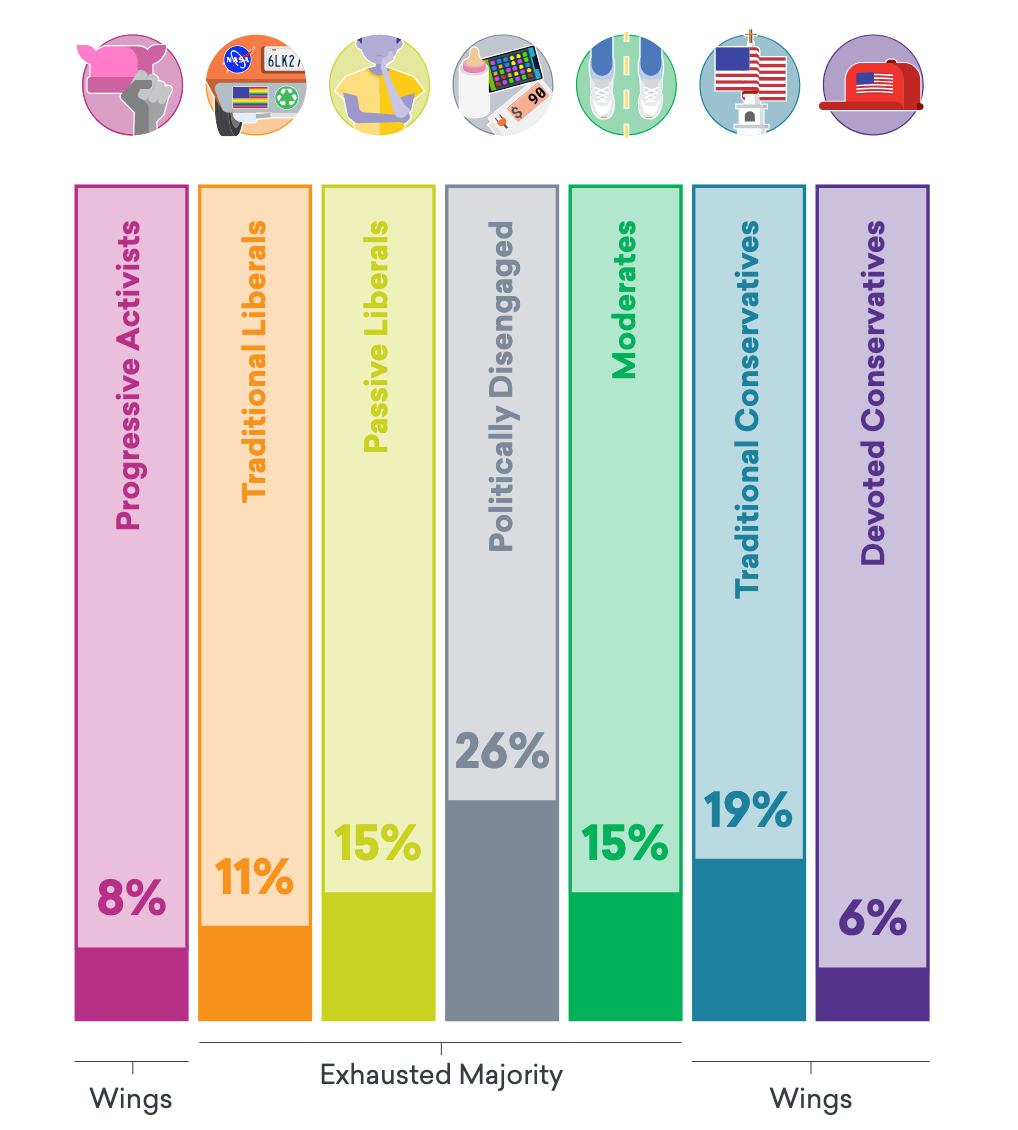
With the feedback I have received from you, my readership is made up of everyone from traditional liberals to traditional conservatives, and five out of seven is not bad. I’ll take it. That is heartening and amazing. I am at heart an institutional realist. The great historian Daryl Michael Scott told me over and over that “history doesn’t love anybody.” What he meant was that history does not play favorites, and any institution or society that behaves irresponsibly will get the consequences of their actions eventually, and they will not like it. He also meant that every group has moments of shame and honor in their past, and there is no avoiding that reality.
In 2025 reality caught up to America. We are no longer exceptional by default, and we in 2026 we will have to earn American exceptionalism back. And you intuit that.
This year you responded to my pieces that exposed critical failures in the American system and the realization that the American people have either wolves or Don Quixotes as leaders rather than shepherds. We are experiencing directly correlated context and stewardship collapses in politics, business, and civil society, including our religious organizations. I can categorize my top six essays into three pairs: The Anatomy of the Scam; The Architecture of Belonging; and The Audit of Our Reality.
I. The Anatomy of the Scam
I started exploring the idea of American people being sold out in “The Private Equitization of America.” Partisanship and gloating will not help in the face of an elite who are barely recognizable as American in their manner, principles, and ambitions. And in “When Truth Comes Late,” I explored the social politics of shame that keep us tethered to the sunken place of failed leadership. You had hopes that the bluster would fade and there would be a serious attempt to deal with American problems. What you got was chaos and governing that looked a lot like favors for the wealthy. This was my top essay this year. Thank you for your feedback on power and pain moral injury that comes for facing up to social and political deception.


II. The Architecture of Belonging
In my pieces on the protest/riots in L.A. and America’s ongoing obsession with race, I have basically the same thing to say: you defend what you belong to and what belongs to you. Protests work the more they situate themselves within what Americans are and want to be and means patriotic and law-abiding; if you are protesting injustice you have to make it clear that you are not the ones doing the injustice. And, race remains a tool used by external and internal foes to manipulate and weaken the American people. We do not have to let them keep getting away with this, and we can stop playing along. Of course, race does not equal ethnicity. I am very much looking forward to Irish American Heritage Month in March. Americans will overcome our institutional problems together or keep getting taken advantage of separately.


III. The Audit of Our Reality
The Charlie Kirk murder was a public trauma. Those few who praised it were rightly condemned, as it was right to call out those spreading misinformation. However, the matter was one of crime and should be treated as that, not as a call for cutting off contact with Americans who are to left or right of yourselves. That is what your opponents want and a clear rule of conflict is you do not give them what they want. Too many people on both sides saw a young man killed and looked for advantage and tried to shape perceptions. It is on us to audit what is happening around us and clearly call things what they are. A private citizen who was a famous activist and not a government official was murdered. The accused is another private citizen who held no government position or political party position. They were both young white males, born ten years apart. But one was a victim and the other is an alleged killer who not only committed an evil act but forced everyone else present to witness it. Kirk, his family and all the attendees are victims. This is awful, even in court earlier this month the prosecution moved to clarify the term “witness” with the judge in the case because there could be 3,000 potential witnesses.2 The pathway back to a lawbounded society is focusing the core matters; the facts of the case. Charlie Kirk had a right to life, one person took that life—for what appear to be political reasons which will hopefully come out in trial—that one person needs to face the full force of the law, swiftly, and we should not be taken in by those who want to use a horrible crime to turn us against one another.


I guess, belatedly, there was a theme: we have to relearn how to live together. How to live with difference, live with mistakes, and live in reality. And I really do think our unique American history is the manual to rediscovering the better angles of our nature, and also finding our reserve of indignation to demand a better 2026, and make it happen. But that is up to us, because history does not play favorites, and the arc of history does not bend toward a better America on its own, we have to bend it.