

Vanity and Other Countries' Problems: Wilson's Reactionary Sword
World War Wednesdays: America heads toward the Great War

Welcome to World War Wednesday, a weekly dive into the continuous, thirty-year epoch of global conflict from 1914 to 1945. Here, I strip away popular myths to analyze the dynamics of industrial warfare, institutional behaviors, and the ideologies that shaped the world we inherited.
North America can be defined two ways: the countries north of Columbia, or as the United States of America and Canada. Geographically the first way is used to divide the Western Hemisphere in two as North and South America rather than the traditional America or Americas. This second definition isolates the old mainland British colonial empire, distinguishing it from the societies southward that traced their political heritages to Spain and Portugal, and recognizing the Caribbean as a diverse mosaic of mixed heritages.
During the Great War while Canada contributed blood and treasure to the fight in Europe the United States was busy asserting its hegemony over the Western Hemisphere with interventions in Mexico and the Caribbean.
In the mid-eighteenth century, it was unclear which of these areas would dominate the new Enlightenment Age but British America was not the clear leader.
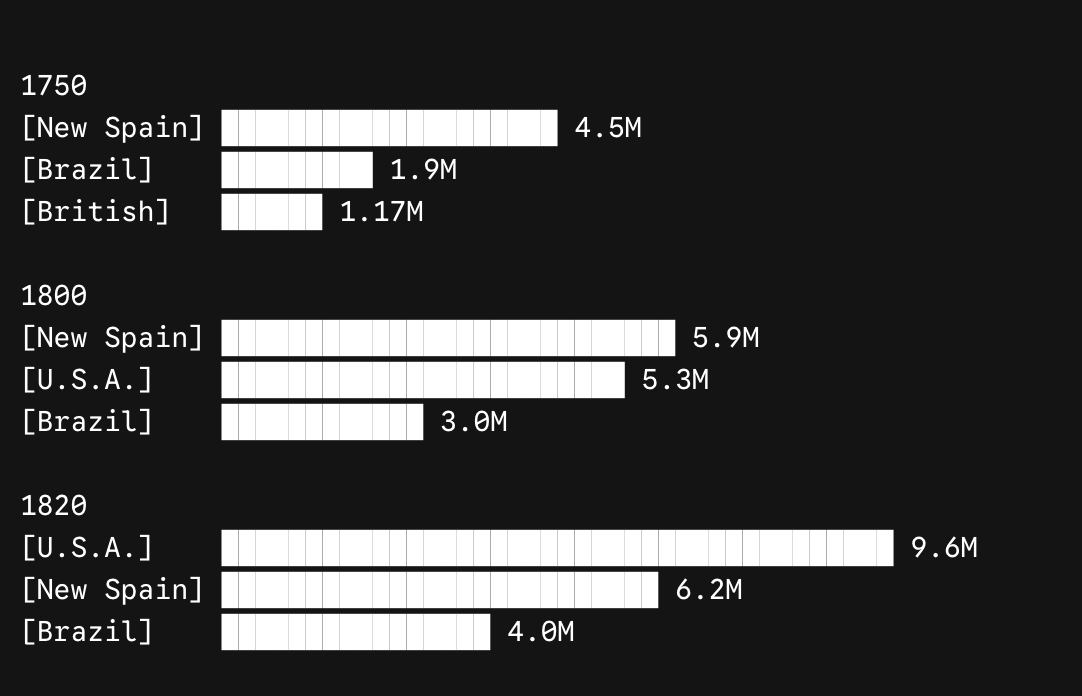
New Spain/Mexico and Brazil slipped behind the Anglo-Americans. A massive domestic birth rate and lower mortality rates propelled the United States past its rivals. By 1900, the contest was settled. The United States began treating the hemisphere as its backyard.
When Mexico fractured into civil war in the early twentieth century, American involvement grew by degrees. Civil wars naturally generate factions desperate for outside leverage to crush their domestic rivals. From the borderlands of Nogales entreaties were made. On August 20, 1913, José M. Maytorena, the Governor of Sonora a Mexican state, dispatched a urgent telegram to Washington:
It is impossible to reach any agreement between the military dictatorship of Huerta, fruit of treason and crime, and the just aspirations of the good Mexican people. War will continue until the downfall of Huerta is consummated. If the American Government will waive the embargo on arms and ammunition the Mexican people will end the war within a very short time and peace shall be solidly implanted in the Mexican Republic. The State of Sonora, of which I am Constitutional Governor, has succeeded in sweeping away from its territory Huerta’s troops that occupy only the port of Guaymas, which is besieged by our troops. Throughout the entire State is peace and the legal authorities are in office, as your excellency can prove by the testimony of the United States [omission] in Sonora. As Governor of Sonora I beg leave to suggest to your excellency that the waiving of the embargo on arms and ammunition would abbreviate the civil war and produce, with the triumph of the Mexican people, peace in the Republic. In all the Mexican States there are numerous troops in arms against Huerta and we all recognize the Supreme Chief, Señor Venustiano Carranza, the patriotic Governor of Coahuila. We have confidence in the spirit of rectitude that characterizes President Wilson and the honorable Secretary of State.
—José M. Maytorena, Governor of Sonora
Americans however had little interest in getting involved in Mexico’s internal problems. With Europe consumed by the Great War after 1914 the Western Hemisphere was left entirely to American devices. Yet, the American public remained deeply ambivalent about empire. Earlier annexations of the Philippines and Hawai’i had generated major blow back and protests. It led directly to the formation of the American Anti-Imperialist League, which included prominent figures like Mark Twain, Andrew Carnegie, and William Jennings Bryan. African Americans also supported their goal of opposing empire such as Ida B. Wells, W.E.B. Du Bois, and Booker T. Washington. These Americans argued fiercely that ruling foreign populations without their consent violated the fundamental democratic principles of the U.S. Constitution. Likewise the average citizen had no desire to conquer or annex or intervene in foreign lands. Content within their own borders, the public mood was one of insular satisfaction rather than isolationism. As Booker T. Washington spoke for many Americans when he said in September 1898:
My opinion is that the Philippine Islands should be given the opportunity to govern themselves. They will make mistakes, but will learn from these errors. Until our nation has settled the Negro and Indian problems I do not think we have a right to assume more social problems.”
—Booker T. Washington Papers, Sept. 24, 1898
As the First World War broke out in Europe, the driving force behind America taking on other people’s problems was not the American people, but the singular figure in the White House: Thomas Woodrow Wilson, the new president. Wilson was a strange, volatile mix of Progressive technocrat and unrepentant Southern reactionary. The first Southerner elected to the presidency since the Civil War, he carried old ideas about racial hierarchy and power to Washington, masking them in the high-minded language of institutional reform and progressivism. He moved quickly to impose his vision at home, beginning with the resegregation of much of the federal civil service.
Overseas, Wilson channeled his rigid Southern Presbyterianism into a moral mandate to police the hemisphere. Long before he deployed American troops to Europe in 1917, he used the military to project American hegemony into Mexico, Haiti, and the Dominican Republic, while keeping the US in Nicaragua.
Argentina, Brazil, and Chile worked to limit American intervention in Mexico, but Wilson’s America was on the move whether the American people or the republics of the Western Hemisphere wanted it or not. While he would promote self-determination for European peoples, he did not apply that to the countries he deemed inferior. The US would rule the Dominican Republic until 1924 and Haiti until 1934.
Wilson demanded absolute personal loyalty to him from his subordinates and refused to be restrained by tradition or Congress in his pursuit to remake world order. But as a PhD political scientist, Wilson’s autocratic tendencies were presented with academic sophistication and high-minded moralism. He broke the rules with erudition. The consequences of his paternalist need to solve other people’s problems would still be long lasting and awful.
If this essay was worth your time, the heart button below costs nothing and means a lot. And if you’d like to support more writing like this, becoming a paid subscriber keeps it coming.
