

Trump’s Quiet Revolution
Voters Want To Be Masters In Their Own House

If a podcast drops on the web and the Democracy doesn’t listen to it, does it make a sound?
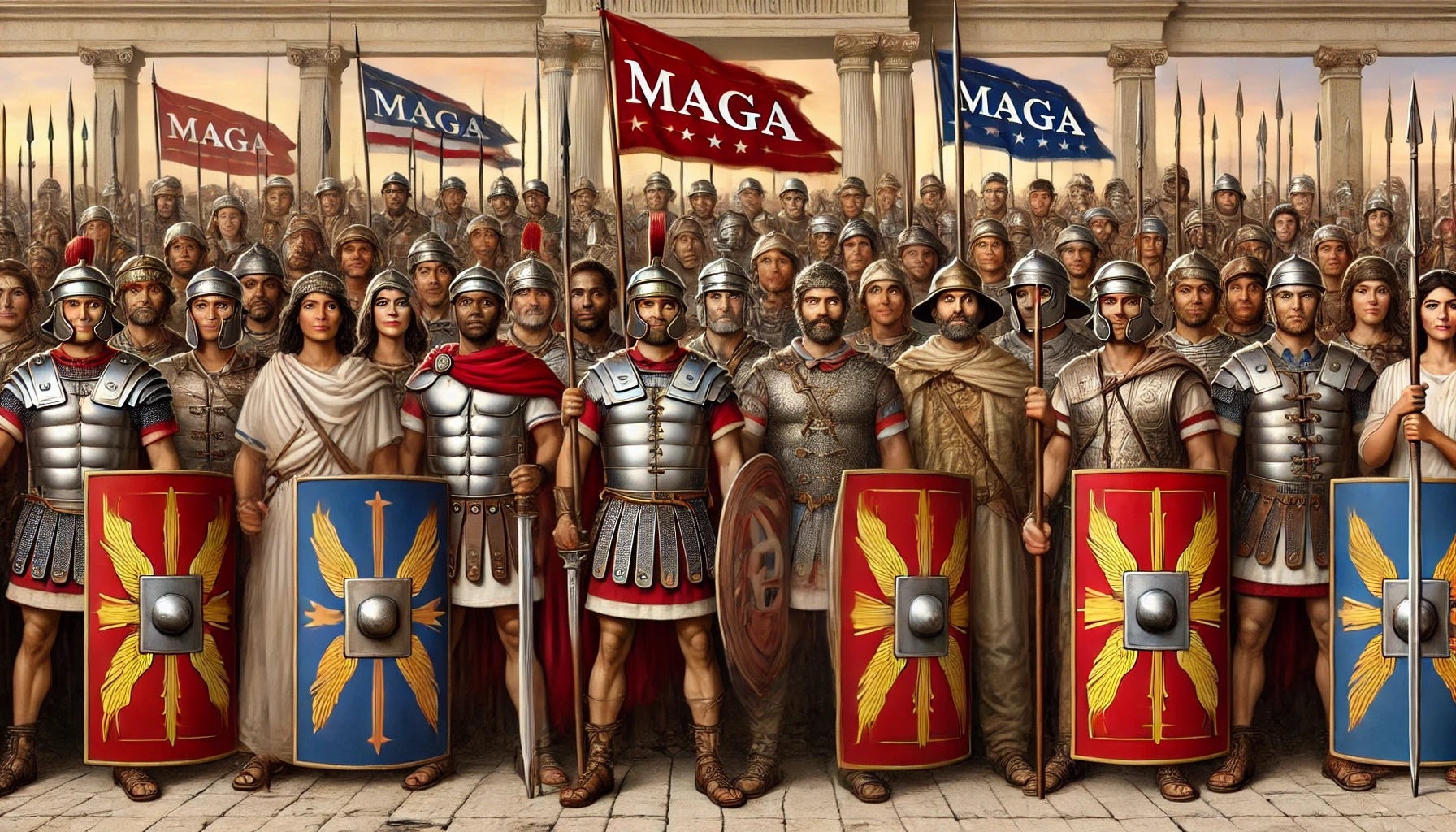
One analogy I have used for Trump in the past is that he is an American Caesar, not a fascist. Caesar was a patrician who championed the people, which is why the conservatives who tried to stop his movement failed: the people supported Caesar over the elites who were out for themselves. Caesar spoke to the people’s concerns. In America, however, many of the people felt that they were being gaslit into believing their concerns were unfounded or illegitimate.
The disaffected citizens learned to hide their thoughts. Harnessing this feeling of alienation effected a social counterrevolution that seemed not only unlikely but also impossible because it was carried out in alternative and dismissed venues. The legacy power structure didn’t see it coming.
The MAGA-curious revolution was not televised but it was podcasted, it was tweeted, it was streamed. Hushed by legacy media and silenced by cultural gatekeepers, the MAGA coalition, largely but not entirely male, created an alternative media economy. In 2024, it burst out into the open as the current American majority and the culmination of a Quiet Revolution.
Many readers may be unfamiliar with the reference. I am comparing Donald Trump’s electoral comeback, particularly among American non-white men, with Quebec’s Quiet Revolution, which shocked Catholic Canada in the 1960s. The MAGA realignment and the Quiet Revolution are reactions to the perceived inadequacy and complacency of establishment dominance and empowerment of the unengaged. What happens next depends on Trump’s administrative capacity to out-govern the Democrats.
The Quiet Revolution (QR), hit in the 1960s transforming Québécois identity, governance, and society. The QR brought secularization, modernization, and a new Québécois identity centered on enhanced autonomy in Canada and the veiled threat of self-determination. Quebec, before the 1960s, has been called French culture as it was before the 1789 Revolution. Here’s what happened.
The Union Nationale Party governed the Province of Quebec during the Great Depression and from 1944-1960, the period that concerns us at the moment. It was an old French Catholic society that provided government money to the Church, which provided health services and education. It was also old machine politics, and while the government supported the distinct Québécois identity, it was seen as too tied to old interests, not doing enough to share the natural resource wealth of the province, and too friendly to the majority English federal government and its interpretation of Canadian federalism. To Union Nationale’s opponents, this was linked to its attachment to Catholicism and social conservatism, though that is a misunderstanding of Catholicism’s role, and the real source of the business and economic conflict was distinct from the Catholic Church’s influence. Later, the Quiet Revolutionaries would attack the period when Catholicism still held sway in Quebec as the mythical Grande Noirceur, literally the Great Darkness. Really? That’s laying it on too thick.
But while its opponents were winning the quiet debate over social values, the Union Nationale kept winning elections. And then it had a string of bad luck. Its founder and leader, the premier of Quebec (like the governor of a US state), Maurice Duplessis, aka “Le Chef,” died in 1959. Then, his successor as premier and leader died three months later! So they got a third leader who then called for a new election to be held in six months, and they lost 51.38% - 46.61% to the Quebec Liberal Party. With that small mandate, the Liberals went to town and seized the moment. Trump beat the Democrats 50.2% - 48.2%. Not too far off. The 1960 elections are considered the most important in Quebec’s history. No one saw the huge change coming because the shifting of middle-class thought in Quebec was slow, and the establishment seemed secure; they did not see they needed to engage the dissenters. With a slim majority the new Premier John Lasange created a team of thunder “l’équipe de tonnerre” to form his revolutionary government. They determined to unleash massive change. They would not waste their majority.
Keep reading with a 7-day free trial
Subscribe to Outside the Academy w/ Dr. Albert Thompson to keep reading this post and get 7 days of free access to the full post archives.