
The Washington Post Endorsement, If You Don’t Get It, You Don’t Get It
Something Is Going Wrong For the Harris Campaign

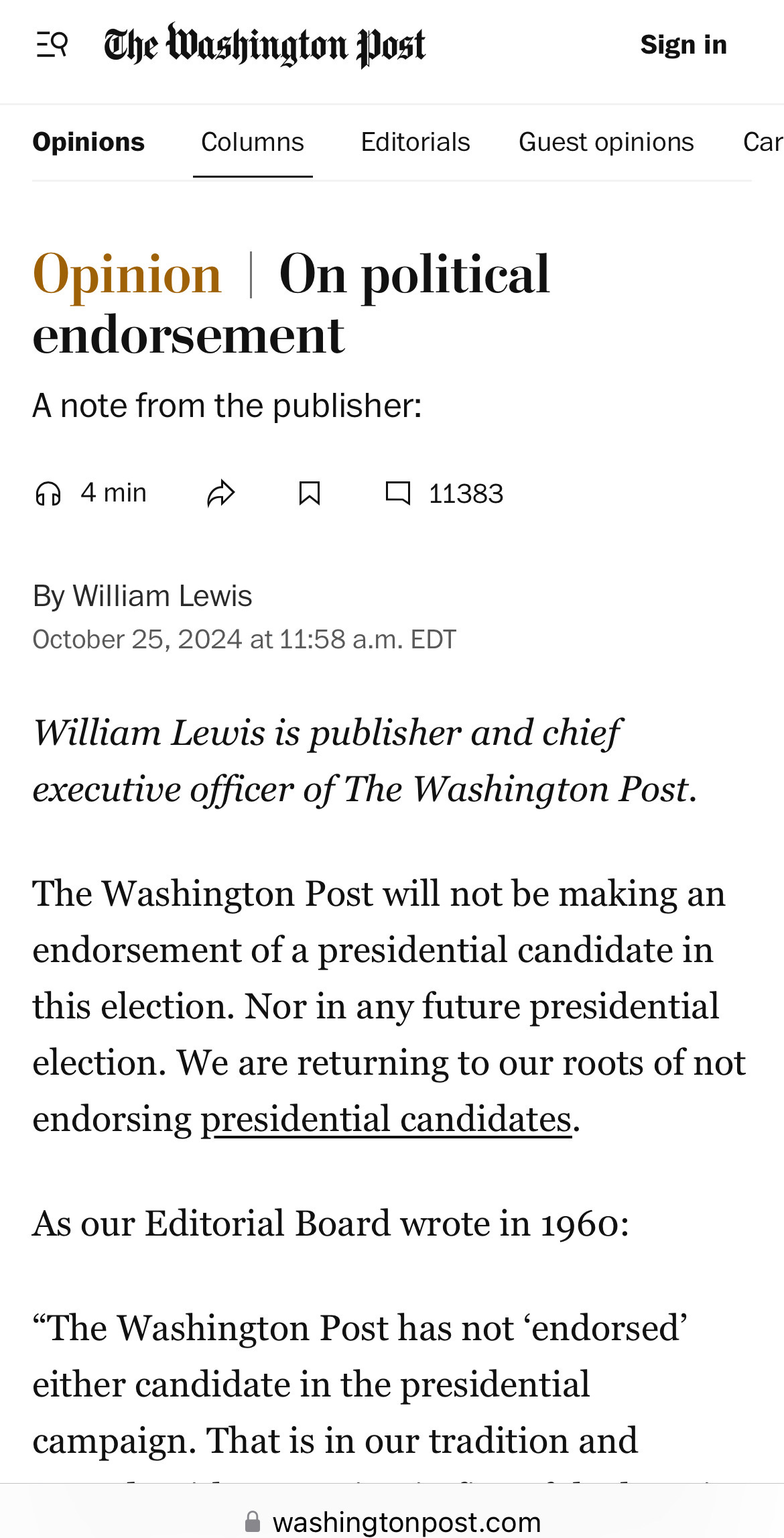
(OK, it’s my first time trying to write from the Substack app on my phone, as I’m reading the news and traveling back from class. Bear with me.)
Oh boy.
The Washington Post, long loved and hated for its Democrat neoliberal-leaning editorial stance, won’t endorse Vice President Kamala Harris in her race against Republican candidate Donald Trump. This decision, especially without endorsing any candidate at all, suggests deep reservations about Harris’s viability as a leader. The Post’s neutrality is a shock, calling into question Harris’s suitability as a president.
Historically, endorsements from newspapers like The Washington Post, The New York Times, and The Chicago Tribune have shaped public opinion by offering credibility and a stamp of approval for candidates. The Washington Post’s voice is particularly influential among moderate and left-leaning readers, many of whom look to its endorsement as a sign of a candidate’s integrity and alignment with progressive values. When such an established publication abstains from supporting a Democrat—especially one running against Donald Trump—it signals a significant breach of trust and casts doubt on Harris’s appeal and qualifications. Readers accustomed to the Post’s Democratic lean may interpret this silence as an unspoken critique, reshaping the public’s perception of Harris’s campaign. I mean, these are the “Democracy Dies in a Darkness” folks, right? But you choose now to be neutral?
The Washington Post’s recent history is largely defined by its alignment with Democratic principles, particularly in its criticism of Trump’s administration. By remaining neutral, the Post subtly conveys its concerns, whether about Harris’s electability, her policies, or her resonance with key voter groups; whatever, it looks like an attack on her competence. People will wonder what its proprietor, Jeff Bezos, is up to. What does he know? DC tongues will wag.
The lack of endorsement from The Washington Post could deal a serious blow to Harris’s campaign, serving as a silent endorsement of her opponent. Republicans will seize on the neutrality as proof of Harris’s weaknesses, while her supporters may be disillusioned by the paper’s reticence to back her with less than two weeks to go. It could be seen as a betrayal of the Democrats by an oligarch and could provoke the Dems to get tougher on the rich in fact rather than in meaningless rhetoric.
And for undecided voters, particularly those who respect the Post’s viewpoint, this could be the nudge that sways them away from Harris with ripple effects for turnout that hurts the Democratic Party's other candidates in critical Congressional races. If The Washington Post is reluctant to endorse Harris, it might embolden other media outlets or party leaders to voice similar concerns aloud. Which could intensify intra-party fights about her electability, reopen the debate about dumping Biden and not holding a brokered convention, further weakening Harris and dividing the Democratic Party.
Beyond its impact on Harris’s candidacy, The Washington Post’s decision may reflect a broader shift in how newspapers approach endorsements, potentially ushering in a more scrutinizing, impartial approach to political endorsements. Maybe. (Not holding breath)
This stance, however, could set a precedent, encouraging other newspapers to weigh their endorsements more critically and to feel empowered to withhold support when necessary. If - and it is a big if -The Washington Post’s neutrality inspires similar decisions from other outlets, candidates may find themselves under greater scrutiny, needing to earn endorsements through clear, compelling policy positions and public trust rather than relying on traditional partisanship.
Bottomline: Harris is in trouble.
It's obvious. Jeff Bezos does not want his beloved Washington Post to endorse Kamala Harris. It is not, as you suggest, have anything to do with her qualifications. I'm prone to lean towards Occam's razor on this one, Albert. Jeff Bezos doesn't want to get on the bad side of Donald Trump. It's just that simple. That's more likely why there's no Post endorsement of the Vice-President. I'm highly disappointed in this installment of History Wars and I'll be unsubscribing now.