

The Trumpian Dialogue and the End of American Dominion?
"Nice Lady" Venezuelan opposition leader, 2025 Nobel Peace Prize winner Maria Corina Machado is not poised to take the place of Nicolas Maduro. Trump said he will run the country.

Written on January 3, 2026—the 36th anniversary of the surrender of Manuel Noriega.
In 416BC the worldview of the pagan Greco-Roman world was most succinctly summed up by the Athenians during the Siege of Melos. Athens was at war with Sparta, and Melos was a neutral city-state but one with old ties to Sparta. but Melos was at peace with Athens, had not attacked Athens and was not attempting to join Sparta in the war. Athens invaded, conquered and enslaved them anyway.
Thucydides one of the fathers of history wrote about the incident in his The History of the Peloponnesian War:
The Melians are colonists of the Lacedaemonians who would not submit to Athens like the other islanders. At first they were neutral and took no part. But when the Athenians tried to coerce them by ravaging their lands, they were driven into open hostilities…
Melians to the Athenian negotiators: But your warlike movements, which are present not only to our fears but to our eyes, seem to belie your words. We see that, although you may reason with us, you mean to be our judges; and that at the end of the discussion, if the justice of our cause prevail and we therefore refuse to yield, we may expect war; if we are convinced by you, slavery.'
Athenians to the Melians: If you are only going to argue from fancies about the future, or if you meet us with any other purpose than that of looking your circumstances in the face and saving your city, we’re done; but if this is your intention we will proceed.'
Melians: 'It is an excusable and natural thing that men in our position should neglect no argument and no view which may avail. But we admit that this conference has met to consider the question of our preservation; and therefore let the argument proceed as you propose.
Athenians: Well, then, we Athenians will use no fine words; we will not go out of our way to prove at length that we have a right to rule, because we overthrew the Persians; or that we attack you now because we are suffering any injury at your hands. We should not convince you if we did; nor must you expect to convince us by arguing that, although a colony of the Lacedaemonians, you have taken no part in their expeditions, or that you have never done us any wrong.
But you and we should say what we really think, and aim only at what is possible, for we both alike know that into the discussion of human affairs the question of justice only enters where there is equal power to enforce it, and that the powerful exact what they can, and the weak grant what they must…
Melians: It may be your interest to be our masters, but how can it be ours to be your slaves? ——Jowett 1881 translation
the powerful exact what they can, and the weak grant what they must…
or in the Crawley 1874 translation
the strong do what they can and the weak suffer what they must
In the book Dominion the British classicist, Tom Holland reminded modern audiences of the real ethical differences between the ancient pagan worldview and the modern human rights regime: there was no expectation that weakness was to honored or respected in the ancient world. Christianity by emphasizing equity, the value of women, the poor, and the destitute, challenged the presumption that the powerful can just do what they want. And this is why the association of “conservative” Evangelical and Catholic Christianity in American with the 45/47 president has been so controversial with some considering it the moral paganization of rightwing Christianity in the United States.
The news from Caracas arrived in the early morning hours of January 3rd, 2026: Delta Force operators had captured Venezuelan President Nicolás Maduro and his wife Cilia Flores, and massive U.S. airstrikes had begun around 2:00 AM local time. The operation was a modern application of ancient Athenian logic. Venezuela, like Melos, had not attacked the United States. Venezuela, like Melos, was weak. And the United States, like Athens, decided that weakness was sufficient justification for conquest.
United States Senator Andy Kim (D) of New Jersey captured the institutional betrayal:
"Secretaries Rubio and Hegseth looked every Senator in the eye a few weeks ago and said this wasn't about regime change. I didn't trust them then and we see now that they blatantly lied to Congress."
Many Democrats are angry because they were lied to as part of a deliberate strategy to circumvent constitutional constraints. But the anger among non-interventionist Republicans stems from something different: wishcasting, the practice of projecting desired outcomes onto reality despite clear evidence to the contrary. Anyone who carefully read the November 2025 National Security Strategy knew this was coming. The document didn't hide American intentions in the Western Hemisphere—it announced them with Athenian clarity.
What the National Security Strategy Actually Promised: “The Strong Do What They Can”
The November 2025 NSS devoted significant attention to what it termed the “Trump Corollary to the Monroe Doctrine”—a reassertion of American preeminence in the Western Hemisphere. The language echoed the Athenian negotiators at Melos: we will use no fine words to prove we have a right to rule.
While the document paid lip service to a “predisposition to non-interventionism,” it immediately qualified this principle: “For a country whose interests are as numerous and diverse as ours, rigid adherence to non-interventionism is not possible. Yet this predisposition should set a high bar for what constitutes a justified intervention.” In practice, this wasn’t a commitment to restraint—it was permission to intervene whenever deemed necessary. The “high bar” proved to be no bar at all.
The strategy explicitly called for “targeted deployments to secure the border and defeat cartels, including where necessary the use of lethal force to replace the failed law enforcement-only strategy of the last several decades.” More tellingly, it announced America’s intention to dictate the terms of regional economic relationships: “The United States must also resist and reverse measures such as targeted taxation, unfair regulation, and expropriation that disadvantage U.S. businesses. The terms of our agreements, especially with those countries that depend on us most and therefore over which we have the most leverage, must be sole-source contracts for our companies.” While the attacks on Venezuela began with attacks on alleged drug trafficking boats, the 45/47 president today largely spoke about extracting oil and projecting American power. He revealed the administration's actual priorities: oligarchic American business interests backed by the threat—and now the reality—of military force.
The announced occupation of Venezuela will occupy Congress and remove focus from the Epstein files as well. But the international ramifications are potentially more important.
The Congressional Problem: Do Elections and Institutions Still Matter?
The political damage may be most acute with Secretary of State Marco Rubio, who served in the Senate alongside many of those now expressing outrage. The Senate operates on institutional norms and personal relationships built over years of service. When a former colleague becomes a Cabinet secretary, there's an expectation—perhaps naive in this political environment, but institutionally necessary—that testimony will be honest, even when policies diverge.
The threats made against Cuba, by Rubio, the son of Cuban exiles will potentially rile up the America First movement which has nativist tendencies and is skeptical of foreign ties. They voted against foreign occupations. If they decide to stay home in November the Democrats may find a pathway to the Senate, especially if the occupation faces organized opposition. The Republican Party is again the party of foreign occupation and that will not sit well with many supporters of the 45/47 president. Republican Thomas Massie of Kentucky is a rare GOP critic of the president. He may be joined by others soon.


Democratic congressman from California Ro Khanna said what many Republicans are thinking.

Global Implications: Everyone Is Watching
The Venezuela operation’s significance extends far beyond Caracas or Washington. Within hours of the news breaking, Israeli opposition leader Yair Lapid, the former prime minister, tweeted in both English and Hebrew: “The regime in Iran should pay close attention to what is happening in Venezuela.
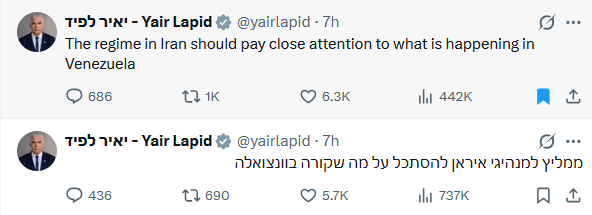
Lapid’s message reveals how quickly other nations recalibrate their strategies based on American actions. For Israel, the Venezuela operation represents potential leverage renew war with Iran: if the United States is willing to conduct regime change operations in the Western Hemisphere, perhaps it can be enlisted for similar action in the Middle East? The NSS’s Middle East section explicitly sought to shift burdens away from perpetual American involvement in the region, but actions speak louder than strategic documents. Furthermore, if the United States of America succeeds in taking direct control of the Venezuelan oil reserves it will have the ability to stabilize the price of oil prior to any regime change operation or invasion of Iran. That means taking over Venezuelan makes direct action against the existence of the Iranian regime is more, not less likely.
When the United States demonstrates willingness to use military force for regime change, allies and partners immediately begin lobbying to redirect that force toward their regional adversaries. Lapid by the way is the opposition to Prime Minister Netanyahu, meaning if that is his opinion then there is already an Israeli consensus to use American power this way. But that runs the serious risk of making the American right more hostile to Israel and likely to be exploited by antisemites like Nick Fuentes and his groyper movement who are making troubling inroads with young rightwing Americans in the MAGA movement.
The Democrats face their own potential divisions as some associated with aggressive anti-Iranian stances like U.S. Senator John Fetterman of Pennsylvania and U.S. Representative Debbie Wasserman Schultz of Florida’s 25th District have signaled either support or only tepid criticism of the moves against Maduro.1 This has the potential to divide the Democrats just the American rightwing faces serious fractures. If the American right is turning against Israel, and rightwing evangelicals are becoming less empathetic, then maintaining a strong Democratic Party base of support for Israel becomes even more important to long-term US-Israel relations. Consequently, the association of Israel with the 45/47 president can erode Democratic Party support.
Capacity & Coherence
Does the United States have the military, economic, and political resources to sustain interventions in the Western Hemisphere while simultaneously competing with China in the Indo-Pacific, maintaining commitments in Europe, and managing Middle Eastern relationships? The NSS acknowledged the problem of overextension that plagued previous administrations. Adding Venezuela to the list of American responsibilities doesn’t obviously solve that problem. Especially if the 45/47 president just told the world that he will not hand over power to Nobel Peace Prize winner Maria Corina Machado who many see as the Venezuelan president-in-exile because she does not have enough support in the country according to him.
Retiring U.S. Rep from Georgia Majorie Taylor Green brought Mexico into her criticism of Trump:
I’ve served on the Homeland Security Committee for the past three years. I’m 100% for strong safe secure borders and stopping narco terrorists and cartels from trafficking deadly drugs and human trafficking into America. Fentanyl is responsible for over 70% of U.S. drug overdose deaths and fentanyl comes from Mexican cartels made with chemical precursors from China and trafficked across the U.S. Mexico border. Mexican cartels are primarily and overwhelmingly responsible for killing Americans with deadly drugs. If U.S. military action and regime change in Venezuela was really about saving American lives from deadly drugs then why hasn’t the Trump admin taken action against Mexican cartels?2
President Claudia Sheinbaum of Mexico should be concerned if the US is using narcotics as the excuse to recover expropriated oil assets which Mexico did when it created Pemex the Mexican state-owned petroleum corporation in 1938 by nationalization and expropriation of all private oil companies in Mexico. The settlement between Mexico and foreign investors was negotiated by President Franklin Delano Roosevelt and the matter was put to rest. The current American government may simply negate it and potentially seek to control the border by controlling Mexico. Doing that might actually reverse the loss of support from the American First movement which overlaps with the anti-immigration movement. But any such action would likely bring more violence and chaos to the American border.
Cuba however has not been forewarned and will probably seek some sort of direct Russian or Chinese guarantee. But would China reject helping Cuban in exchange for a free hand with Taiwan?
Afterall according to official policy there is only “One China.” Okay, what then prevents the Chinese government in Beijing from charging the leaders of Taiwan with sedition, insurrection, or treason and launching an invasion that is termed a police operation to arrest renegade provincial administrators? Using today’s operations against Venezuela as a precedent, China could credibly claim far better justification than America under international law.
Can the United States maintain a strategy of “burden-shifting” to allies while simultaneously demonstrating willingness to conduct unilateral regime change operations? The two goals work at cross-purposes. Allies asked to assume greater responsibility for their own security will reasonably ask why they should do so when the United States continues to act unilaterally in pursuit of its interests. Let me explain, the idea of burden sharing assumes you are sharing burdens. If the US is not abiding by rules, then the Europeans will not only seek to take more responsibility for their defense but likely—behind closed doors—direct their power against the United States. How can they trust the 45/47 president to act as a peacemaker in Ukraine and oppose Russia morally?
France opposes the US operation as illegal. Former Russian President Dmitry Medvedev has joked that it would be nice if the Americans would direct their efforts against Ukraine rather than Venezuela, meaning why not arrest Zelenskyy? Less jokingly, Medvedev said the rest of the world should look to their own defenses—against America.
The deeper problem is that “America First” rhetoric was never a genuine strategy—it was a branding exercise. The NSS dressed up exploitive interventionism in the language of restraint and selectivity, but when something could be exacted it went for gunboat diplomacy. I think the 2026 Nobel committee will have likely decided against the US leader. 2026 has opened with a shock and awe for America and the world. But they should have seen it coming.


