

The French Connection: No Confidence In Impeachment
Accountability Systems Need Reasonable Thresholds


The French government has a problem. The people are sick of the president who appears to only govern for the rich, and the traditional rightwing party, the Republicans, and the old leftwing party, the Socialists, have kept their influence by collaborating with the unpopular but new centrist party of President Emmanuel Macron. They have done so in order to keep the insurgent right and the populist left out of power. Well, the president’s party, Ensemble (ENS), just ran out of luck; the prime minister was kicked out by parliament. America could learn from this example.
Political accountability is a cornerstone of any democracy, but different nations use different tools to enforce it. France and the United States, though both presidential democracies have different methods of checking leaders who go too far. What happened in France cannot happen in America in part because we have a threshold problem left over from the Founding Fathers. The principles of the Founding Fathers are timeless, but today, we care about their procedures more than their principles. That is a mistake. The founders believed that the powerful had to live in fear of accountability, of being civilly audited for their behavior by the people’s representatives. For executive officers and judges, the method we use is impeachment. Simply put, it usually does not work as a real deterrent or means of punishing bad officials.
Off with their heads - well, there’s a better way.
The problem with U.S.-style impeachment is that it is an artifact from when politics was deadly earnest and changes in government not infrequently resulted in losses of heads, literally removed from shoulders.
Impeachment is the medieval English way of forcibly removing officers of the crown and was often used in conjunction with attainder. The first time impeachment was used in the Kingdom of England was in 1376 against Baron William Latimer. Lord Latimer was accused of selling a castle to the enemy - the French - and illicitly taking funds in the name of the king. He was impeached by Parliament and lost status but was rehabilitated years later. But that was not always the case; some faced, um, more lasting consequences.
Thomas Wentworth, 1st Earl of Strafford, got the full measure of Parliament’s wrath during the conflict between King Charles I’s realms, which we now call the Wars of the Three Kingdoms. Lord Strafford was a leading adviser to the king, and his advice and policies made him many enemies among those who wanted to weaken royal power and contest the king’s religious policies. Lord Strafford led a skillful administration in Ireland, and his success in enforcing royal authority was particularly hated. When Scotland rose in rebellion against Charles I, Lord Strafford advised the king to use the Irish Army against “this kingdom,” which everyone knew meant Scotland. But Strattford’s English enemies needed to accuse him of a crime to remove him, so they impeached him on charges of treason. He was accused of subverting the laws of England and allegedly offering to use the Irish army against the king's opponents in England. A lie.
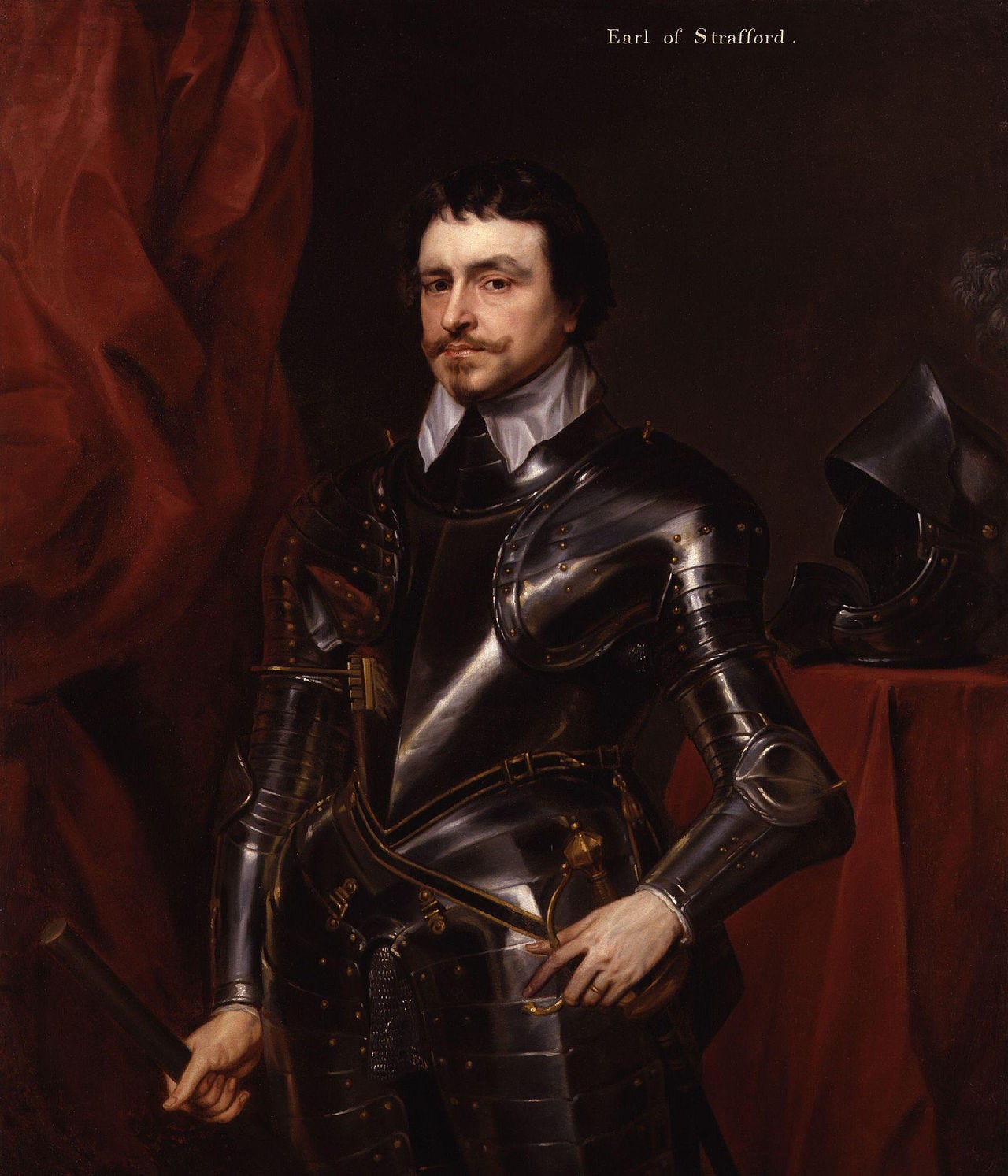
However, because his supporters presented a skilled defense during his trial, it looked like the plot was going to fail. This was unacceptable to John Pym, an anti-Charles leader in the House of Commons, who introduced a bill of attainder, which allowed for Strafford's condemnation and a death sentence by a special act of Parliament. This bill passed the Commons by a large majority, and the Lords were intimidated into passing it, and the king was forced to sign it. It was legislative murder. A bill of attainder is a legislative act, in case an act of Parliament, that just declares a person guilty of a crime and imposes punishment without a normal judicial trial. It’s like Alice in Wonderland or something, sentence first, verdict afterward. Historically, these acts were used by the English Parliament to punish individuals, often for treason, without the need for a court proceeding. Again, they just declared you guilty of the crime they wanted you to be guilty of committing. Of course, it was ideal for targeting your political opponents, especially if you thought them too dangerous to live. The charges against you in such bills did not have to meet existing legal definitions of crimes, meaning they could be complete after the fact or ex post facto condemnations. Like raising a loyal army for your king in Ireland and then having that declared to be a crime against England, whose king was the same king of Ireland! Article One, Section Nine, Clause Three of the United States Constitution is explicit: “No Bill of Attainder or ex post facto Law shall be passed.” Lord Stratford lacked the protection of the U.S. Constitution; he was executed on May 12, 1641.
The Founders knew well the problem with the British system of attainder. But they kept impeachment. The problem with impeachment, especially of the president or judges, is that they must be accused of a crime, and in theory, they should then be put on trial in a regular court after being impeached by the House of Representatives and then convicted by the Senate. That is a high bar. Too high in most cases to get Congress to remove maladministration or punish incompetence. Being horrible at your job and causing great harm to the public good due to being inept is not a crime. So, you are often stuck with high-level personnel problems whose only solution is impeachment. The British stopped using impeachment in 1806 because it was a problem, and the new method of losing the support of the House of Commons, or No-Confidence, was much better. The last impeachment trial in the United Kingdom concluded in 1806 with the acquittal of Henry Dundas, 1st Viscount Melville, and just before that, the longest impeachment trial had occurred from 1788 to 1795! Edmund Burke, the famed father of modern classical conservatism, accused Warren Hastings of gross misconduct and abuse during his time running British India in Bengal. After seven years, he was acquitted. Edmund Burke stood up for the rights of the people of Bengal and has a clear list of 20 allegations, and after all that time Hastings was acquitted. Just as the British were realizing that impeachment was a bad idea, we wrote it into our Constitution because the Founders were traditional Englishmen and were trying to rationalize English political tradition. The Constitution they wrote is almost perfect, but the work of human hands. Their principles are right, but the procedures could use some rethinking.
De Gualle’s mixed Fifth Republic System
Now, normally, I would never, ever use France as an example of good government. In the time we have had one Republic, they have had, well, let me see: the 1st Republic, the 1st Empire - Napoleon the Great’s -, the Restored Bourbon Monarchy, the Citizen Monarchy, the 2nd Republic, the 2nd Empire, the 3rd Republic, the 4th Republic and now the current 5th Republic. And now I am dizzy.
The Third Republic lasted from 1870 until 1940 when Germany crushed it in the Second World War. The Fourth Republic was created after the American-led allies liberated France, but it was a mess. The factions of France blamed each other for the 1940 disaster. The French Fifth Republic was formed in response to the political instability of the Fourth. General Charles de Gaulle, who had been critical of the Fourth Republic, was empowered to set up a new constitution, and he picked the drafters. The new constitution significantly increased executive power at the expense of the Parliament. This constitution established a stronger presidency, with the president the authority to appoint the prime minister.
So, to clarify, in France’s semi-presidential system, executive power is divided between the President and the Prime Minister. The president is the head of state and has near-regal powers, including the ability to dissolve the National Assembly but not the Senate, call referenda to go over the head of the Parliament and directly to the voters, and appoint the prime minister. The president also presides over the Council of Ministers, signs decrees, appoints high civil servants and judges, negotiates and ratifies treaties, and serves as the commander in chief of the armed forces.
The prime minister, appointed by the president, is responsible for the day-to-day operations of the government and must command a majority in the National Assembly, the lower house of parliament. The prime minister determines and directs government policy, exercises control over the civil service and armed forces, and manages domestic policy, especially during periods of "cohabitation" when the president and prime minister are from different political parties. Of course, the French would call it that.
So, while voters elect the President, who is largely immune to parliamentary control, the Prime Minister relies on the support of the National Assembly. If the Assembly withdraws its confidence through a no-confidence vote, the Prime Minister and their cabinet must resign, even though the president appointed them. To pass, a no-confidence vote requires an absolute majority in the National Assembly, making it a serious but achievable measure. You don’t have to accuse the French prime minister of a crime to register your disapproval, you vote no confidence. And that just happened; on December 4, 2024, Prime Minister Michel Barnier and his Cabinet were tossed out by the National Assembly, and President Macro has been humbled. It had not happened since 1962 because French governments were normally stable and elections tended to deliver clear verdicts, but in this case, the last elections left the government vulnerable, and the government alienated the National Assembly. So, they ended the government. In America, this kind of check on the president’s administration is extremely difficult, and breakdowns between the White House and Congress often lead to regular mini-crises of government shutdowns and other destabilizing brinksmanship.
Back to Impeachment
Impeachment does not work, as we have seen throughout U.S. history, from Andrew Johnson to Bill Clinton’s clear guilt of perjury. Asking Congress to decide executive and judicial guilt for crimes is too much in modern America. Without different tools, Congress cannot do its job of protecting the public from maladministration and shady behavior. The core difference between France and the United States lies in the speed and focus of their systems. France’s adoption of Britain’s no-confidence procedure enables quick action against unpopular Prime Ministers; however, the U.S. impeachment process is too deliberate and slow, and though originally designed to safeguard against politically motivated removals of the President, it now actually allows for politically motivated protection of a bad administration. If America should pass a vote of no confidence on something, it should be reliance on impeachment.