

SAFE and Sorry: Canada's Pivot Away from American Defense
December 5, AD 2025

For much of American history, the Monroe Doctrine existed more as an ideal than as a practical reality. In the 1820s the United States did not have the power to keep the European great powers of Russia, Britain, and France out of the Americas. Even keeping the Spanish from reconquering Latin America was due to its aligning with British interests. If Spain lost its colonies from Mexico to Argentina, that left the British Empire—with control of Jamaica, the Bahamas, Barbados, Dominica, Grenada, Trinidad and Tobago, Belize, and Canada, among others—as the dominant power in the Western Hemisphere, not the United States.
During the Civil War, Abraham Lincoln was rightly worried that the British would intervene to support the rebel slaveholding Confederacy. While the British people had a reputation for abolitionism, the British government was led by Prime Minister Lord Palmerston, who despised Abraham Lincoln as a representative of the common people. Lord Palmerston was an elitist and represented the British establishment view of America. He not only hated that Lincoln represented democracy, but he also wanted Southern cotton for British industry and preferred a weak and divided America that could be manipulated to serve the economic interests of the Empire. What we would now call neocolonialism. The threat to America came from the idea of armed mediation.
Armed mediation is a diplomatic posture where a third power offers to broker peace while keeping (or mobilizing) armed force as leverage—essentially: “accept my terms, or I will intervene militarily.” The fear was the British and French would threaten to intervene in the Civil War in the name of “peace” because the conflict was so “bloody,” and the United States would have to let the South go or fight the rebels, the French, and the British. Of course, neither the British nor the French cared about the slaves or the principles of American democracy. When the Union won the war, the U.S. made sure to force the French out of Mexico to eliminate that threat, and they kept their eyes on Canada as the place the British would build up forces in the event of war with America.
Britain and America remained rivals throughout the 19th century, and America even sued and won an international case against Great Britain for its support of the Confederacy. But with industrialization and the naval buildup of the 1890s, the USA was finally able to enforce the Monroe Doctrine on its own as a credible threat. Europe took note. American national strategy has always seen European powers as the biggest threat to the USA because the Atlantic is smaller than the Pacific. Strengthening America and the Americas against European intervention had been the goal since President Monroe. Generations of American policymakers pursued that goal. We bought the Virgin Islands from Denmark to keep them away from Germany. We took over Greenland in World War Two to also keep it away from Germany, in both cases before we officially went to war with Germany.
During World War Two, the USA took ruthless advantage of British weakness to enact the Bases-for-Destroyers plan. The UK traded parts of its network of imperial bases for the destroyers it needed to survive, and in doing so, it removed the threat of the Royal Navy to the United States and allowed the Americans to become the dominant Atlantic power and undisputed master of the Western Hemisphere. It took more than a century, but the USA finally achieved immunity from European invasion and intervention for itself and the Americas. To enforce this victory, John Fitzgerald Kennedy was prepared to go to war in the Cuban Missile Crisis.
What made this victory complete was the end of the mutual USA–Canada threat. By saving Europe in the First and Second World Wars, without demanding conquests, the USA showed that it was not an imperial power like the Europeans. This gained the USA the esteem and respect of most of the world. That was PR you could not put a price tag on. The biggest gain was not the “Special Relationship” with the mother country, but the end of the rivalry with America’s brothers in Canada. Canada and the USA have the same roots in Anglo-French colonialism. Louisiana, Missouri, Vermont, Quebec were major French infusions into the Anglophone dominated USA and later British Canada, with Quebec maintaining the strongest distinction. Both the American and Canadian system are Westminster descended, with Canada operating much like the Americans did before independence, and a point I have made before is that Canada is what the USA would likely look like if the negotiations with Crown and Parliament had succeeded in the 1770s. After 1945 the American Republic and Dominion of Canada were on the best terms in their history and eventually we could trust that the border would be truly open and undefended.
This worked for both powers because the biggest threat to the USA would be if a hostile force had a foothold in Canada. But Canadians were no longer potential hostiles, solving a problem that America had to worry about since 1775.
And it has been thrown away.
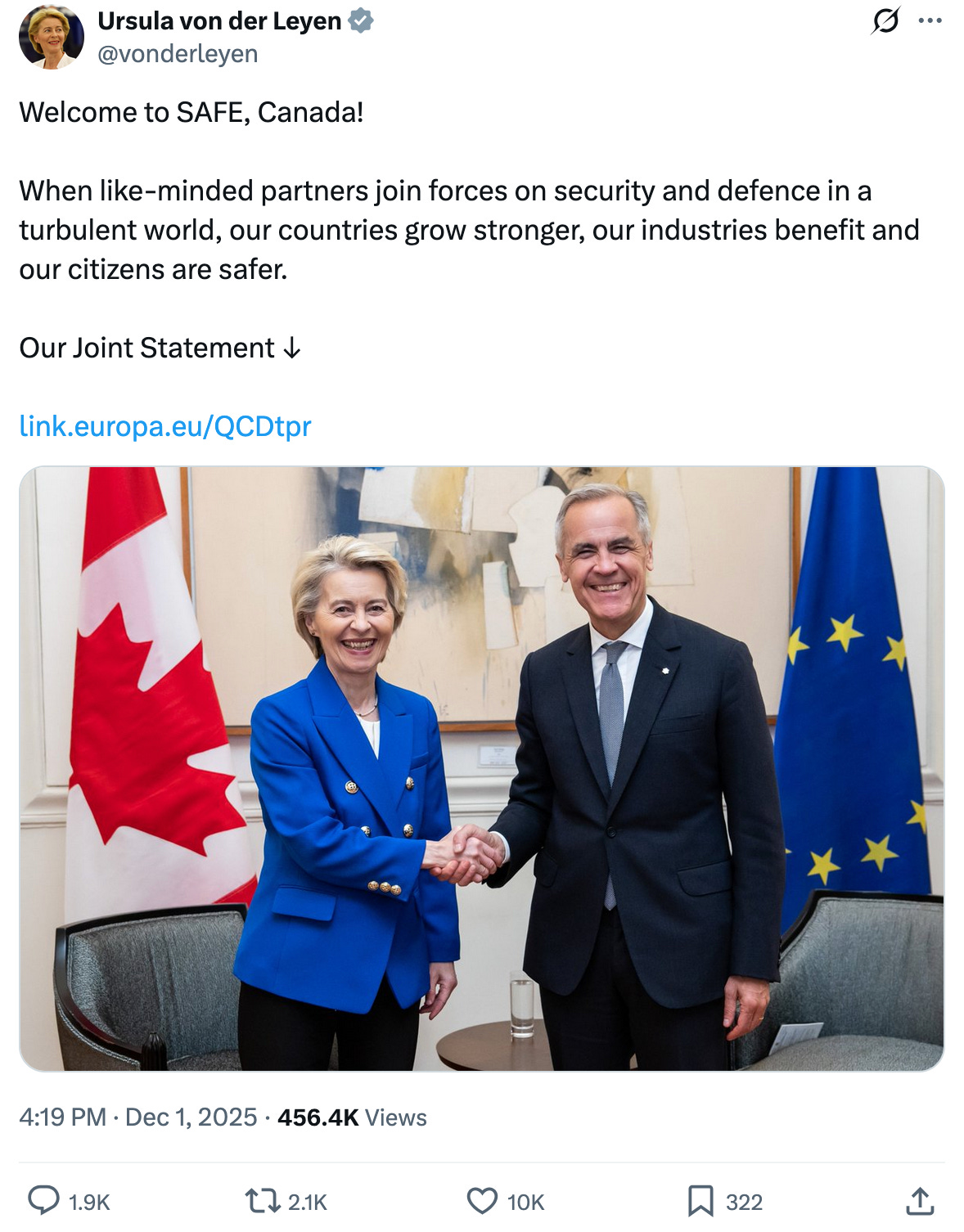
Canada Joins EU’s SAFE Defense Program as First Non-European Partner
Canada has become the first country outside the European Union to join the bloc’s Security Action for Europe (SAFE) initiative, a €150 billion loan program designed to accelerate European rearmament and coordinate joint defense procurement. This is real money for Canada. The agreement, finalized after months of challenging negotiations, demonstrates that the shift in Canadian defense policy I mentioned last week is a fact that Americans will have to deal with. Presuming that the EU will remain friendly with the US is not a good bet, and having Canada tied to the EU and its agenda is not in America’s interests and is the definition of provoking America last consequences.
Canadian Prime Minister Mark Carney characterized the decision as part of a strategic pivot away from US defense suppliers, following President Donald John Trump’s trade actions and threats to Canada. I do not like it, but I understand the cold logic of the move. Carney emphasized that SAFE membership will open European markets to Canadian defense firms, attract EU investment, and help address capability gaps in the Canadian Armed Forces while providing new export opportunities for Canadian-made equipment. All things Canada needs to build its own ready-for-export, top-tier defense industry.
Under the agreement, Canada will gain access to jointly financed weapons procurement, and its defense firms will be eligible to compete for EU-supported contracts. While SAFE projects typically require most components to be produced within the EU, Canada has negotiated special terms allowing it to exceed the standard 35 percent cap on non-EU content, though there are conditions. But this means Carney can claim to have actually made a deal that will create real jobs in Canada.
The SAFE program prioritizes funding for missiles, drones, artillery, cyber capabilities, air and missile defense, and maritime and space security systems. That is the future of warfare, and with fewer foreign students coming to the USA, and with more being provoked by the USA, Canada may end up having the best minds rather than America. There is even a threat that Carney, if he plays it smart — and he is already being smart — can provoke a brain drain from the USA to Canada.
And going back to my concerns last week about the Canadian shift on fighter planes, the EU financing could impact future fighter jet purchases beyond the initial 16 F-35s Canada is going for. The guys up north are weighing whether or not to operate a mixed fighter fleet that could include Sweden’s Gripen alongside the F-35s. And as I noted, some are saying get a few F-35s and put the rest of the money into homegrown Canadian planes. Carney, as PM, is running circles around Keir Starmer, and it is not close. I have never seen a British PM so outclassed by his counterpart across the Atlantic. Maybe King Charles III should spend more time in Ottawa, because his best-governed realm is not Great Britain.
To be clear, I am not picking on Starmer or Labour. No, I am looking at Canada’s successful accession to SAFE, where the “E” stands for Europe, and the fact that Starmer failed to join SAFE despite the UK being a European country and United Nations Security Council permanent member. The Europeans respect Carney’s seriousness as a defense partner, in contrast with Starmer. The UK attempt to join failed because the British were dragging their feet on their financial contributions to the project. The EU asked for €4billion and the UK offered only €200 to €300 million. The EU dropped their ask for the UK to commit €2billion and the UK still would not meet it.
Population:
Canada: about 40 million
United Kingdom: about 67 million
GDP
Canada: roughly $2.1 trillion USD
United Kingdom: roughly $3.4 trillion USD
Well okay then.
So the UK failed to join SAFE because London and Brussels could not agree on how much Britain would pay to participate, with the EU asking for billions of while the UK offered only millions. The UK also wanted a higher share of non-EU content in SAFE-funded projects to favor its own arms industry, and the two sides could not bridge that gap. Carney built a whole bridge across the ocean while Starmer cannot cross the Channel.
At its core, the issue is that Canadian defense strategists argue that Canada must reduce its over-dependence on the United States after the Trump administration demonstrated that American reliability can no longer be assumed, while emphasizing that an immediate and complete decoupling would be neither possible nor wise. They frame Canada’s admission to the EU’s SAFE defense initiative as a significant first step toward strategic diversification. They are arguing that this is a historic turning point for Canada and acting accordingly. Most Americans are completely asleep to the problem.
https://x.com/vonderleyen/status/1995603653915541923?s=20

Very interesting analysis of Canada!