Russia’s First Revolutionaries Didn’t Want Peace
Same War, Different Flags in 1917
Friday Flashpoint: Current Events, World War Roots
Russia’s empire was out of step with the times. Dry, clear summer conditions prevailed in St. Petersburg when Tsar Nicholas II issued Russia's formal Imperial Manifesto proclaiming a state of war against Germany July 20 (O.S.) 1914. It was the beginning of the last thousand days of the Russian Empire.
The usage of the terms Old Style (O.S.) and New Style (N.S.) stems from the difference between dates recorded under the Julian calendar and the Gregorian calendar. Introduced by Julius Caesar in 45 BC, the Julian calendar calculates a year as 365.25 days, adding a leap day every four years without exception; however, the calendar slowly drifted out of sync because the actual solar year was a few minutes shorter than the strict calculations of the Caesarians. In October 1582, to correct that drift, Pope Gregory XIII issued the updated Gregorian calendar that skips having a leap year in century years not divisible by 400, like the year 1900. While Western and Central Europe had long adopted the Gregorian calendar, Imperial Russia retained the Julian calendar, making it an unlucky 13 days behind the rest of the West.
The Russian Empire was just that: an empire of Russians over the others, over the Ukrainians, the peoples of the Caucasus, the Central Asians, the Poles, and the Baltic peoples. This, combined with a backward aristocracy clinging to unearned privileges, meant that Russia was actually more unstable than Austria-Hungary despite the narratives focused on Habsburg problems in the Balkans. Russian instability was exposed by the curious continuity of its regimes despite the appearance of revolutionary change.
Contradiction was at the heart of Romanov policy in the First World War. An absolute monarchy that ruled over many nationalities openly supported Serbian claims on the South Slavic populations against the dynastic claims of the multiethnic Habsburg Empire. This irrational adherence to the Serbian war enmeshed Russia in a conflict that could only threaten Russia’s own internal cohesion.
By 1916, the war had gone far longer than anyone had expected, and the Russian Empire of more than 160 million souls could not defeat its enemies, whose combined populations Russia alone outnumbered, even with their strength being drawn away by French, British, and Italian forces.
Like Austria-Hungary, the Russian state appealed to premodern martial images to rally the public, such as this appeal to buy war bonds.
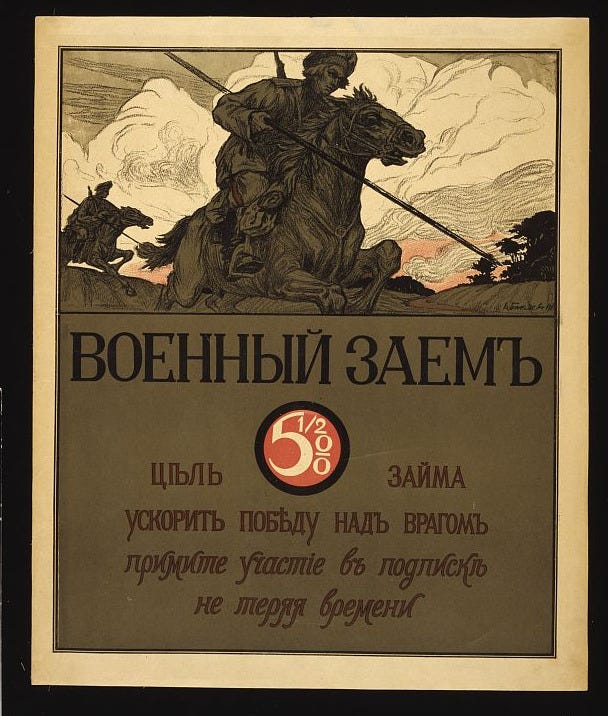
Exalting Russia’s war legends, the poster Voennyǐ zaëm (War-Loan), centers the charging Cossack style cavalryman, whose lance thrusts downward creating an aggressive, unstoppable, and flowing momentum on page directed against an unseen enemy. The translation of the banner at the top reads “War Loan”, while the texts flanking the 5 1/2% seal read “Goal of the Loan” and the remaining texts make clear “TO HASTEN VICTORY OVER THE ENEMY, take part in the subscription, without losing time”. The poster uses a revivalist typeface that pairs modern Russian uppercase and lowercase letters with medieval-style Old Church Slavonic script flourishes so the text looks old and traditional while remaining easy to read.
The empire that claimed to be the Third Rome still lusted after the second one: Ottoman-ruled Constantinople. Yet, it was through that gateway that Russia was slowly throttled, as its foreign trade was choked by German naval forces in the Baltic and Turkish control of the Black Sea exits into the Mediterranean. Then in Europe, the army and navy were on the verge of mutiny, and the rural population was restless and being seduced by revolutionary rhetoric.
On March 2, 1917, it came to a head. In late February 1917, against harsh winter conditions with the Neva River itself frozen, severe wartime bread and fuel shortages sparked mass strikes in Petrograd (the renamed St. Petersburg). Quickly escalating, a revolutionary provisional government was formed to replace the tsar’s authority when the city’s garrison mutinied rather than fire on the protesters.
In Pskov, at the Northern Front headquarters, the day had been sunny but cold; the night would be even colder for the Russian monarch. The new Provisional Government accepted Tsar Nicholas II’s abdication, given aboard the Imperial train at Pskov railway station. The red banner waved in the streets as the new government determined the path forward for Russia.
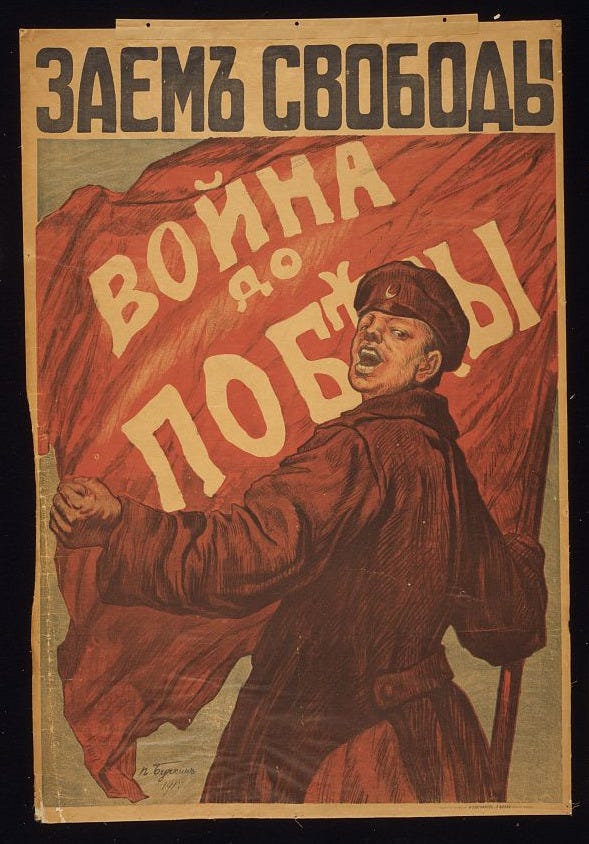
As the poster above reveals, the common narrative in the West of treating the February Revolution as an anti-war revolution misses the reality of the divisions between the Russian street, the Provisional Government, and the Petrograd Soviet. That they opposed Nicholas II is not sufficient to understand the situation on the ground: it mattered why they did so. For the leaders of the Provisional Government—which operated as a de facto republic—opposition was because the tsar was mismanaging the war, not because they wanted to end it; rather, they took power to keep fighting and to conquer Constantinople in the end. The poster, released after they took power, calls not for peace but for the people to support the “Loan of Liberty,” as its first line reads, followed by “War until victory.”
The Cossack is replaced by the comrade, the man on the street. At the time, the red banner was not exclusively associated with the Bolsheviks but with anti-tsarism in general, and even moderates in the Petrograd Soviet demanded not an immediate end to the war by capitulating to Germany, but a “revolutionary defensism,” fighting the Kaiser to secure the anti-tsarist revolution. However, among the population, many, if not most, wished for an end to the war and the reopening of the economy. The division between anti-war and pro-war-but-anti-tsar created the conditions for the Bolshevik Revolution of Red October 1917.
Propaganda can only go so far, and only works when it taps into the deep and latent feelings of the population, the soul of the nation.
This is the eighth entry in The Iron Professor’s Imagining World War One series.
Modern observers in the West should recall these lessons when considering opposition to Putinism in Russia today. Did this essay make you want to become a paid subscriber?
You can upgrade at the standard rate here to support my project to bring serious, applied history outside the academy and keep most posts free for readers everywhere.
If full price is a stretch right now, take 25% off here—or, if you are a student, educator, retiree, or on a fixed income, use this 50% off link for a steep discount on an annual subscription.
