

Palaces, Pandemics, and Creation of Washington D.C.
Friday Flashpoint, August 7 AD2026

Welcome to Friday Flashpoint where I analyze and expose important historical and social developments impacting America’s place in the world.

Yesterday, August 6, 2026, the Republican majority on the Senate Committee on Homeland Security and Governmental Affairs voted to hold Dr. Anthony Stephen Fauci in contempt of Congress. Committee Chairman, Dr. Randal Howard Paul (R-KY) argued that Fauci could not legitimately invoke the Fifth Amendment right against self-incrimination because the former president, Joseph Robinette Biden Jr. granted Fauci a preemptive pardon for any federal crime he might have been accused of regarding US policy during the COVID-19 pandemic.
However, Fauci’s legal team argued that testifying created a risk of alleged perjury traps regarding things not covered by the federal pardon or and could open him up to alleged state-level crimes.
The impact of the pandemic continues to shake up official Washington.
This is not the first time a pandemic had a years-long impact on how the American capital operated.
During and immediately after the American Revolution, Congress shuffled from one location to the other. After a mutiny in the Summer of 1783, Congress fled to Princeton, New Jersey. They were not there long before they moved to Annapolis, Maryland in November and discovered that Annapolis was so inconvenient to get to in those days that Congress barely could scrape together a quorum to get work done.
However, the South also gets hot in summer so they packed up in June 1784 and did not come back into session until they headed up to Jersey, settling in Trenton in November. And they quickly figured out Trenton did not have the infrastructure for a national capital. The solution: move to New York City until figuring out a permanent location.
January 11, 1785, New York City became the American capital and remained so uninterruptedly longer than any of the previous locales. That’s why in the play Hamilton by Lin-Manuel Miranda “the room where it happens” is in New York. George Washington was sworn in as the first president in NYC. And if you followed the play only, you would think the capital was New York until they moved to D.C. to make Jefferson and Madison happy. But we would be missing another player, Robert Morris.
Robert Morris Jr. can be seen as almost a mirror of Hamilton. He was born illegitimate in Liverpool, England; he moved to colonial Maryland in his early teens where his father had success in the tobacco industry. From there he learned the merchant trade. Banking, shipping, slavery, he tried it all. But he made his life in Philadelphia’s shipping industry.
A prominent member of society at the time of the Revolution he was a Pennsylvania delegate to the Continental Congress from 1775–1778, and served as United States Agent of Marine, and an early version of the Secretary of the Navy, from 1781-84. What Hamilton was for New York, Morris was for Philly.
In 1790 as Secretary of the Treasury Alexander Hamilton, Secretary of State Thomas Jefferson, and Congressman James Madison of Virginia debated “An Act for Establishing the Temporary and Permanent Seat of the Government of the United States,” which would designate a site on the Potomac as the new national capital, Pennsylvania’s United States Senator, yes, Robert Morris, hatched a plot to put his city back on top.
Hamilton got his wish for the federal government to assume the debt of the states. On July 16, 1790 the Virginians got the capital when the Residence Act became law. But Morris had an offer to “help” the transition.
The original Continental Congress first met in Philadelphia. The Declaration of Independence was signed in Philadelphia. Philadelphia was the largest city in the United States. The Founding Fathers even went back to Philadelphia, and not New York, to write the Constitution. Morris wanted the capital back where it started. Pennsylvania Congressman Thomas Fitzsimons backed the plan in the House of Representatives.
Senator Morris and the Pennsylvania crew argued that building a capital takes time, and moving to the Virginia-Maryland border makes sense as midpoint between the states, why not make life easy for the next decade and move to Philadelphia while the District of Columbia is built?
It was a clever trap of Morris and the Philadelphia elites. They went to work improving the city. They wanted Congress comfortable. So comfortable that in ten years they would amend the Residence Act and make Philadelphia the permanent capital.
They went all out even building George Washington a presidential palace to entice him and future presidents to want to remain in the City of Brotherly Love. It was red brick, with white marble trim, pilasters, and a balustraded roof topped by a cupola.
The project was backed by the Pennsylvania state government. The governor attended the laying of the cornerstone. The state government also passed a bill to fund improvements in the city. It was a concerted effort to keep the capital.
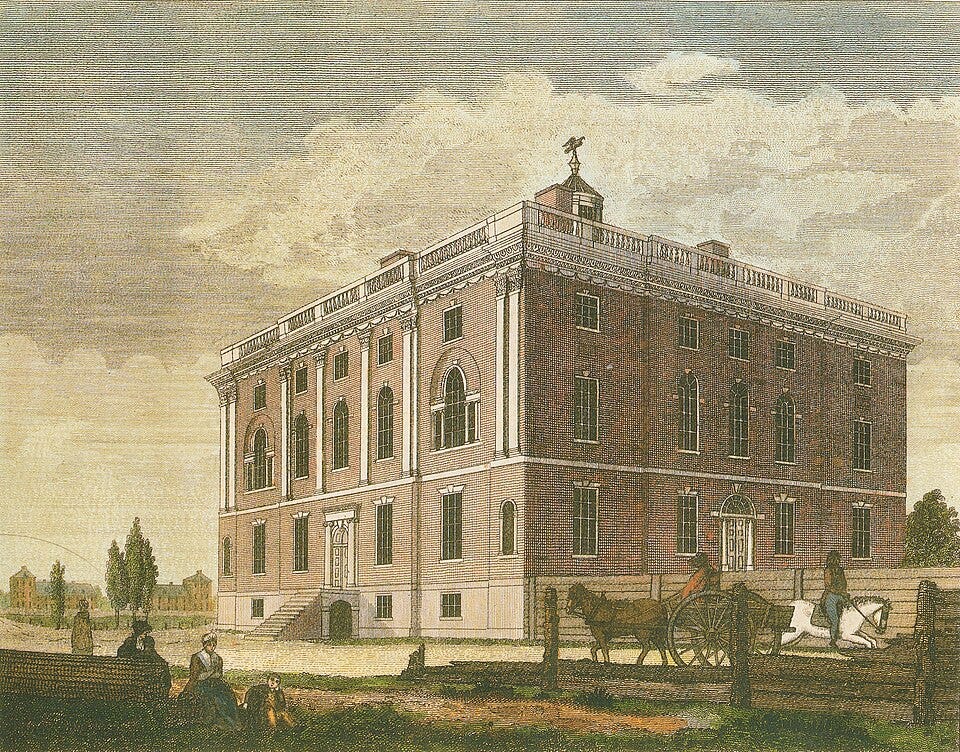
When completed this Philadelphia palace was 40,000 square feet, compare that to the original White House that opened in 1800 and was only 28,000 sq ft.
President Washington felt it was too extravagant and would look odd if the federal executive received a house from a city. John Adams agreed and neither man lived there while Philly was the capital. But the Philadelphia elite did not stop with the “President’s House” on Ninth Street.
The old County Courthouse was expanded to become Congress Hall, the city paid for transportation infrastructure improvements. They created a lively social atmosphere for federal officials to enjoy the city. However it was for naught.
Yellow fever epidemics hit Philadelphia from August to November in 1793, 1797, 1798, and 1799. Each time killing over 1,000 people, with approximately 5,000 dying in the big epidemic of 1793. The recurring outbreaks made many question the safety of Philadelphia as a long-term national capital, especially if the population continued to grow.
1793 was a mess.
Nearly half the city evacuated including Washington, Hamilton and Jefferson. The Free African Society was misled by the myth that Black people were immune to Yellow Fever and therefore could help care for the sick white residents. At a time when racism was standard, they volunteered to stay behind and help their neighbors. The mayor praised them for their “diligence, attention and decency of deportment.” They died for their efforts.
And the medical community was divided on what to do.
Dr. Benjamin Rush was a Founding Father, signer of the Declaration of Independence, and the most prominent physician in the early United States, known for shaping American medical practice and pioneering public health initiatives. And he was a Philly man.
He said the yellow fever outbreak originated locally due to unsanitary urban conditions. Local officials disagreed and said that French refugees fleeing from the Haitian Revolution imported the disease and wanted to quarantine foreign ships before letting them disembark. They were correct.
They also disagreed on treatments. Rush advocated bloodletting and purges. Others called for fresh air, cold baths, and wine or herbal teas. Bloodletting and purging only dehydrated patients and weakened their immune systems and brought Rush into disrepute, which divided his defenders and detractors.
French doctors from the Caribbean also disagreed with Rush. It was Rush who spread the idea that Blacks were naturally immune, but we now know that was a grave correlation error, one he should have recognized. Many Blacks encountered and survived yellow fever in Africa and the Caribbean before they were brought to the US. Those who had not had no such immunity. Despite the praise of the mayor, those Blacks who volunteered were still discriminated against and accused of taking advantage of the sick.
Angry at his opponents in the medical community, Rush resigned from the Philadelphia College of Physicians.
And after all that drama, still the epidemics returned to Philly again and again.
After such a run of misfortune, Congress was ready to leave Philadelphia for the District of Columbia. Though they would soon complain of being forced to live in a humid, near-swamp on the Potomac.