


The Death of Jim Crow began in France.
In 1917, the United States declared war on the German Empire. Thomas Woodrow Wilson, the president, claimed that it was a war to make the world safe for democracy, but he sent men into combat whom he did not care lacked democracy at home in America.
One man who went was the former valedictorian of Amherst College, where he was the only Black student in his class. He was undaunted by striving. Finishing college at the age of 20, he returned home to his native Washington, D.C. as Europe was in the middle of the Great War, yet, while America still enjoyed the benefits of neutrality. He was teaching at Howard University when the call to arms was made.
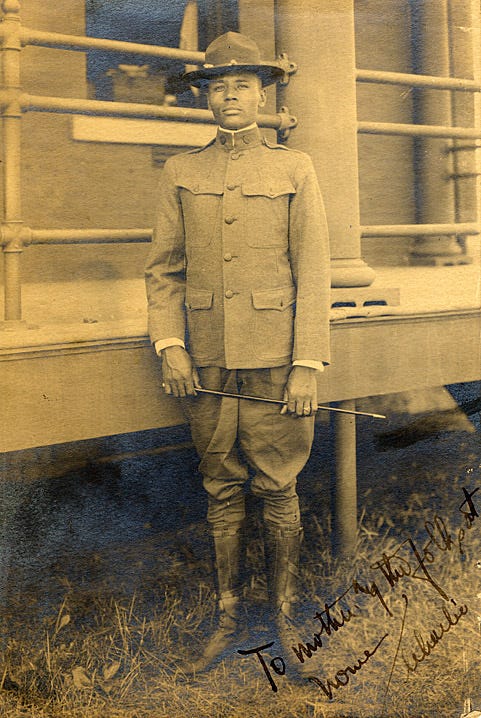
The U.S. Army was segregated by race during World War One, and despite having a qualified African American for the job, Woodrow Wilson’s War Department made sure there would be no Black general in America. But many men educated at the Historically Black Colleges and Universities—and in the institutions of the north that were more open to inclusion—served as junior officers. But the G.I. in question came to rethink what he was doing “over there” in Europe. Charles Hamilton Houston joined the army and trained in Iowa. He did not like the experience.
Much of the US Army officer corps was Southern, and they tried to enforce their unique brand of racism on the frontlines of France. They did this everywhere they went, obnoxiously insisting that other countries adopt American versions of racism so that the American Whites would not be uncomfortable. This would happen again in World War Two. Since the Army wanted to keep Black units from the White American units, the Black troops were often sent to fight as part of a French division. For his part Houston transferred from the infantry to the artillery, as he did not appreciate how African Americans were treated by the infantry instructors. And so, he headed to the Western Front as an artilleryman.
All Black recruits operated in the context of a prevailing institutional race-based irrationalism. In France Houston saw Europeans who treated Black soldiers fighting on side with much more respect, and even socially engaged the soldiers about music like the emerging genre of Jazz. Europeans had prejudices as well, but the American version was far stricter and unyielding.
But in the case of Charles Houston these issues of discrimination were a matter of justice, literally. During the war Houston also served as a Judge Advocate, and in that role, he became even more disillusioned with the America and the army. He questioned why he was overseas putting his life on the line for people who treated him badly because of his skin and birth. He saw firsthand that the system harshly punished Black soldiers but took it easy on their white counterparts. Even accusations against Blacks had a much lower bar to meet, and he was disrespected when he spoke out against the double standards.
The hate and scorn showered on us Negro officers by our fellow Americans convinced me that there was no sense in my dying for a world ruled by them. I made up my mind that if I got through this war, I would study law and use my time fighting for men who could not strike back. —Charles Hamilton Houston
That decision changed American history. Houston survived, and went to law school, passed the bar, and was shutout of the American Bar Association (ABA). No matter, in 1925 he and other Black lawyers founded the National Bar Association (NBA) which still exists. During the first years of the Great Depression, he headed up the Howard University Law School as vice-dean and eventually dean. It is estimated that around of quarter of all Black lawyers practicing during the interwar period came under his tutelage. And he had an idea for them. How about we sue Jim Crow to death? He left HU to become the top lawyer for the National Association for the Advancement of Colored People (NAACP) where he continued to refine litigation strategies against Jim Crow; it was death by a thousand cuts.
Like an artilleryman he found his target and pounded it: equality.
Plessy v. Ferguson, one the worst Supreme Court decisions, allowed the states to segregate non-whites from whites on the basis of “separate but equal” accommodations and services. The states, especially the Southern states, used this doctrine to control the public square and public lives of non-whites, especially African Americans. But did this not presume equal availability of the benefits Whites got, only provided separately from the Whites? As it did, Houston fired away at the clear inequalities in how the government provided for non-Whites.
If a government’s policy is to give Blacks nothing, then the policy is exclusion not segregation, because segregation presumes, not-Whites at least get the same quality and value Whites get.
Houston attacked all white juries convicting African Americans, pushed for the integration of state-run law-schools when there were no separate law-schools for non-Whites and challenged separate-and-unequal where he could. His efforts started cracking the Jim Crow wall. He died in 1950, but his work was taken up by his student Thoroughgood Marshall, better known as Thurgood Marshall, who would litigate Brown v. Board of Education in 1954 and become the first Black member of the Supreme Court of the United States in 1967.
That is a very interesting piece on military and civil rights history, and something I didn't know about. The linkage of Thurgood Marshall as Houston's student answered an unspoken question in my mind as to Marshall's background which motivated his involvement in countering unjust legal persecution of African American military service members during WWII. The case I knew about, from my Navy experience as the supply officer of a ammunition ship that loaded and discharged ordinance at the former Port Chicago (renamed Concord Naval Weapons Station), was Marshall attending the Port Chicago 50 court martial and attempting to influence the outcome in a more just direction. These sailors were charged with mutiny over their refusal to work in unsafe ammunition handling conditions after an ammunition explosion had instantly killed over 320 on the docks.
The Smithsonian link below has more info on Marshall's & the NAACP's involvement in other WWII court martials which are likely lesser known:
https://www.smithsonianmag.com/history/deadly-world-war-ii-explosion-sparked-black-soldiers-fight-equal-treatment-180980545/
Amazing Article ! Wow! Great Job!