May 9, AD2025, The Minority Pope

Dear Reader,
Well, once again, news from Rome has changed most of my plans for what I planned to write. Let’s go.
Much of the West celebrated Victory in Europe Day this week, which takes place on May 8th in the West and May 9th in Russia due to the timezone difference. The German armed forces signed their surrender in Berlin on May 8 at 23:43, or 11:43PM UK, French and German Time, and 5:43PM Eastern Time in the USA, which was after midnight in Moscow, hence the Russians celebrate May 9th.
In US news, the Trump Administration has suspended the rules to allow several dozen Afrikaners into the United States as refugee residents; they are expected to arrive on Monday at Dulles International Airport in Virginia, just outside of Washington, DC. Questions remain about what, if any, vetting process took place before agreeing to bring them to the United States and relocating them at taxpayer expense. Afrikaners are a South African ethnic group descended primarily from Dutch settlers who began arriving at the Cape of Good Hope in the mid-1600s, along with smaller numbers of French Huguenots and Germans. Most speak Afrikaans, a language that evolved from 17th-century Dutch, and were historically known for farming, strict Calvinist beliefs, the architects of the apartheid system model on American Jim Crow that enforced European supremacy over and the segregation of the majority black Southern Africans. While other refugee groups are being denied entry, many Americans see the exception for Afrikaners as a deliberately racially provocative policy at odds with putting “America first” and do not want to pay taxpayer money to solve South African problems. Other Americans feel that the Afrikaners do face some issues in South Africa, much which can be put down to the same problems that other South Africans face due to widespread government corruption and crime, and disagree with their being used as mascots for “white oppression” for US political purposes.
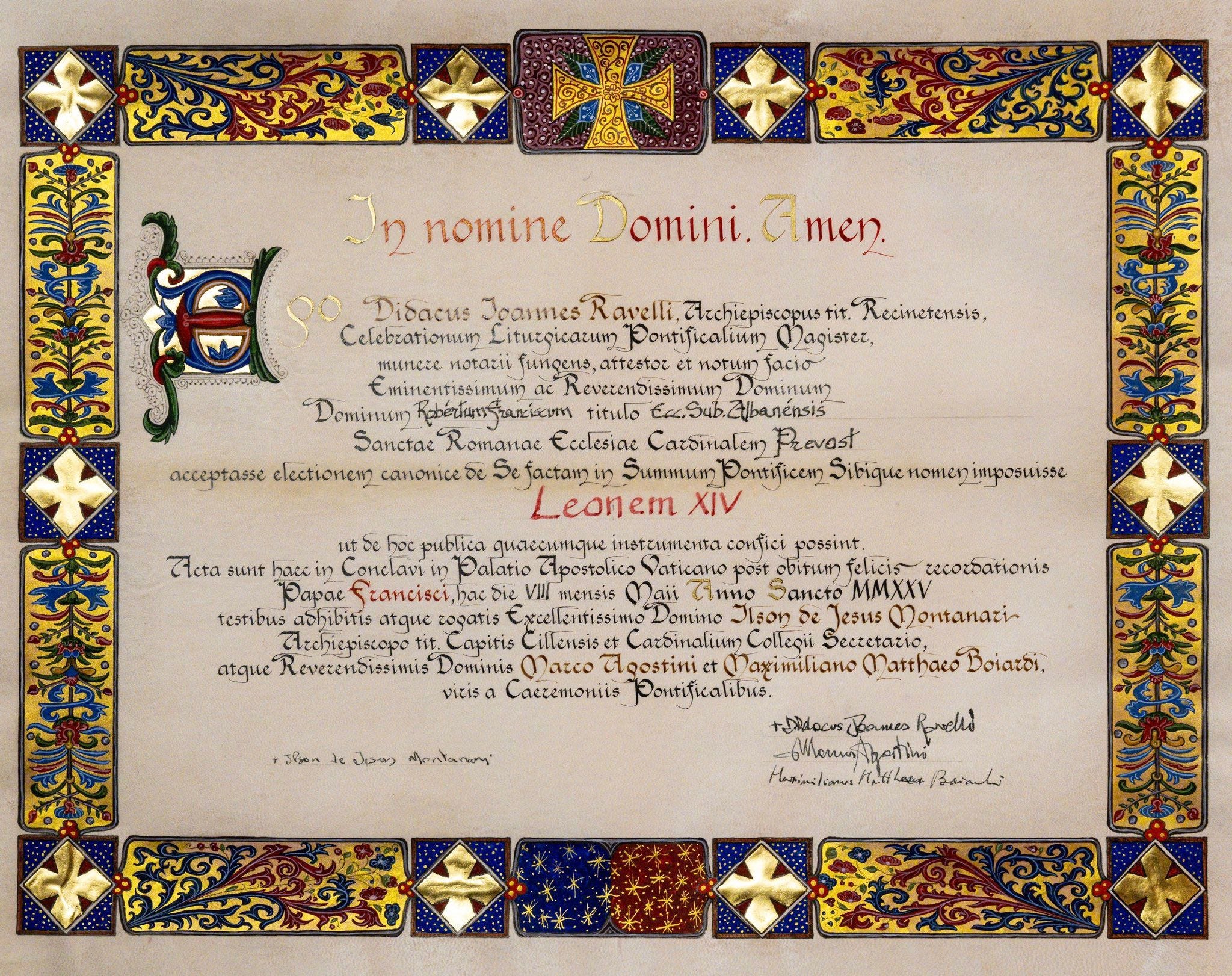
But the biggest news story is that on VE Day, the voting members of the College of Cardinals elected an American Pope when the United States and the historic Western Church are at a crossroads with very divergent paths ahead of them. The two most important Americans are now the Pope in Rome and the American president. The Christian social war is expected to heat up as the American Pope is already frightening those who have long tried to make American Christianity an appendage to libertarian economics and culture wars, which are both contradictory and tinged with racial, ethinic, and tribal animus, themselves antithetical to the historic Christian tradition before the Renaissance.
Pope Leo XIV is the first pope since the ancient Church to come from both a minority background and a country that has never been Catholic. In fact, the United States of America is the first foundationally Protestant state in the world, one that never underwent a reformation. The USA was born Protestant. Catholics have always been a minority, though in recent years they have exercised unprecedented governmental power.
In many respects, Catholic America was made by the Industrial Revolution and the economic success and political stability of Protestant liberalism. Catholics left Europe and moved to America primarily for jobs and economic oppurtunity. For many, especially among the native-born Protestant majority, the nation's expanding global footprint and the waves of newcomers flooding its industrial cities both symbolized a growing dependence on "others"—foreign markets abroad, immigrant labor at home.
Consequently, Catholic immigrants coming from Italy, Mexico, Germany, and Poland also annoyed Irish Catholics who dominated and wanted to keep dominating American Catholicism. They formed parishes of one ethnic group or another and would discriminate against outsider-Catholics, even when it came to Catholic school kids. But all Catholics were seen as suspect by the Protestant majority. By the 20th century, Catholicism was the largest single Christian sect in the US, but it was still dwarfed by the combined Protestant population. A Protestant American was that Catholic countries were illiberal and tended to be economically backward, so they feared that bringing Catholics would undermine democracy and that Catholics would endorse more authoritarian politics or be secretly politically loyal to the pope.
However, the Catholic ethnics also disputed among themselves, especially about assimilation and what it meant to become American. There arose a dispute between the bishops, who divided into two camps: the Americanists and the conservative traditionalist faction, who want to maintain a more distant connection to wider American society. The Americanists wanted to end the ethnic parishes, and to assimilate into the public square, which they argued who help sustain Catholicism as America had no official religion, Catholics could compete in the marketplace of ideas on equal footing. The traditionalists rejected this because they rejected both the principle of the separation of Church and state, and feared that American public schools would undermine Catholicism in children. Some accused the Americanists of crypto-protestantism and working for the infiltration of Protestant ideas, values, or theological tendencies within Catholic settings, often without formal rupture or open declaration. It was alleged that crypto-protestantism manifested as an overemphasis on individual conscience, democratic or rationalist ideals, and secular civic engagement at the expense of traditional Catholic teachings on hierarchy, sacramental life, and supernatural grace. Specifically in our case the issue was a concern in the Roman Catholic Church that the work of Father Isaac Thomas Hecker -who died in 1888, and was the founder of the Missionary Society of Saint Paul the Apostle (the Paulist Fathers)- was encouraging crypto-protestantism. In response, Pope Leo XIII issued an 1899 Apostolic Letter, Testem Benevolentiae Nostrae, sent to James Cardinal Gibbons, the Archbishop of Baltimore. The occasion was caused by the controversy in Europe that followed the publication of a translation of Hecker’s biography in France.
It is known to you, beloved son, that the biography of Isaac Thomas Hecker, especially through the action of those who under took to translate or interpret it in a foreign language, has excited not a little controversy, on account of certain opinions brought forward concerning the way of leading Christian life.
We, therefore, on account of our apostolic office, having to guard the integrity of the faith and the security of the faithful, are desirous of writing to you more at length concerning this whole matter.
The underlying principle of these new opinions is that, in order to more easily attract those who differ from her, the Church should shape her teachings more in accord with the spirit of the age and relax some of her ancient severity and make some concessions to new opinions. Many think that these concessions should be made not only in regard to ways of living, but even in regard to doctrines which belong to the deposit of the faith. They contend that it would be opportune, in order to gain those who differ from us, to omit certain points of her teaching which are of lesser importance, and to tone down the meaning which the Church has always attached to them. It does not need many words, beloved son, to prove the falsity of these ideas if the nature and origin of the doctrine which the Church proposes are recalled to mind. The Vatican Council says concerning this point: “For the doctrine of faith which God has revealed has not been proposed, like a philosophical invention to be perfected by human ingenuity, but has been delivered as a divine deposit to the Spouse of Christ to be faithfully kept and infallibly declared. Hence that meaning of the sacred dogmas is perpetually to be retained which our Holy Mother, the Church, has once declared, nor is that meaning ever to be departed from under the pretense or pretext of a deeper comprehension of them. — Leo XIII, 1899
It continued in this line of reasoning, warning the cardinal and the American Church against folding Catholic doctrine to fit American political and cultural preoccupations. Pope Leo XIII warned against confusing license with liberty and that “We, indeed, have no thought of rejecting everything that modern industry and study has produced; so far from it that we welcome to the patrimony of truth and to an ever-widening scope of public well-being whatsoever helps toward the progress of learning and virtue. Yet all this, to be of any solid benefit, nay, to have a real existence and growth, can only be on the condition of recognizing the wisdom and authority of the Church.”
Recognizing that America was an inherently Protestant society, the Church hierarchy was concerned that Catholic ambitions to ascend to the heights of American political and economic status would cause the faithful to lose their distinctive Catholic heritage and fall into spiritual error. They at least solved much of the ethnic parish problem in the 1930s, but continued to struggle with race issues into the 1940s. Catholicism maintained an outsider position in American life until the rise of the Kennedy family and the Golden Age of Hollywood used Catholic priests as the default on-screen clergyman. It was this slightly outsiderish world into which Pope Leo XIV, born Robert Francis Prevost in Chicago in 1955, a descendant of Latin Europe with Spanish, French, and Italian ancestry, not Irish as might have been expected for the first American pope. He is the first Augustinian and as well as the first American in the See of Saint Peter. A man from the Midwest, from a country where Catholics were traditionally outside the mainstream, the first minority pope in over a millennium.
A pope who grew up in America, a nation where Catholicism could not be presumed; it had to be proclaimed and guarded. Interesting times.
After earning his doctorate in Canon Law, he began his missionary work in Peru in 1985, which has formed much of his character. In 2014, Pope Francis named him Apostolic Administrator of Chiclayo, where he became bishop and served from 2015 to 2023. He also held roles within the Peruvian Episcopal Conference. In 2023, he was appointed Prefect of the Dicastery for Bishops and President of the Pontifical Commission for Latin America, later becoming a cardinal and taking part in multiple Vatican synods. In 2024 and early 2025, he was named to several major Vatican dicasteries and promoted to the Order of Bishops. He recently presided at high-profile liturgies, including prayers for Pope Francis’s health.
As Cardinal Prevost, Pope Leo XIV was known for his traditional views holy orders, and a more tolerant attitude toward the Latin Mass. He also has a record of criticism of the very publically Catholic recent convert, the US vice president, JD Vance.
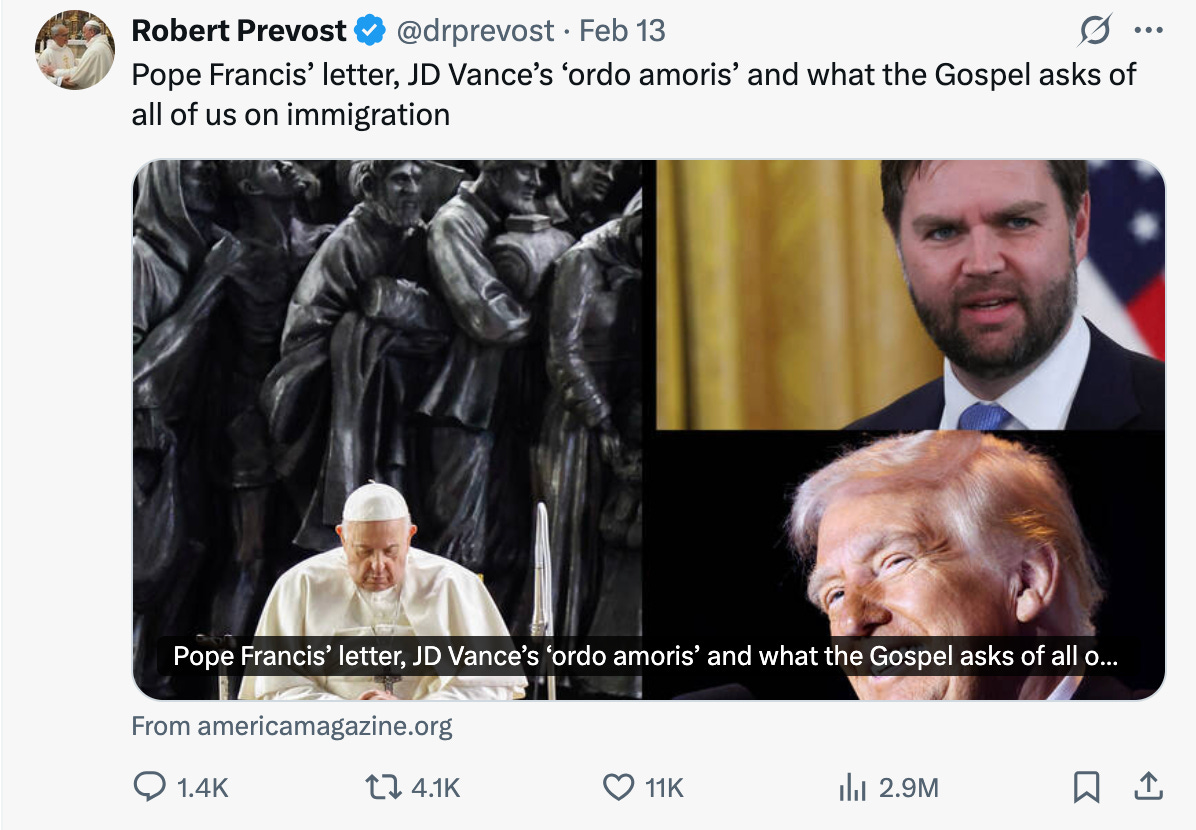
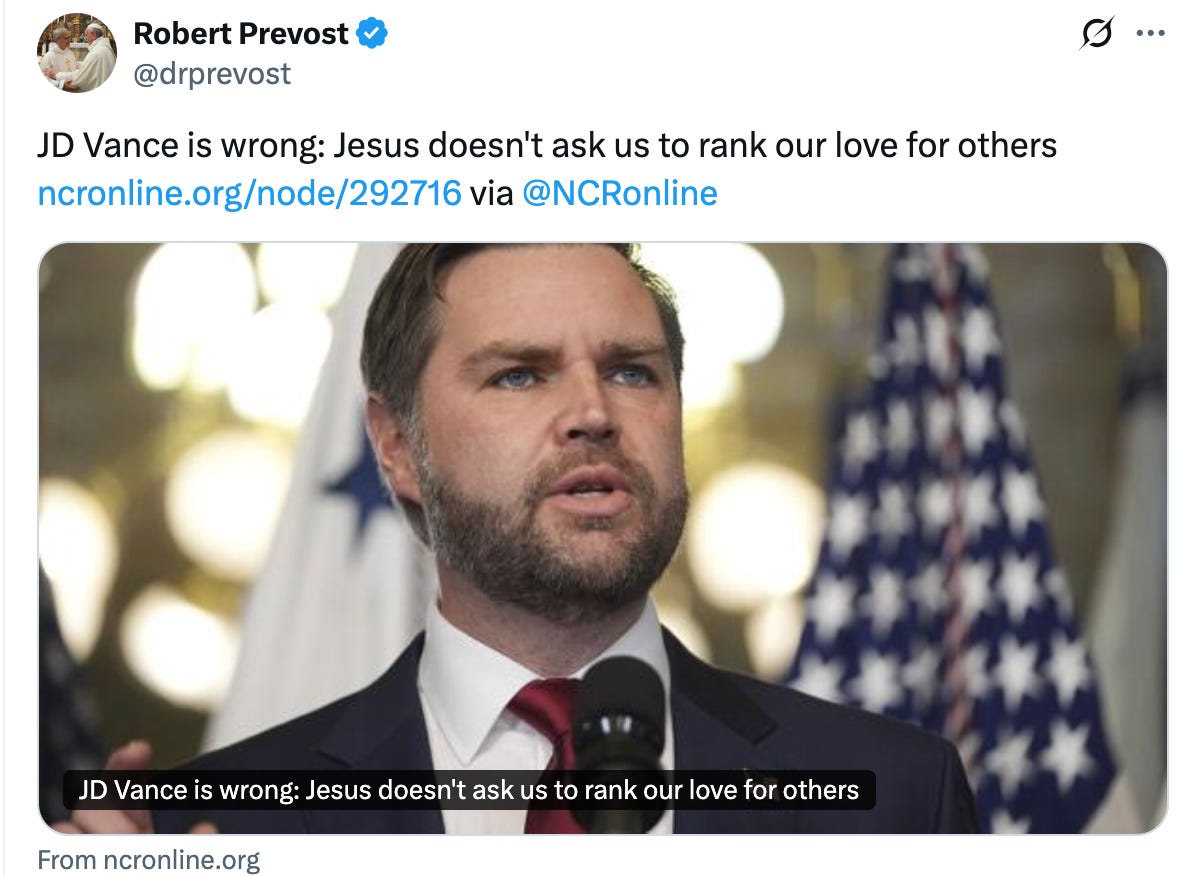
This has cause many of the very-online MAGA supporters to allege that Pope Leo XIV is a “progressive” who will be a “disaster” for Christianity. What is meant by “progressive” is anyone’s guess, but more to the point, it heralds a shift in the US political culture wars and perhaps the beginning of a more clear and present religious conflict. To many, MAGA-Catholicism is the new Americanist controversy which Leo XIII confronted. Once the name was announced, I thought of Leo XIII as the Pope who combated socialism, unrestrained corporation-centered capitalism, and told US Catholics to cool it with conformity to the majority culture. Leo XIV is an aggressive name. This will be a historic pontificate. He has also hinted that he is not Pope Francis in significant ways. That is actually the bigger threat to the current preferences of the US right under Trump-Vance.
The new Bishop of Rome began by appearing wearing the mozzetta, the traditional red papal garment over his white cassock, and wearing the pectoralis, the pectoral cross. All were traditional actions that Pope Francis deliberately did not do. He gave the traditional blessing in Latin, and Francis did not do that either. And again, the name is traditional, whereas Francis was Pope Francis I, the only one, a name without papal precedent. “Leo” is now tied with Clement as the fourth most popular papal name behind John(21), Gregory(16), and Benedict(16). Likewise, as a canon law expert, Leo XIV is likely to enforce rules and use the canons to ensure the Church is better administered than under Francis, with more reliable and predictable behavior. Everything points to the potent combination of traditional papal behavior, governance, and aesthetics with a strong moral ministry focused on justice and evangelism. His first homily further set a tone that hints at a return to tradition and social reform like Leo XIII. (A homily is a short sermon explaining Scripture during worship; in Catholicism, it's a formal part of the Mass tied to the Gospel, while in Anglicanism, it serves the same function but can also refer to the Reformation-era books of official sermons used for teaching doctrine.)
I will begin with a word in English, and the rest is in Italian. But I want to repeat the words from the responsorial Psalm: “I will sing a new song to the Lord, because he has done marvels.”
And indeed, not just with me but with all of us. My brother cardinals, as we celebrate this morning, I invite you to recognize the marvels that the Lord has done, the blessings that the Lord continues to pour out on all of us through the ministry of Peter.
You have called me to carry that cross, and to be blessed with that mission, and I know I can rely on each and every one of you to walk with me, as we continue as a Church, as a community of friends of Jesus, as believers to announce the good news, to announce the Gospel. [Continuing in Italian] “You are the Christ, the Son of the living God” (Mt 16:16). In these words, Peter, asked by the Master, together with the other disciples, about his faith in him, expressed the patrimony that the Church, through the apostolic succession, has preserved, deepened, and handed on for 2,000 years.
—Pope Leo XIV, May 9 2025
It does not get much more traditionally Roman Catholic than that. Probably the most important pontificate in half a century has begun.