

July 11, AD2025, the Problem of SCOTUS Confusion and Average Leaders in an Extraordinary Time
An Insolvent America Will Be An Irrelevant America

I will be open to the considered views of my colleagues on the bench, and I will decide every case based on the record, according to the rule of law, without fear or favor, to the best of my ability, and I will remember that it’s my job to call balls and strikes, and not to pitch or bat.
—John Roberts, 2005 testimony before the Senate Judiciary Committee
Dear Reader,
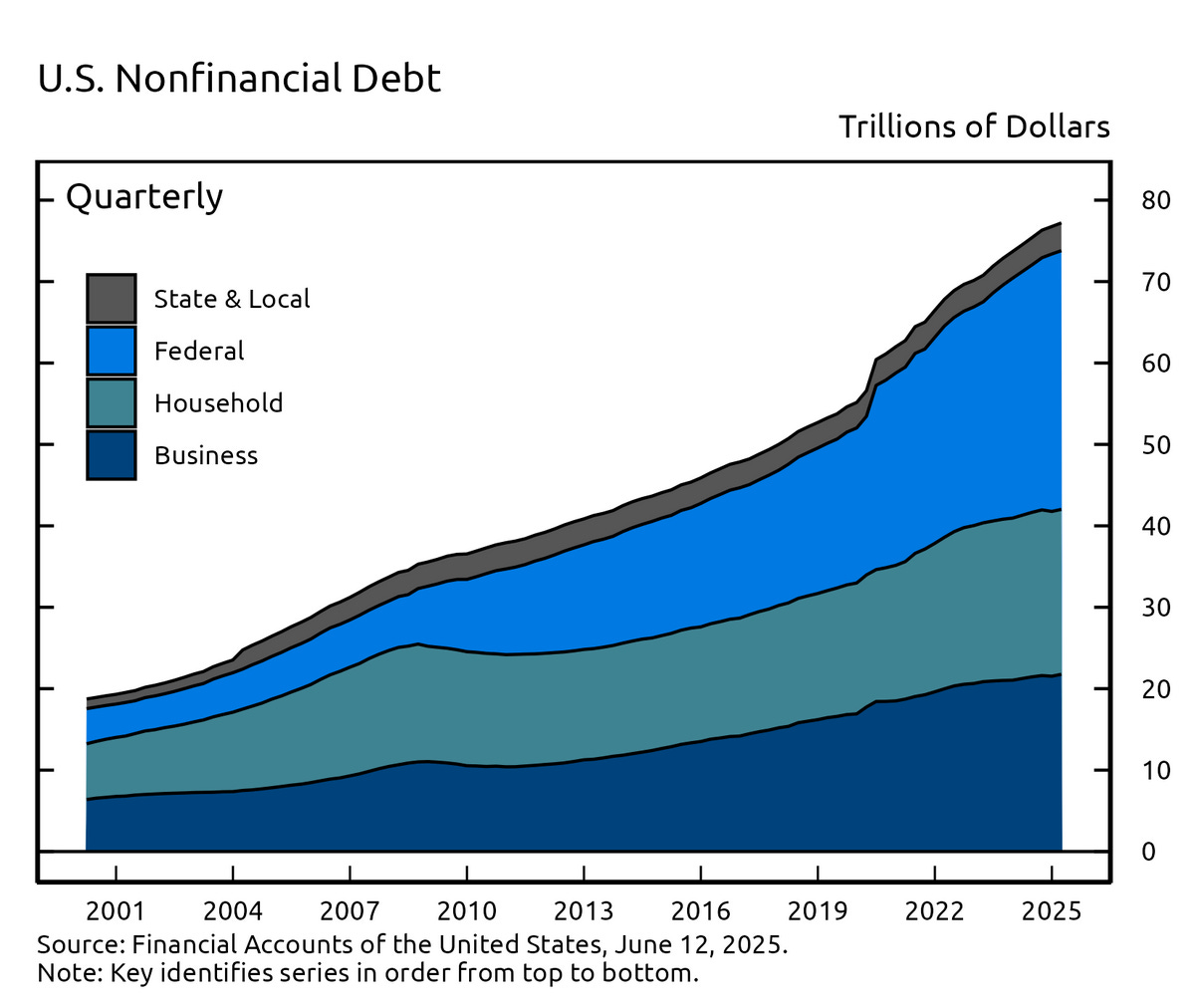
Nonfinancial debt, as defined in the Federal Reserve’s Z.1 report, refers to debt held by sectors that are not financial intermediaries (such as banks or insurance companies). According to the Federal Reserve’s technical definitions, nonfinancial debt consists of two main components: debt securities (e.g., bonds such as Treasury, municipal, and corporate bonds, and commercial paper) and loans (e.g., mortgages, business and consumer loans, and other depository and non-depository advances).
The US Government Debt is approximately $36.22 trillion. The states have liabilities of over $3 trillion. This is a crisis—an extraordinary one that will be made worse by H.R. 1, the “One Big Beautiful Bill Act” (OBBBA), a sweeping legislative package passed via budget reconciliation. It is not a normal funding budget; instead of merely funding government agencies, it also sets long-term fiscal and policy rules on taxes, entitlements, and spending ceilings. It will increase the debt by at least an additional $1.5 trillion at a time when the debt needs to stop rising entirely. The United States needs a balanced budget with zero increase in federal debt now, not later. The Republicans failed the country but secured the tax cuts their donors wanted. This, coupled with tariff disputes, has led Democrats and other Republican opponents to claim that the GOP leader is a moron. They are wrong, and their wrongness, coupled with their elitism and moral corruption, is why they keep losing.
The American President, Donald John Trump, is not an idiot. He is also not a genius. He is average. He is an average baby boomer American who inherited a fortune and has enjoyed the ease of life one would expect from someone who inherited a major real estate business and wealth from his father. He resonates with average Americans because he is simply average himself. His surprise that the President of Liberia speaks English well, has been taken as either humor or racism, but more likely it is that he has had the average American’s lack of curiosity about Liberia and Africa. In the last election before 9/11 changed our country set us in a geopolitical tailspin, pollsters and pundits founded that while Vice President Albert Arnold Gore Jr., was often viewed as more experienced or intelligent, Texas Governor, George Walker Bush scored higher on likability. People felt Bush was someone they could “have a beer with”—a regular guy.
This is a problem for both the Republicans and the Democrats. America does not have average problems for the GOP to kick down the road, and its unwillingness to govern for everyone means that the bottom will fall out sooner rather than later. They presume they will avoid personal consequences, but history tells a different story, and history plays no favorites. It is not a good situation
You cannot solve the world's problems over a beer, and forgetting the world, America’s domestic problems are enormous.
And the Democrats do not have a dummy for an opponent. They must stop reassuring themselves by thinking so, it is lazy. Trump does not have the character or talent to solve the nation’s extraordinary and existential debt issues - or geopolitical challenges - but he is also not going to simply give the Democrats an easy path back to power. He knows how to fight them. He is able to see and call out the Democrats for being ridiculous while taking themselves too seriously—the same thing average Americans can see as well. He is very good at making Americans laugh at his opponents. It may be low cunning and humor, but he is good at it. The Democrat leaders are not up to his challenge so they reassure themselves by attacking his ability. This is a crisis of averages, Trump’s averages are just higher than the Democrats’. In perilous times, you need greatness, and the Republican and Democrat leaders in Washington, D.C. are average for the times: B- and C-list celebrities playing at being statesmen.
SCOTUS
The Supreme Court of the United States has made very confused decisions lately, but I do not think anyone should be too surprised given the history of Chief Justice John Roberts. Doing the right thing for the wrong reasons, and wrong reasoning, is very bad for the constitutional order. And often they have not even done the right thing. The 2025 Supreme Court term revealed a legal philosophy increasingly estranged from the American constitutional tradition. This end state should have be evident with Chief Justice Roberts’s decision regarding Obamacare, also known as the Patient Protection and Affordable Care Act; and the Health Care and Education Reconciliation Act of 2010, for which the Republican Party pilloried him then, and the Democratic Party cheered. But his reasoning was terrible.
The Republicans were furious with Robert’s reasoning in National Federation of Independent Business v. Sebelius. I remember how they were so incensed that the radio host Michael Savage made ugly accusations about epilepsy affecting Robert’s mind. It was called one of the worst decisions in history. It took them a long time to get over it. What did Roberts do that I think should have been a warning to Democrats?
Article One, Section Seven of the United States Constitution, reads:
All Bills for raising Revenue shall originate in the House of Representatives; but the Senate may propose or concur with Amendments as on other Bills.
That is clear as possible, a bill that deals with taxes must start in the People’s House. The Bill we call Obamacare is numbered H.R. 3590. But in 2009 H.R. 3590 started as the Service Members Home Ownership Tax Act of 2009. Which if it seems like it has nothing to do with health insurance then that is because it did not. When it went to the Senate, the senators rewrote it in a maneuver known as “gut-and-replace” where they stripped out the language and inserted what you now call Obamacare and renamed it to the Patient Protection and Affordable Care Act. Why?
Well, the Service Member Home Ownership Tax Act of 2009, which offered tax credits to military members who were first-time home buyers, passed out of committee with ease and then passed the House of Representatives 416–0. Meaning, if you were treating it as the same bill, no Republicans voted against Obamacare the first time it was passed—which would be a ridiculous thing to say. But both versions are “H.R. 3590,” so you can say the first time H.R. 3590 passed the House, the GOP was on board. Why go through the bait and switch? Because if you do it this way, you skip the scrutiny of the committee process. In Hawai’i the state Supreme Court actually struck down gut-and-replace in a particular egregious example when a bill that originally passed as a tackling criminal recidivism was turned in something about hurricane shelters in schools. I am serious.
In the case of Obamacare, the Senate committees put out two versions of the bill. Then the Majority Leader, Senator Harry Mason Reid Jr. of Nevada, rewrote them behind closed doors using leadership procedures, did not send them back to the committees, and passed them in a party-line vote. This new bill was then sent to the House as H.R. 3590. The House, under Speaker Nancy Patricia Pelosi of California, did not send it back to its committees either, and then passed this new version called H.R. 3590 in another party-line vote. Very different from something giving tax breaks to military members. And this was the law signed in 2010 by President Barack Hussein Obama II. It was challenged because it was passed with a penalty for not buying health insurance, known as the individual mandate, the House and Senate agreed that this was a penalty under the authority of the commerce clause of Article One, Section Eight, Clause Three which reads:
Congress shall have power…To regulate Commerce with foreign Nations, and among the several States, and with the Indian Tribes;
Okay, but not buying something is not commerce. The critics were right to point out the flaw in the Democrats’ reasoning: a citizen who does not buy something is not engaging in commerce. You have a right not to spend your money, and nothing in the Framers’ intent allowed Congress to force citizens to buy something. Where would that end—can they make you buy a Tesla? So, if Obamacare’s individual mandate penalty is a penalty, then it is not a tax and does not have to originate in the House. And if Congress said it was not a tax, then it is not a tax. “Originate” means it must start in the House; the Senate may only “amend.” Amend does not mean write a bill about something completely different. It violates both the spirit and the letter of the Constitution to then call such a thing a tax and uphold it as constitutionally passed.
Then in National Federation of Independent Business v. Sebelius Chief Justice Roberts ruled for the obvious, that a penalty for not buying health insurance was blatantly unconstitutional, but then he said that the individual mandate was fine because the money you paid for not buying insurance was really a tax!
So, John Roberts, to keep the individual mandate, said that a penalty which Congress said was not a tax, was a tax, and that it was passed properly even though it did not originate in its actual form in the House but in the Senate through gut-and-replace. The whole thing is sloppy logic. He made up a tax that Congress said was not a tax. And Democrats largely cheered because it saved the individual mandate.
The late Justice Antonin Gregory Scalia was appropriately scathing in his dissent:
The Court today decides to save a statute Congress did not write. It rules that what the statute declares to be a requirement with a penalty is instead an option subject to a tax. And it changes the intentionally coercive sanction of a total cut-off of Medicaid funds to a supposedly noncoercive cut-off of only the incremental funds that the Act makes available.
The Court regards its strained statutory interpretation as judicial modesty. It is not. It amounts instead to a vast judicial overreaching. It creates a debilitated, inoperable version of health-care regulation that Congress did not enact and the public does not expect…The Constitution, though it dates from the founding of the Republic, has powerful meaning and vital relevance to our own times. The constitutional protections that this case involves are protections of structure. Structural protections—notably, the restraints imposed by federalism and separation of powers—are less romantic and have less obvious a connection to personal freedom than the provisions of the Bill of Rights or the Civil War Amendments. Hence they tend to be undervalued or even forgotten by our citizens.
It should be the responsibility of the Court to teach otherwise, to remind our people that the Framers considered structural protections of freedom the most important ones, for which reason they alone were embodied in the original Constitution and not left to later amendment… Scalia, Kennedy, Thomas, Alito dissenting
Eventually Scalia started calling Obamacare, “SCOTUScare”.
Now, honest Democrats should look at that messy situation and wonder why they ever cheered for Roberts. Was it because they got what they wanted? What we see now is that, when pressed, Roberts tries to give politicians in power a way to get what they want on legislation and executive policy, even if the Constitution’s provisions are set up to tell them “no.” Even if the politicians craft policy and swing and miss badly, Roberts will still find a way to say they never swung and the pitch was a ball so he can walk them onto base. So perhaps he was not lying when he said his job was to call balls and strikes—he just calls them according to his own rules, not the rules of the game. The Constitution has to matter whether we get our way or not. And sometimes we should not get our way, and that is okay.
If Democrats, or constitutionalists, concerned with executive overreach are disappointed in the Roberts Court in 2025, I say why so surprised?