
In Paradise's Shadow, the Gig Economy's Pathological Division of Labor

There is no doubt that external conditions leave their mark upon individuals, and through their diversity can cause differentiation. But the question is whether this diversity, doubtlessly related to the division of labor, is sufficient to constitute it. To be sure, explanation can be made by referring to the properties of the soil and climatic conditions, inhabitants producing wheat here, elsewhere sheep and cattle. (264)…
The division of labor appears to us otherwise than it does to economists. For them, it essentially consists in greater production. For us, this greater productivity is only a necessary consequence, a repercussion of the phenomenon. If we specialize, it is not to produce more, but it is to enable us to live in new conditions of existence that have been made for us. (275)
Emile Durkheim in De la division du travail social, 1893, trans. 1933
Dear Reader,
I. The Disappearing Promise
The loudly spoken rule in the US was: work hard, stay straight, and you will get somewhere. For many people, that was an illusion until 1965 or ‘68 due to discrimination. And it was hard in many communities to break the idea that it was a lie, but for others, it was taken as true and was a major reason immigrants left Europe and came to the New World. And then the rest of the world started to come after 1965, when some domestic populations were just getting their shot. But overall, folks had faith in the future. It is why the 1990s saw some of the best advancements in what we Americans call “race relations;” and why the decline of hope has us in the place we are now. Then, people believed that almost everyone had a decent shot “to make it.” Making it at its most basic level, it was the idea that you could live honestly with dignity. Other countries were for suckers, meaning they were organized in ways that those who worked hard got nowhere and were preyed on by those above them. Think of the USSR, or many other countries from Latin America to Africa to much of the Middle East in the 20th century. People were ruled, subjects, not citizens, and when they could get out of those countries, they invariably came to North America, mostly the US, but Canada too. But around that same time, a shift was happening in America’s boardrooms and business schools. New leadership cadres no longer identified their personal interests with the workers’ interests, or the consumers’, or the nation’s. The greenback commisars did not think about maximizing customer value, the thought about maximizing shareholder value, and the two did not have to be remotely similar or exist in the same realm.
The change came with subtle bumps and then jolts. Employers began to cut benefits, then hours, then the idea of employment itself. Slow and over the decades.
What we now have for many is this thing we call the “gig economy,” like you are a free-styling musician happily playing a set. It is not freedom to it is freedom from; it is the lack of belonging to either a stable, independent career or an employer. What is worse for the millions who wound up in this gig economy are the American mantras on repeat proclaiming: “best country in the world,” “freest people ever,” “here all dreams can come true,” “look at the market,” and for the young “come on at your age you should eager for the grind,” etc. The loss is financial and moral when a nation’s institutions no longer believe they owe anything to those who work. The social contract has been shredded, and in its place is a fantasy propped up by apps and advertising. They are told the hustle is beautiful, the grind shows their mettle. However, beneath the slogans is exhaustion, debt, and the quiet terror of downward mobility. To sustain itself, such a system encourages social mores that tell the individual their dignity is conditional and that asking for support is a weakness. The gig economy is accompanied by national gaslighting about employment instability. Everything is fine.
II. The False Gospel of Hustle
Hustle is the new false piety that adds gloss to struggle-labor. No day of rest, only the idea that being “Mr. No Days Off” is some sort of badge of honor. A new American commercial cult where the exploited worker is supposed to feel proud of being exploited. It is cringe and weird. People are nudged to brand their struggle, to package their fight for survival as ambition. In our algorithmically induced false sense of community, hustle culture was not created by the poor; it was marketed to them. But in a way, it did not start when Silicon Valley turned vulnerable, precarious labor into a lifestyle brand. It began with offshoring, with pretending there would be no consequences to everyone doing it when one company's labor force was another company’s customers. It was always meant to serve capital, not workers or customers.
I remember when George W. Bush was just starting his second term and an American woman, Mary Mornin, told him of her need to work several jobs and he cut her off to applaud the struggle.
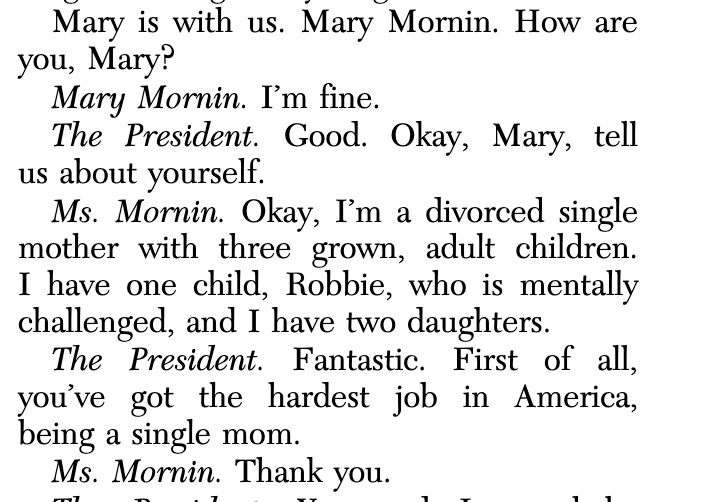
A short while later in the conversation,
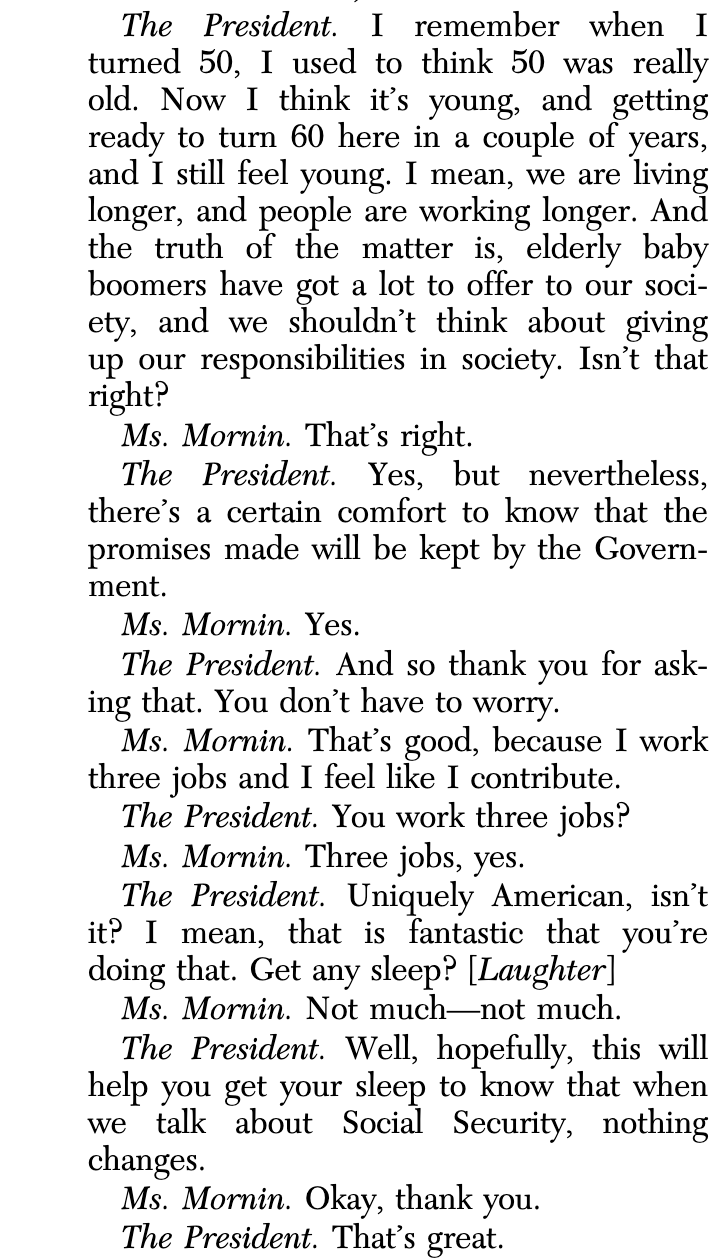
…..Sorry, I lost my eyes for a second as they rolled so hard, revisiting that episode.
We used to look down on sloth, and now we feel ashamed to rest. You must appear proud of your hustle, grateful for the scraps, happy to “have a gig.” If I were president, I would have asked why anyone needed more than one job and what was going on that there was no full-time work for her. Clearly, she was not unwilling to work, and there are only 24 hours in a day and 7 days a week. Pretending this is okay is perhaps uniquely American. It is easier to pretend you want this than to admit you have no other option. Or that, as the leader, you do not care. I remember when Jeb Bush angered Americans by saying they needed to work more hours. I knew he was toast way back in 2015, if the Bush team hadn’t got a clue in a whole decade.
However, back to the matter at hand, for many Americans, on top of the family breakdown that has afflicted the country’s children for the last two generations, and produced cohorts of traumatized adults, they now have to deal with even greater fear of adulthood due to the unseen pitfalls and which can lead to being stuck in underemployment. The idea that college is no longer the ticket to a steady career is a historical development without precedence because, for so long, the university route was rare, and now youth are still siloed to university without the guarantee. And those who do not make it to university are left more exposed because of societal expectations.
And the gigging mantra lulls people into a pretended satisfaction. It is exhausting to feel like a failure. It is easier to pretend you are free, especially when there is little sympathy for those who sometimes gig in ways that society finds appalling, but is not willing to consider economic reforms to make such jobs unnecessary. In some communities, it is a gang lifestyle; in others, it is in front of a camera. Gigging is just the new catch-all term we give to a lot of work that we would have seen before as work of desperation, but those in more respectable work are just insecure. That shared insecurity is the real paradigm of the gig economy.
III. Anomie and the Fall
The most dangerous thing in America today is disorientation. We live in what the late French sociologist Émile Durkheim (1858-1917) called anomie: a state of society when the old normalities no longer apply and the supposed new ones are incoherent and often hurtful due to the social and economic divergence that has produced the dislocation. Anomie is what happens when people no longer know what is expected of them and no longer trust that what they’re doing has any meaning. Labor relations in the past also organized social relations in a manner that connected management, labor, and customers, or artisans, merchants, and clients. The connections within communities built solidarity, but with the changes in the economy and technology, it became more necessary to have a common moral outlook so that most elites did not take advantage of their ability to take advantage. If this shifted, then the whole thing becomes rigged, the benefits accrue ever upward. Individuals begin to feel like they are surplus population whose contributions do not really matter. So they focus on just getting by in a society that continues to assure them that their devaluation is not occurring just before their eyes. It has gotten to the point that when a company refers to itself as “more like a family,” the suspicions are raised because that is often code for “don’t rock the boat or complain about extra work without extra pay.” And certainly do not unionize or seek full-time employment. Even in full-time work, the mentality has infected job searches. Students complain that trying to break into a job feels like the Hunger Games, where interviewers lay traps to justify not hiring someone rather than being upfront about what they are looking for to see if someone is a match; no emails to let them know they were not selected, no feedback, and no upfront salary ranges so they have to guess what they should ask for while knowing the company is looking for an excuse to pay them less.
In America, this widespread behavior is contributing to becoming a much lower trust society, as outside of family and friends, work is where most people interact with other people, and we tend to spend more time at work than with friends and family due to our commuting times. People no longer know what is expected of them, life becomes a game where people are not willing to be upfront, and those who try to be honest and upfront feel like they are being played. Passive-aggressive behavior is rewarded rather than shut down, because the ones in charge are actually inner cowards unwilling to confront the bullies. This causes the reaction of either withdrawal or self-hatred among the victims of this behavior, and sometimes a lashing out. This affects the young and the middle-aged, especially Gen Z and Millennials. It is the source of resentment against boomers. Speaking to my students as they prepare to graduate from college, they are in no way deceived about the reality that the previous leadership generation has left little for them to hope in. They are used to insecurity and hate it. But they are expected not to complain. They move into the exploitative and dignity-denying gig economy not to be more productive, because it is a condition of their continued existence. It is about survival. It is the condition of the “freelancer” who is always busy but never secure, and the job seeker who never knows where they stand. The driver who earns enough to scrape by but not enough to rest. The man whose labor produces value for others but never for himself. The cam girl pretending to be dignified while performing the pretence of having no dignity, and yet hates her job and customers. It is hard to be a fallen angel, told constantly that they still live in paradise.
The rise of all this is a sign of a bad economy and a superpower in denial. It is a crisis as Millennials enter what should be the sandwich years, when they should be caring for their aged parents and raising children, but now many cannot afford to do either, and politicians are looking for schemes to get the birthrate up. Nonsense. Children are about the future; what reason has been given for many to believe in the future? An elite that, from the highest levels, appears fixated on vanity projects and present-oriented hedonism cannot expect the rest of the society to maintain a future-oriented mindset. The cultural problem is the unspoken impediment to the idea of reshoring American jobs and reindustrializing: it relies on the same group that deindustrialized America to undo their work and pay their employees more, despite the evidence that, absent tax restructuring that removes the incentives on mega-salaries for executives, they have no intention of doing so. When American factories closed, it was not because American workers were uncompetitive with countries that did not even have factories a decade before.
Stepping out from the shadows of the gig economy means more than continuing to bet on yourself and being tenacious; it means being gracious to yourself and everyone around you who is working hard and doing their best. Americans must rediscover patience with one another. And with the person in the mirror. It also means you don’t have to pretend that there is no problem. Neither hopelessness nor delusional optimism is are option: realism is required. This will be hard, but Americans can do hard things like reform their economy and renew their communities. But let’s start by acknowledging that something is not right with our economy.
If you like this essay, and you'd like to show support, a coffee is always appreciated.