Imagining American Power: Air Force One
Friday Flashpoint, August 14, AD2026

Welcome to Friday Flashpoint where I analyze and expose important historical and social developments impacting America’s place in the world.
Historians often study “imagination” in one of two ways: the ability to form new ideas, and the images that form in an individual’s or community’s hearts and minds affecting their attachments and beliefs they hold about themselves and the world around them.
Since the Second World War victory over the Imperial Japanese Navy and the decline of the British Royal Navy, US Navy aircraft carriers have been the premier symbol of American military might. The other symbol of American power has been the presidential plane, with its iconic 1962 design that began with the Boeing VC-137C first used by John Fitzgerald Kennedy.
Both images took hits this week.
Reports this week have alarmed American military families and national security reporters, alleging rising mental health concerns among the roughly 5,000 personnel on the USS Abraham Lincoln. There are claims in outlets such as the UK newspaper The Guardian that some sailors and marines on this record setting 250+ day deployment have attempted self-harm.1 If this is true, it is a horrific set of circumstances for the nation’s defenders, their families, and the prestige of the United States Navy.
Also disclosed this week was the nature of the presidential plane “mishap” during the July NATO summit hosted in Ankara, the capital of Türkiye. The American president, Donald John Trump, secretly switched planes due to a threat against him, being snuck out in a catering truck.2 The controversy stems from the fact that few others were moved to a safe location and the rest were left aboard the plane that was no longer Air Force One. Some have called the ploy not a decoy but rather bait.
If the attack had happened perhaps many innocents, including civilian reporters would have been killed. In a decoy maneuver, however, they argue the plane would be used to deceive the enemy, but the people would be saved as the intent should have been to sacrifice an object–the plane–and save the human beings.
The 1990s Imagining of American Nobility
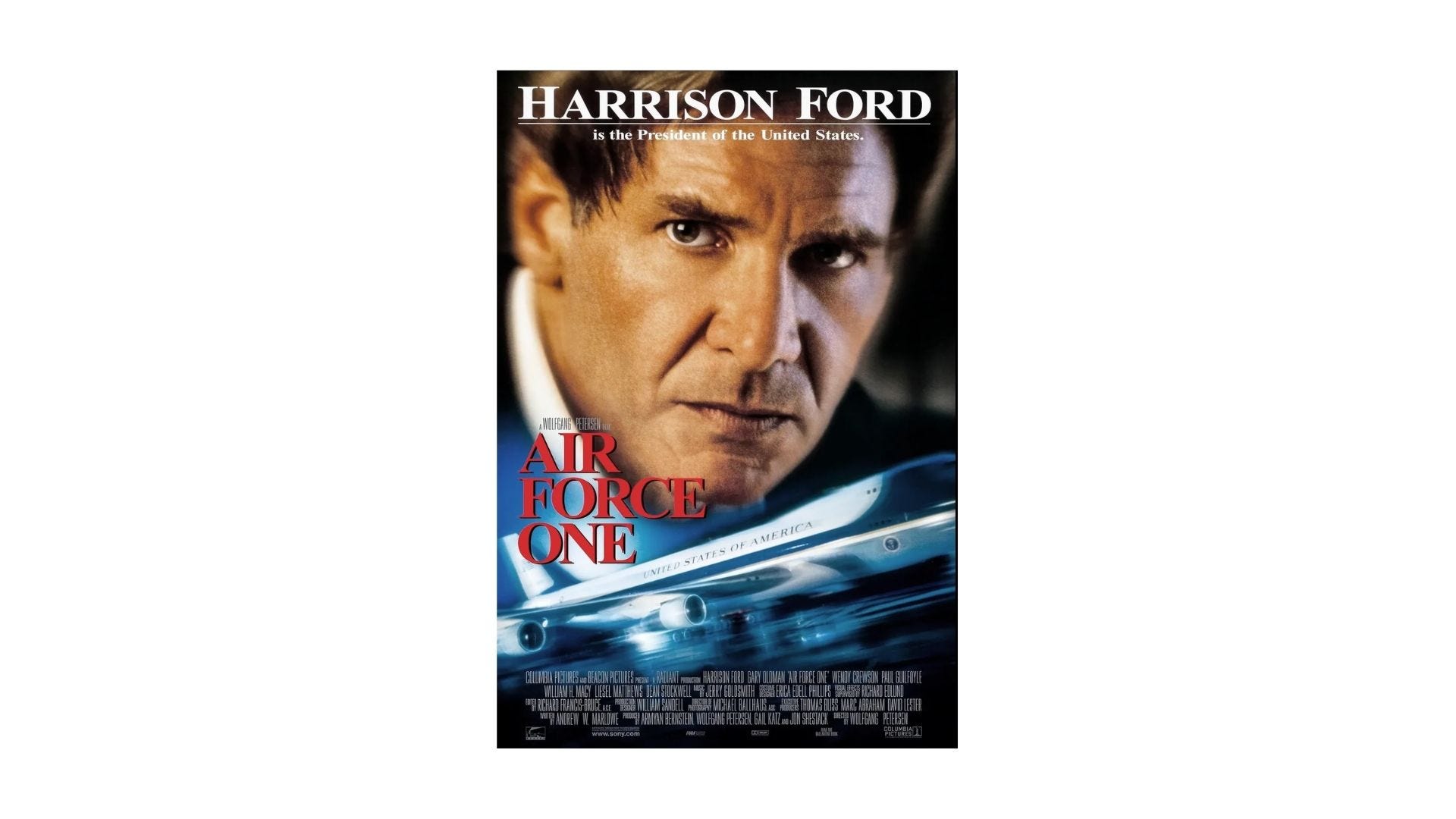
The image of the leader of the USA potentially sacrificing Americans while he escaped with the catering is the opposite of the vibe Harrison Ford presented as President James Marshall in the 1997 film Air Force One.
Co-starring Gary Oldman as the ex-Soviet villain Egor Korshunov and directed by German filmmaker Wolfgang Petersen, the summer blockbuster thriller made Han Solo/Indiana Jones president. In the film, the president’s plane is hijacked in a stunning act of betrayal, but the president escapes through a secure parachute capsule. The First Lady and First Daughter are taken hostage.
Except this was 1997, America and Hollywood were still high off the victory in the Cold War and the First Gulf War. Ford’s President Marshall was a Vietnam war hero; no way he would leave his family and his staff behind while he ran to safety. This was a film president for the America of red, white, and blue hope and fury.
Over the next 100 minutes, the president of the United States, like a medieval warrior-king with a Midwest accent, risked himself for kin and country. To a Jerry Goldsmith score, Ford smashed the foe like they were wayward Star Wars storm troopers, while evading detection with spec op precision.
Audiences loved it!
Will America ever see such films like that again? Would they be acceptable or believable today? Back in 1997, it was the highest opening weekend ever for a Harrison Ford film up to that point. It was the fourth-highest grossing film of the calendar year, bringing in over $300 million in worldwide ticket sales.
Nearly twenty years later, a Wall Street Journal article ranked Harrison Ford’s portrayal of James Marshall as the best fictional president in history, ranking higher than The West Wing icon President Josiah “Jed” Bartlet, played by Martin Sheen.
It was a moment in history when the president was still believable as a hero, and that image was projected globally by Hollywood, which fed into the image of America as the noble superpower. That’s a soft power America took for granted.