

I'm Thankful for US History
On My Love of Teaching, and Black American Patriotism


Did you know America put a man on the Moon in 1969? It wasn’t even a country 200 years before that. And its continuous history didn’t start until less than 400 years before they walked on the Moon.
Every year, beginning in August and ending in May, I get to teach the history of my country. It’s a whirlwind. Thankfully, and I mean this, I am grateful the U.S. has a starting point: 1607. Not 1492, that’s the Spanish, and we are English. Not the 1580s with Ronoake Island; no, that didn’t work out. 1607 to 2024 is a straight line, and it is thrilling. In that period, I cover three dynastic changes, a military dictatorship, a social revolution and a political counterrevolution, industrialization, the conquest of a continent, a crusade against slavery, the rise of the labor movement, neo-imperialism, at least three religious revivals and transformations, the invention of telecommunications, the creation of modern sport, the discovery of germs and the development of modern hygiene, the evolution of the arts from neoclassicism to jazz and rock ‘n roll, the World Wars, the challenge of feminism and Darwinism, computerization, digitization and yes going to the Moon.
I love teaching Western Civilization, and I am passionate about the history of England, but those are long, long histories, and it's very hard to cover them sufficiently in two semesters. I really need two years for each. But American history’s 418 years is the Goldilocks of a year-long course. It’s just right. I sometimes daydream about what American historians will elide and gloss over in 2424. Yes, I fully expect there to be an English-speaking nation from sea-to-shining sea on this continent in 400 years, and they will call themselves Americans with a flag that has 13 alternating red and white stripes. How will they teach the history of our time?
Whew, that will be a doozy. But I am thankful for my own little slice of history, onward to our 250th national celebration in 2026!
On Black American Patriotism
There has been some chatter about this lately, but as a historian, let me tell you that Black American Patriotism is normal, ordinary, and remarkable only in light of the fact our history of oppression in this land makes others think we would be justified in not loving the country. But that’s the projection of other groups onto Black Americans because many still have some identification with a pre-America heritage that is different from Black American history. Black Americans as a group were formed in the United States because our ancestors were from various kingdoms and nations in Africa. Much of the specificity of knowledge about those identities was lost; what remained was familial and depoliticized with no attachment to a foreign state. African Americans are a haphazardly hyphenated group; in fact, the hyphen was imposed. In terms of national identity, Black Americans are the most singularly American - closest to the Old WASPs - in that we cannot effortlessly identify with another country. I write effortlessly because, of course, people can choose to identify with another country or research to try and find some ancestral connection to a specific people or nation that can be identified on a 21st-century map. But that would take effort, it is not so simple as saying “in the old country.” What country? Africa is a continent, not a country.
The Brown University economist Glenn Loury writes in Free Black Thought that:
My issue is not with Dr. Loury but with the perception among those who do not know Black history or the community well that the vast majority of African Americans have not settled their identity a long time ago. Like former heavyweight champion George Foreman, most African Americans have been unapologetic in claiming that America is their country and they are not going anywhere. Those who imply the opposite get undo attention.
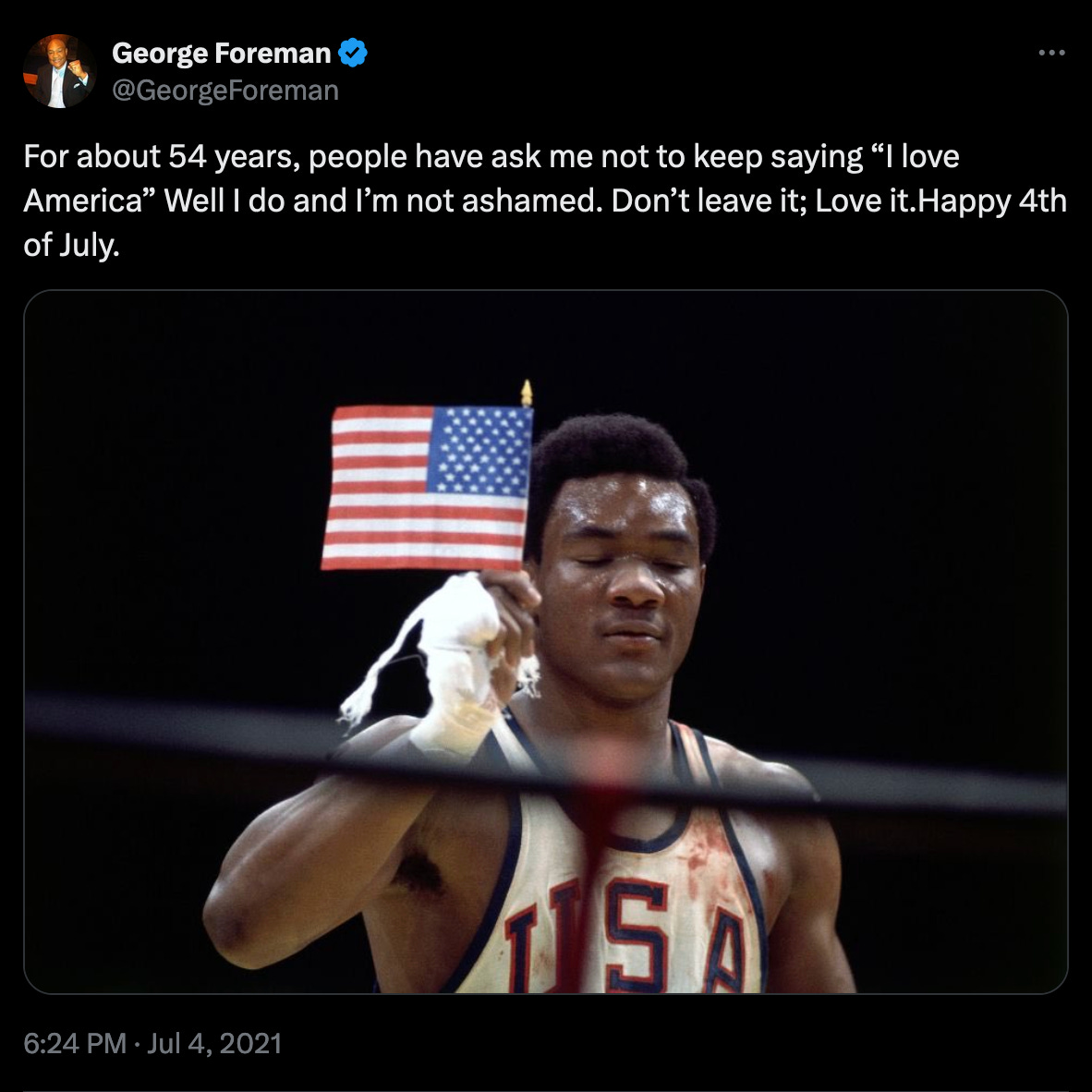
Unfortunately, some public intellectuals present a narrative to the wider public, and especially to white Americans, that African American identification with the country remains an open question. This is misleading and gives too much attention to celebrity intellectuals who are selling a narrative rather than informing on truth and history. But it is also wrong that the choices are “America is either evil or is the best thing ever.” For one thing, the greatest contributor to the African intellectual tradition is African American Christianity, which is historically and traditionally orthodox Protestantism, and accordingly, throughout most of our history, the larger part of African Americans have believed that the greatest force for human liberty on the planet is the Gospel of Jesus Christ. I recommend Esau McCaulley’s Reading While Black for those interested in the contours of that tradition. As Federick Douglass wrote in the appendix of his Autobiography
I FIND, since reading over the foregoing Narrative that I have, in several instances, spoken in such a tone and manner, respecting religion, as may possibly lead those unacquainted with my religious views to suppose me an opponent of all religion. To remove the liability of such misapprehension, I deem it proper to append the following brief explanation. What I have said respecting and against religion, I mean strictly to apply to the slaveholding religion of this land, and with no possible reference to Christianity proper; for, between the Christianity of this land, and the Christianity of Christ, I recognize the widest, possible difference--so wide, that to receive the one as good, pure, and holy, is of necessity to reject the other as bad, corrupt, and wicked. To be the friend of the one, is of necessity to be the enemy of the other. I love the pure, peaceable, and impartial Christianity of Christ: I therefore hate the corrupt, slaveholding, women-whipping, cradle-plundering, partial and hypocritical Christianity of this land. Indeed, I can see no reason, but the most deceitful one, for calling the religion of this land Christianity. I look upon it as the climax of all misnomers, the boldest of all frauds, and the grossest of all libels. Never was there a clearer case of "stealing the livery of the court of heaven to serve the devil in."
This argument over the meaning of Christianity and liberty is an inseparable part of the heritage of Black American identity, and to the extent you see confusion on Black identity, it can be found among those most separate from Black tradition. This debate did not begin in 2016, nor 2008, not 1960; it is old and deep. Many of the leftwing intellectuals have alienated themselves from their communities and country and project that onto others, just as other ethnic groups have projected their anxiety and desire for revenge for historical wrongs onto African Americans. The Orthodox Christian and American expatriate writer Rod Dreher understood this when he wrote, asking and almost warning of what might happen to America if it loses the example of Black American Christians?
We, Americans, make a mistake when we concede too many normal and settled things as endlessly litigable. It is a tactic of the unsettled and disturbed left. Influenced by thinkers like the Italian Marxist philosopher and politician Antonio Francesco Gramsci and his concept of cultural hegemony, left-wing critical theory argues that traditionally dominant beliefs serve to sustain systems of power and oppression. Rather than dealing first with whether or not a belief or tradition is dominant because it is good and beneficent and people have agreed with it, they assume that dominant thought, when it is not their thought, must be evil and oppressive. So, they are stuck in an immature, persistent state of transgressiveness. So often aimless and headless of what they ruin, they break taboos and pick apart traditions to destabilize what appears normal.
If there is a backlash against them, it is not a “racial backlash,” but it is because reliance on constantly challenging settled norms creates unwanted tension and an atmosphere of disquiet that makes coalitions and governing hard because they undermine any conclusion or settlement of problems, ultimately becoming a self-referential nihilistic mess. They will not consent to solutions to actual problems and proceed to invent new issues for which they offer new critiques, which, if accepted, will not lead to resolution because they will continue the process again. Most people will reject that if given the space to do so. Why do we give them the time of day? Claiming that the pushback against their agitation is a “racial backlash” is playing into the hands of actual white racists who want to link civil rights to the craziness coming from radicals when the two are quite distinct and largely unrelated.
My nationalism is Hamiltonian and Washingtonian in its natural affinity. As Alexander Hamilton said to the New York ratifying Convention on the U.S. Constitution:
There are certain social principles in human nature from which we may draw the most solid conclusions with respect to the conduct of individuals and of communities. We love our families more than our neighbors; we love our neighbors more than our countrymen in general. The human affections, like the solar heat, lose their intensity as they depart from the center and become languid in proportion to the expansion of the circle on which they act. On these principles, the attachment of the individual will be first and for ever secured by the State governments; they will be a mutual protection and support. Another source of influence, which has already been pointed out, is the various official connections in the States.
I love my country because it is my home, I am skeptical of a patriotism that only loves its country when you are convinced it is the best thing ever, because humanity’s capacity for success and greatness is not limited to the USA. Others may do better than us in some things and worse in others. I am not holding out for a better deal in case America goes south. To do so would be to think like a colonizer and not like a citizen at home. Likewise, as General George Washington argued in his Farewell Address:
Citizens, by birth or choice, of a common country, that country has a right to concentrate your affections. The name of American, which belongs to you in your national capacity, must always exalt the just pride of patriotism more than any appellation derived from local discriminations. With slight shades of difference, you have the same religion, manners, habits, and political principles. You have in a common cause fought and triumphed together; the independence and liberty you possess are the work of joint counsels, and joint efforts of common dangers, sufferings, and successes.
The more recent 20th-century exceptionalist ideological patriotism is more of a European-influenced imposition than the traditional American nationalism that was, in fact, based on home, hearth, soil, and family. And I think we are witnessing a return to normal and natural nationalism that is animating much of the multiethnic coalition that elected Donald Trump. Many of these voters do not think the wealth and success of their country mean they have to or should share it with the world, a world that is responsible for the problems they find themselves in. Only if you confuse the USA with the Gospel do you think that America must be shared with the globe.
Americans, especially working-class Americans, do not think it is their responsibility to fix the Middle East or Eastern Europe, and they are fed up with elites who believe that the working class should not expect a more generous social safety net or policies to address deindustrialization, but who also think American security - defense welfare - should be given to countries ranging from Saudi Arabia to Ukraine. Plenty of middle-class Americans are in agreement. It is a nationalism that rejects Woodrow Wilson and George W. Bush. American exceptionalism traditionally meant that the U.S. was exceptional because it did not act like the Europeans who sold out their real interests in peace, order, and good government for the ideological dreams of empire or 1789-style revolution. The idea that American exceptionalism means the U.S. must lead the globe is, in fact, unexceptional and a delusion of several empires throughout history.
Furthermore, back to the racial issue, African Americans already have equal status to whites. The Civil Rights Movement was a total victory for civil and political equality. Why are folks walking around like we lost?
But, the Civil Rights victory freed you to have a class problem. It did not and could not undo the economic consequences of racial oppression, which denied education, stifled creativity, destroyed capital, and reallocated resources from the taxed but unrepresented population during Jim Crow. Frankly, it would be strange if, after only three generations of that system being overturned, and with the defeated whites still in power in much of the country for another two generations - and who resented losing that struggle to the other whites, the ones who passed the Civil Rights laws - that African Americans would have reached total economic parity with whites.
Civil Rights freed African Americans from a racial second-class citizen problem, but not a poor American and disproportionately lower class problem, and the class problem cannot be separated from the general difficulties of the American economy since the 1960s. There is no special black-versus-white inflation, tax rates, energy costs, deindustrialization, problems from mass migration, or threats of automation. All Americans face those problems, and some face them from greater or lesser positions of disadvantage. That’s normal because not since Moses led the Israelites on the Exodus has there been a point in history where you can pause life, make everyone equal, and then restart the game. It does not work like that.
This goes for the Left, too. They can’t have it both ways; either slavery and Jim Crow were really, really bad, and it is a natural consequence of 340 years of oppression that many African Americans remain economically disadvantaged after only being delivered for the last three generations, or it was not so bad, and therefore, the continuation of the racial wealth gap is suspicious. Which is it?
Hint: it was really bad.
Black American nationalism is patriotism because the syncing story of Black American history with the rest of American history is the War for the Union from 1861-65, which destroyed slavery and preserved the nation. We cannot, should not, and will not separate ourselves from the American nationalism our ancestors earned on the battlefield and suffering on the plantation. Without apology, we scorn those who want to take our inheritance.
I am thankful for my country and my American family and friends of all ethnicities.
And for our shared American history: you cannot top it. 🇺🇸🚀