

Hoover's Autumn of 1930
The Kings Mountain

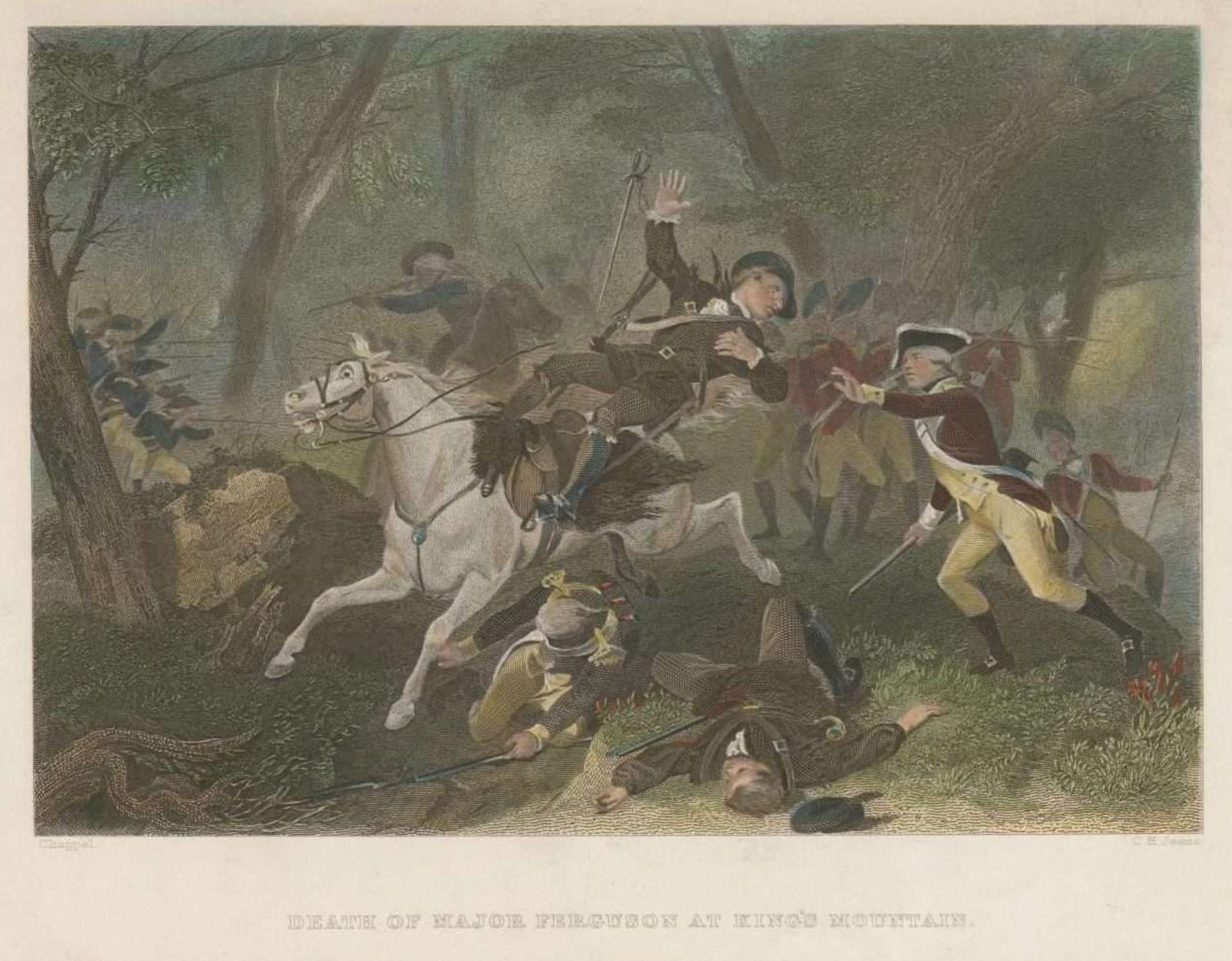
As the United States approached the first anniversary of the 1929 Stock Market Crash, the president was commemorating other events of a more celebratory kind.
On October 7th 1930 an estimated crowd of 30,000 assembled at the battlefield site in Kings Mountain, South Carolina to hear President Herbert Hoover recount the battle.
He spoke of the Founding generation of Patriots:
My fellow countrymen:
This is a place of inspiring memories. Here less than a thousand men, inspired by the urge of freedom, defeated a superior force entrenched in this strategic position. This small band of patriots turned back a dangerous invasion well designed to separate and dismember the united Colonies. It was a little army and a little battle, but it was of mighty portent. History has done scant justice to its significance, which rightly should place it beside Lexington and Bunker Hill, Trenton and Yorktown, as one of the crucial engagements in our long struggle for independence.
The Battle of Kings Mountain stands out in our national memory not only because of the valor of the men of the Carolinas, Georgia, Tennessee, Kentucky, and Virginia, who trod here 150 years ago, and because of the brilliant leadership of Colonel Campbell, but also because the devotion of those men revived the courage of the despondent Colonies and set a nation upon the road of final triumph in American independence.
No American can review the vast pageant of human progress so mightily contributed to by these men without renewed faith in humanity, new courage, and strengthened resolution…
Hoover used the Battle of Kings Mountain as a moral reference point, arguing that a “little army” and a “little battle” carried outsized national consequence by reviving Patriot courage and helping secure independence. From that example he pivoted to define what he called the American system: self-government under law, constitutional checks and balances, and an “equality of opportunity” rooted in religious faith and sustained by universal education.
Our political system was a revolt from dictatorship, whether by individuals or classes. It was rounded upon the conception that freedom was inalienable, and that liberty and freedom should rest upon law, and that law should spring from the expressed wisdom of the representatives of the majority of the people themselves. This self-government was not in itself a new human ideal, but the Constitution which provided its framework, with the checks and balances which gave it stability, was of marvelous genius…
He contrasted this system with socialism, Bolshevism, anarchy, despotism, and class rule, claiming those philosophies either erased initiative or denied liberty. He warned that America’s gravest dangers were internal—crime, corruption, ballot manipulation, apathy, bureaucratic overreach, and both militarism and pacifism as extremes—and insisted these could be contained if citizens held fast to first principles.
From experiences in many lands I have sometimes compared some of these systems to a race. In the American system, through free and universal education, we train the runners, we strive to give to them an equal start, our Government is the umpire of its fairness. The winner is he who shows the most conscientious training, the greatest ability, the strongest character. Socialism or its violent brother, Bolshevism, would compel all the runners to end the race equally; it would hold the swiftest to the speed of the most backward. Anarchy would provide neither training nor umpire. Despotism or class government picks those who run and also those who win…
He also warned Americans against being overconfident and to beware foreign influence which seek to undermine their liberty and impose alien ideas of control.
It would be foolish for me to stand here and say that our political and social system works perfectly. It does not. The human race is not perfect yet. There are disheartening occurrences every hour of the day. There are always malevolent or selfish forces at work which, unchecked, would destroy the very basis of our American life. These forces of destruction vary from generation to generation; and if we would hand on our great inheritance to our children, we must successfully contend with them.
While we cannot permit any foreign person or agency to undermine our institutions, yet we must look to our own conduct that we do not, by our own failure to uphold and safeguard the true spirit of America, weaken our own institutions and destroy the very forces which upbuild our national greatness. It is in our own house that our real dangers lie, and it is there that we have need to summon our highest wisdom and our highest sense of public service…
He went on to further encourage the American people to oppose vice and corruption but in public and in the original source of government and education, the family home.
We must keep corruptive influences from the Nation and its ideals as we would keep them from our homes. Crime and disobedience of law are the very incarnation of destruction to a system whose basis is law. Both pacifism and militarism court danger from abroad, the one by promoting weakness, the other by promoting arrogance. Failure of many of our citizens to express their opinions at the ballot box is at once their abandonment of the whole basis of self-government…
The Depression had begun but not yet deepened. Hoover extolled the superiority of America over Europe. Europe was always the great competitor of the US and it was normal for Americans to be wary of ideologies imported from the old continent.
Compared with even the most advanced other country in Europe, we shall find an incomparably greater diffusion of material well-being. We have twice the number of homes owned among every thousand people that they have; we consume four times as much electricity and we have seven times as many automobiles; for each thousand people we have more than four times as many telephones and radio sets; our use of food and clothing is far greater; we have proportionately only one-twentieth as many people in the poorhouse or upon public charity…
Finally he closed by saying the Americans had the ability to grow and repair their economy and lift themselves out of their present struggles.
Our problems are the problems of growth. They are not the problems of decay. They are less difficult than those which confronted generations before us. The forces of righteousness and wisdom work as powerfully in our generation as in theirs. The flame of freedom burns as brightly in every American heart. There need be no fear for the future of a Republic that seeks inspiration from the spirit of the men who fought at the Battle of Kings Mountain.
Hoover strikes me as a man like Jimmy Carter, fundamentally decent, and fundamentally cursed with historic circumstances which denied them the opportunity to use their unique talents and gifts for the public good. Not all leaders are suited to all times. Some men who would make great chiefs of state in ordinary times are dooms to fail when times are hard and men are less patient with calm reserve.
Back in August, Hoover had sent the German President a letter marking the ten-year anniversary of the Wiemar Constitution.
August 12, 1930
[Released August 12, 1930. Dated August 11, 1930]
ON THIS anniversary which the people of Germany are celebrating today, I take pleasure in tendering to Your Excellency cordial greetings. I also offer personally the assurances of my own high regard.
HERBERT HOOVER
[His Excellency President von Hindenburg, Berlin, Germany]
Hoover could not know that a month later the Nazis would come in second place in the German parliamentary elections and permanently upend the Wiemar Republic. A month after that in October, he remarked on the anniversary of Black Thursday October 24:
“No special session is necessary to deal with employment. The sense of voluntary organization and community service in the American people has not vanished. The spirit of voluntary service has been strong enough to cope with the problem for the past year, and it will, I am confident, continue in full measure of the need.
“Colonel [Arthur] Woods is receiving most gratifying evidence of this from the Governors, mayors, industrial leaders, and welfare organizations throughout the country.”
Hoover’s voluntary response to the crisis was his “Associative State” an idea that was not a formal policy but rather an approach to governance and economic management. It relied on voluntary cooperation between government and industry, with Washington convening, sharing data, and encouraging common standards and self-regulation instead of passing new laws. The goals were stability and steady growth through less waste, higher productivity, and stronger competitiveness. It included support for public works to spur jobs and improve roads and public buildings, and it backed joint research to speed innovation. In short, it sought a middle ground between laissez-faire and state control by using the strengths of both sectors for broad prosperity. However, Associative State also supported public works projects as a means of stimulating economic activity and providing employment. This included initiatives to improve infrastructure, such as roads and public buildings, which would benefit both the economy and society. And yet, the approach worked best in good times but had limits, since cooperation could drift into cartels when competitors became too cozy and began fixing prices, rigging bids, limiting output, or dividing markets—so they can raise profits. The Great Depression exposed those limits and pushed the government toward direct relief and regulation. Again conditions were not ripe for Hoover. To use the Jefferey Kerr-Ritchie paraphrase of Marx, “men make history but not under conditions of their own choosing.” The conditions were unfavorable to Hoover and Carter whatever else one may think of their ideas.
