

History in about a Minute: Western Civilization & Continents
A Very Short Intro to Concepts in History


If you like this short history and would like to show your support, a cup of coffee is always appreciated.
In academic discourse, particularly in historical studies, or what the Germans call Geschichtswissenschaft, historical science, the term "problem" differs from its everyday understanding. It reflects the nuanced and critical nature of scholarly work, where problems are viewed as opportunities for understanding, debate, and the advancement of knowledge; it can serve as a tool for intellectual inquiry. Rather than being a purely practical or solution-oriented term, it focuses on exploration, analysis, and theoretical challenges. So, get the jargon part out of the way. This is how academics typically discuss a problem.
In common use, you know a problem is something that needs to be solved or fixed, often related to immediate concerns in life. The focus is on finding a solution or overcoming the problem. So, without knowing that, you might hear the professor talk about the “problem of Western Civilization” and think that someone was anti-Western Civilization or hated European culture. Or North American culture. Or South American culture. Etc.
You see, the West has had a big impact. But what is the West? That’s the problem. You have a situation where you claim a Civilization exists, but it is named according to a direction on the map. That is not helpfully descriptive when the world is round. So you have to interrogate it and set parameters for what we are talking about, and that becomes the fun part of studying.
To recap, in academic circles, the term "problem" typically refers to a specific question or area of study that warrants investigation. It does not carry a negative connotation, but rather indicates a topic worthy of scholarly attention. For historians, such as myself, this may refer to a previously under-explored aspect of history, an unresolved debate about the interpretation of history, or gaps in the historical record. Historians often use "problem" to describe a theoretical issue that complicates understanding. In historical studies, framing a subject as a "problem" often establishes a specific lens through which to analyze it. To deal with the West, I first have to deal with Europe, and what and where that is supposed to be. First, how many continents are there?
The Problem of Continents
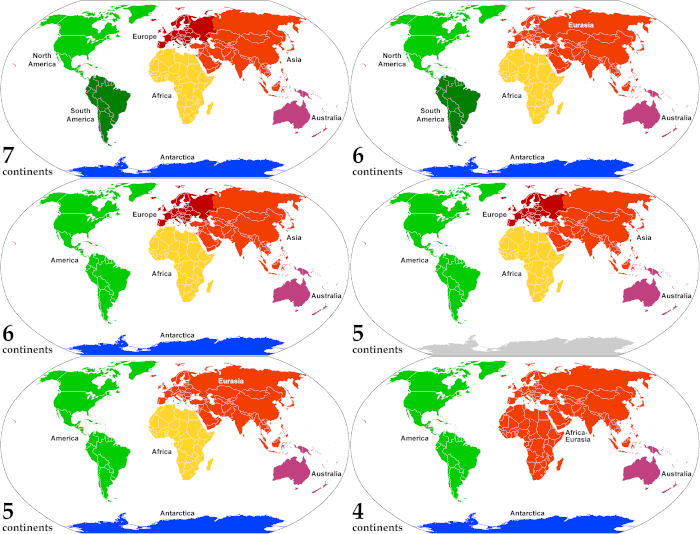
Graphic Source: Wikipedia. 2023. "Continent." Wikimedia Foundation. Last modified November 25, 2023. https://en.wikipedia.org/wiki/Continent.
7-Continent Model: The Anglophone Way.
6-A-Continent Model: Common among European and Asia countries, where Europe and Asia are considered a single continent (Eurasia).
6-B- The United Nations Geoscheme Statistical Model: Australia is part of Oceania, Europe and Asia are separate, and the Americas are combined.
5-Continent Model (Olympic Rings): Less commonly used as a geographic model, but known for its representation in the Olympic Rings. No Antarctica because it lacks a native permanent population.
4-Continent Model: This is the least common model and is rarely used in standard geographical education.
Above, you can see there are five main ways to divide the world into continents. In the US, we treated North and South America as just “America” or “the Americas” until the 20th century. Now, the practice is to treat them as two separate continents. To teach Western Civilization and World History, I use the four-continent model, a rare approach. I do that because I focus on the consequences of contact between people across long periods of time, including migration, war, trade, and disease, and the seven-continent model does not accurately capture how that worked out historically. Okay, well, I said “First, how many continents are there?” when I meant to say “First, what is a continent?”
The word "continent" is derived from the Latin word "continere," which means "to hold together." This word is formed by combining "con-" (together) and "tenere" (to hold). In its original sense, the word conveyed a sense of connectedness or cohesion. The Latin root also gave rise to the adjective "continens" or "continentem," which means "connected" or "uninterrupted." When "continent" first appeared in English in the 16th century, it was used to refer to a continuous expanse or a connected body of land in general. The earliest usage was more about physical continuity than specifically delineating large landmasses, as we culturally understand them today.
Okay, that is about a minute, more or less. More next time.