

Great War Guilt in 2025
War is not a sport. It is a Trial of Death.


Welcome to my World War Wednesday series “Hellfighters” where each week I alternate between reexamining the history of the First and Second World Wars. Part one is available to all subscribers. As a thank you to paid subscribers who make my work Outside the Academy possible, more in-depth analysis is behind the paywall in part two.
It is August, which means it is time to write about the Atomic Bombings or the start of the Great War. I’ll do the latter because I am writing a remembrance on the Second World War for Providence Magazine.
Too often the question of whether this or that country should have gone to war in 1914 evades the moral question at the heart of war: is this worth killing someone over?
War is killing, in fact it is the deliberately planned and premeditated mass killing of other human beings. In war, you plan to kill the other humans as effectively as possible and to prevent them from killing you and the humans on your side. We need to be blunt when we talk about war. War is death and pain. I believe we get our societies into all sorts of moral trouble when we try to sanitize that which should not be sanitized: killing. Killing should always be sober and grave. When you go to war you are saying “We are now going to kill these people until they do the thing that we want them to do.” Killing is a tool of policy change and enforcement. Period.
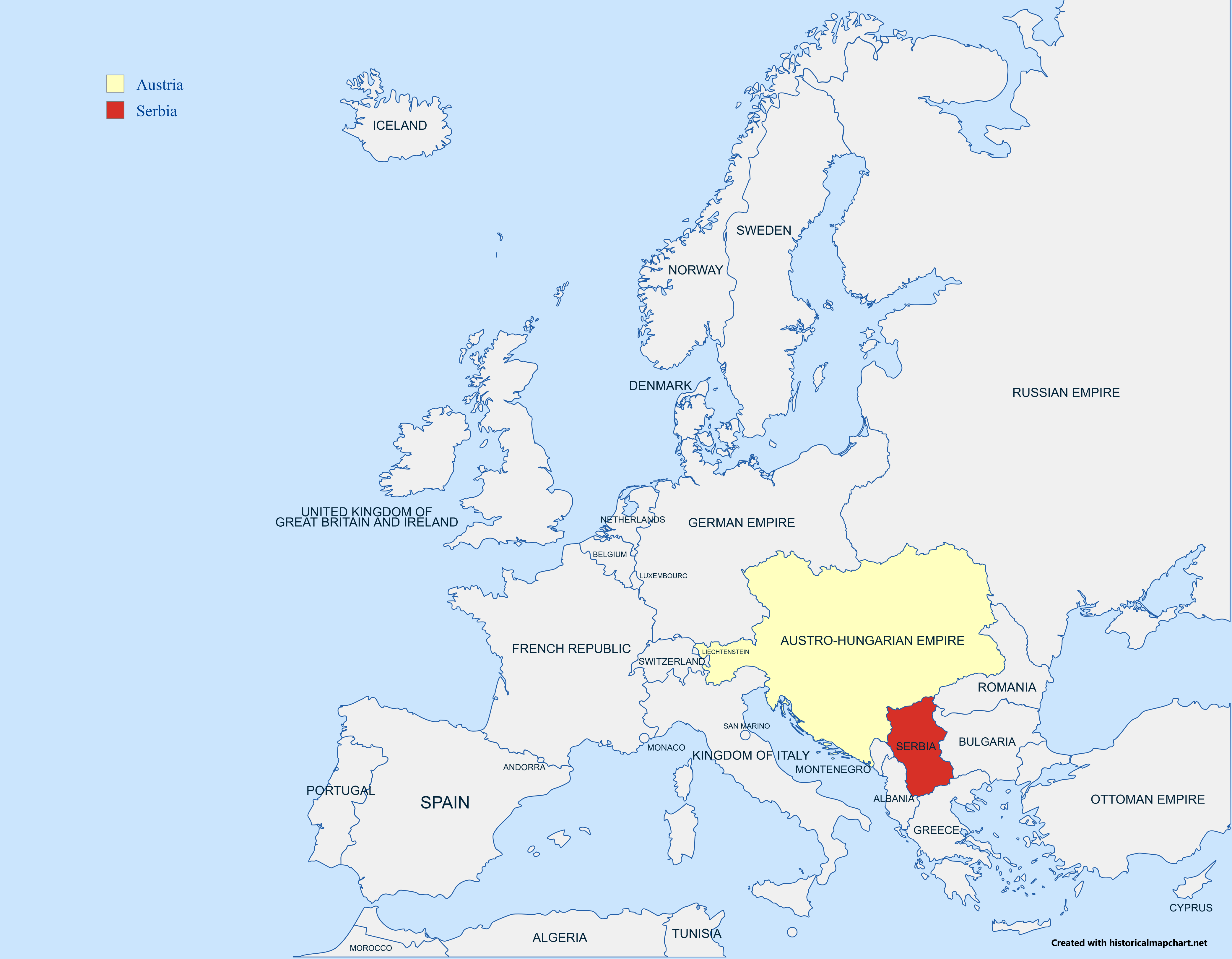
For over a century, historians have debated the question of responsibility for the outbreak of the First World War, with scholarly consensus generally placing primary blame on Germany and, to a lesser extent, Austria-Hungary. This interpretation, rooted in post-war political considerations of the victorious French and British Empires, and reinforced by the memory of German atrocities committed during the Second World War, has become so entrenched that it often goes unexamined. However, a careful analysis of the chronology of events and the agency of all actors involved reveals significant problems with this traditional narrative. I do not believe we can have a discussion of the bearing of responsibility for the war without asking what that implies. Does bearing responsibility mean “Who ended the peace by declaring war?” Or, does it mean - and what I believe is the critical question - “Who initiated the conflict by committing and encouraging the acts of aggression that led to the existence of conflict?” I believe the latter question is the relevant one, otherwise may one commit war and avoid culpability by simply not declaring it first or at all? Or, one may provoke another into a response but not be blamed for creating a grievance where none previously existed. It is a strange case that I cannot recall seeing references to just war theory in the writings on the start of the war during the centennial in 2014. I find this to be odd. In the Western tradition there are conditions for a just war.
The typical conditions of Jus ad Bellum (Right to Go to War):
Just Cause: War must address a serious wrong - typically aggression, or threats to survival. Self-defense against attack is the clearest example.
Legitimate Authority: War must be declared by proper governmental authority, not private groups or individuals as that is simply conspiracy to murder or vendetta.
Right Intention: The purpose must be to address the just cause.
Proportionality: The expected benefits of winning the war must outweigh the anticipated harms and costs of war. Will fighting and winning result in a better situation than not fighting at all?
Last Resort: Peaceful alternatives must have been exhausted or proven clearly futile.
Reasonable Chance of Success: This is one is clear: Do you have a reasonable chance of winning and achieving the goals of the war?
Those are the basics.
Starting with just war theory, I see that a strange asymmetry of violence and morality emerges in much of the thinking about the war. The starting point for any serious analysis must be the assassination itself. On June 28, 1914, Gavrilo Princip, a Bosnian Serb connected to the Black Hand organization run by Serbia military officials, especially Colonel Dragutin Dimitrijević, assassinated Archduke Franz Ferdinand von Habsburg, heir to the Austro-Hungarian throne, and his wife. This was not a random act of political violence, but part of a plot to weaken and destabilize the Habsburgs.
Serbian-backed terrorists assassinated the Austrian heir to the throne. No Austrian-backed terrorists assassinated the Serbian monarch or heir. The violence was unidirectional, emanating from Serbia toward Austria-Hungary. Any serious discussion of responsibility must begin with this basic fact. Austria-Hungary's response by demanding that Serbia crack down on anti-Austrian terrorist networks and allow limited Austrian participation in investigating the assassination, was a legitimate response to an act of state-encouraged terrorism. The July 23 ultimatum, while stern, was not unprecedented in diplomatic history and addressed genuine security concerns arising from hostile activity originating in Serbian territory.
The ultimatum was as follows:
1. Suppress any publication inciting hatred or contempt of the Monarchy and any works promoting actions against its territorial integrity.
2. Dissolve the "Narodna Odbrana" society and confiscate its propaganda tools, similarly addressing other organizations in Serbia involved in anti-monarchy activities, ensuring these groups cannot reconstitute themselves under a different name or form.
3. Remove from Serbian public education any content—whether in teaching staff or instructional materials—liable to incite propaganda against Austria-Hungary.
4. Dismiss from military and civil service all officers and officials guilty of anti-monarchy propaganda, with the names and offenses to be communicated by the Imperial and Royal Governments.
5. Permit Austro-Hungarian representatives to collaborate in Serbia in the suppression of the subversive movement targeting the Monarchy’s territorial integrity.
6. Initiate judicial proceedings against those implicated in the June 28 conspiracy within Serbian territory, with Austro-Hungarian delegates participating in the investigations.
7. Immediately arrest Commandant Vojislav Tankosić and Milan Ciganović, a Serbian state employee implicated by the Sarajevo investigation.
8. Prevent Serbian authorities from aiding the illegal trafficking of arms and explosives across the border and dismiss and severely punish officials at the Šabac and Loznica border posts who assisted the assassins of Sarajevo.
9. Provide explanations regarding hostile remarks made by Serbian officials, both domestically and abroad, who, despite their official status, expressed hostility toward the [Austrian-Hungarian] Monarchy in interviews following the June 28 attack.
10. Notify the Imperial and Royal Government [Austria-Hungary] without delay of the execution of these measures.
The Imperial and Royal Governments expect the Serbian Government’s response by Saturday, July 25, at 5:00 p.m.
Most sources indicate that Serbia only rejected point 6 on the grounds that this would violate sovereignty but this seems disingenuous for how could you implement point 5 if sovereignty and interference in domestic matters would violate Serbian law and its constitution? The same objections would have to apply to point 5, which would leave Serbia the ability to cite them later to void the implementation of point 5.
Now, it is reasonable to argue that points and 5 and 6, asking to participate in the enforcement of anti-Habsburg suppression measures, and the investigation, were both steps too far for Serbia, and also legitimate demands as Austria-Hungary did not trust Serbia to act in good faith if left to do so without external witnesses. In which case we have a conflict, but one provoked by the Serbian government. In such a situation the proper response of the culpable party, Serbia, should have been to comply.
My argument and reasoning are focused on two connected questions: who is responsible for Austria wanting to confront Serbia and why did that confrontation not remain one-on-one.
J'Accuse Serbia for the first, but the second requires further analysis of the other parties. But, by declaring Serbian responsibility I am rejecting the traditional consensus of blaming Germany for a moral problem Germany did not cause or provoke. Was it right for the other powers to choose to kill Austrians to protect Serbia? That is what the choice to go to war is about.
