

GLADIIATOR: Maximus the Lesser
Ridley Scott's Sequel Slashes But Not Deeply


When they first announced a sequel to Gladiator, a friend of mine based in L.A. texted me in amusement. “What are they going to do?” he asked. “They restored the Republic at the end of the first movie!” Indeed. I wondered where Ridley Scott was going with the film after the first Gladiator was such a hit and an almost perfectly executed anachronistic film that relaunched the sword and sandal genre. When I really anticipate a film, I have a ritual where I avoid all trailers for it; I mean, even in the theater, I close my eyes if it is a preview for a movie I already want to see. I do not want to prejudge a film, and I have felt for years that Hollywood has too much of a “pick me” attitude in trailers: they just give too much away. So I went in not knowing much of the plot except it was a sequel and not a prequel.
That answered my first question because I had wondered if, to get around the ending of the first film, Ridley Scott would do a prequel set earlier in Rome’s history. My other question was how long after the first Gladiator would Gladiator 2, sorry, GLADIIATOR, as it is stylized, would be set. So, let’s get my historian’s/film lover’s review.
Scott continues his collaboration with screenwriter David Scarpa, who also wrote the screenplay for 2023’s Napoleon. The pair are on terra firma with Rome; the sands of the Coliseum suit Scott’s storytelling method better than the fields of Austerlitz. I’ll do my best to avoid spoilers.
Like the original, the film is about a warrior who loses loved ones because of the capriciousness of Rome’s rulers and makes his way to Rome as a gladiator slave with hopes of revenge. So far same movie. But then the film takes a turn; Derek Jacobi and Connie Nielsen reprise their roles as and as before, they are eager for Marcus Aurelius ’ dream of a restored virtuous Rome. But things go awry due to the only reason to see this film: Denzel Washington.
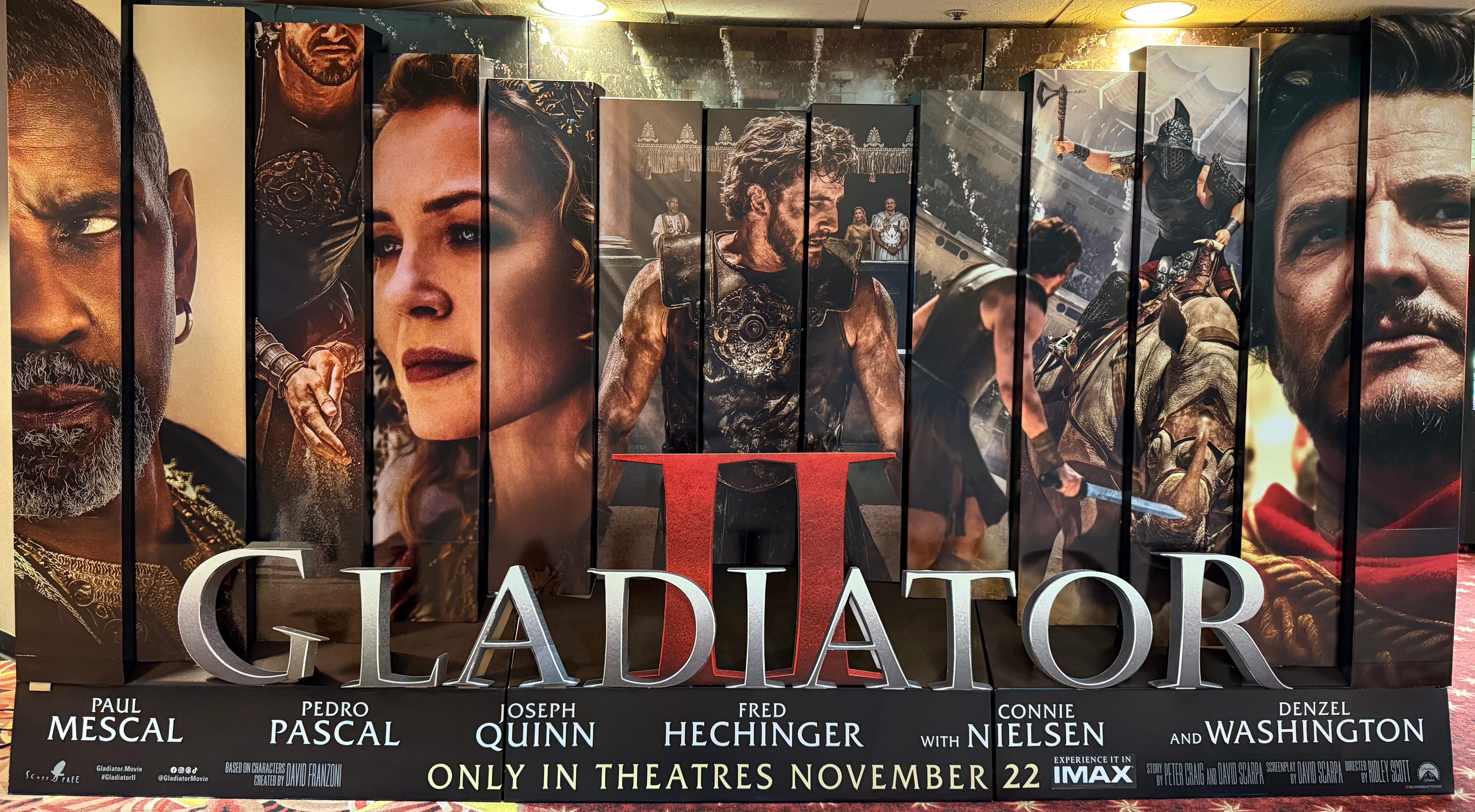
The film stars Paul Mescal, Pedro Pascal, Joseph Quinn, Fred Hechinger, Lior Raz, Derek Jacobi, Connie Nielsen, and Denzel Washington. With the exception of the last three, I will not describe the characters to avoid spoilers. Derek Jacobi and Connie Nielsen were in the first Gladiator; you remember them as Senator Gracchus and the princess, Lucilla, the daughter of Marcus Aurelius and sister of the wicked Commodus, played by Joaquin Phoenix. They play their roles well, but the setup requires too much forgetting of the first film. When the movie starts, the Roman Empire is on an expansionist run under new imperial leadership that is once again capricious. But the movie does not explain how this happened after Maximus killed Commodus, and this is a problem for film and historical reasons if you accept the story taking place in Rome following the norms and rules of Rome but with alternative paths taken.
Russell Crowe’s character Maximus won the day only to die at the end, but before he collapses in the arena, he orders his friend and the commander of the Praetorian Guard, Quintus, played by Tomas Arana, to free the other gladiators and restore Senator Gracchus. Likewise, the army loyal to Maximus was nearby and was close enough to march on Rome. In the end, only Grachus is restored; the movie folds back into the actual timeline as if Maximus was not important. How the restoration of Senator Gracchus happened, but everything was thrown out is not explained, and you would think the new rulers would have eliminated Senator Gracchus since he was acknowledged leader of the pro-republic faction. Likewise, why keep Lucilla around? She is the daughter of one emperor and the sister of the previous one. Historically, Commodus was assassinated, not killed in the arena, and his death led to the Year of the Five Emperors in AD193 when five men fought for the imperial purple and were each proclaimed emperor in turn with the last, Septimius Severus, founding a new dynasty. If you know Roman history, you can maybe assume something like that happened between the first film and Gladiator II. But for everyone else, it is just left up in the air. I don’t think that’s how to make an understandable history-related film for a general audience; you should not have to know the history of less well-known events to keep up with the movie. Let’s be real: the Year of the Five Emperors is not a popular talking point for non-history buffs.
But back to the internal continuity, the Praetorian Guard, the Senate, and the old army of Maximus should have been enough to change Rome. Everything back then came down to military loyalty and with the Senate and the Praetorian Guard — the original deep state and the primary security force in the city of Rome that made and unmade several emperors — Maximus’s dying wish could have been granted. If they had been all on board with the post-Commodus plan, then Gracchus should have had enough support to change the empire. This is a plot hole that can be dealt with best by not thinking about it.
Gladiator I starts in AD 180, the historic death date for Marcus Aurelius, but while in the film Commodus appears to have only a brief reign, in reality, he ruled Rome for over a decade, and his sister Lucilla was executed by him in 182. So the film is already far from history, but that does not matter because Gladiator is a great movie! It does the thing I think a movie should do: it is easy to follow and makes the time period seem worthy of study. Mission accomplished on all fronts. But the problem with a sequel is that it now has to exist in an alternative universe that a stand-alone film like the original does not have to worry about. So be prepared to be a bit confused for the first half-hour or so of the movie. Or better yet, approach Gladiator II by not rewatching the first one and just going with the flow.
The film does a good job of setting up Denzel Washington’s character, Macrinus, as an enigma. I will say no more, but the character was well done. There was some controversy over the casting of Denzel Washington because he is a black actor, and Macrinus was the name of an actual figure in Roman history from North Africa. Some Algerians in the film complained, but on this matter, they are off-point for two reasons. The first is that Macrinus in history and Macrinus in the movie are very different characters and that Macrinus is likewise not well known. Attempting to generate attention by this sort of special pleading is not only going to be ignored, but it is also in poor taste as Macrinus is not held in high esteem by readers of Roman history, so…why would you really want to claim him? The second and more important reason is that Denzel Washington is seen by many to be the best American actor and perhaps the best living actor in the English-language performing arts. He elevates any role he takes on and makes the film workable.
The story becomes easier to follow in the second half, and the mixture of large military maneuvers and battles with contrasts of one-on-one and small unit fights in the Coliseum work well. The film gives us a fuller look at the Roman ruling class that shows some influence from the dramas developed in the aftermath of Gladiator’s success, like HBO’s Rome and Starz’s Spartacus, but with thankfully far less salaciousness and the look behind the curtain helps the film stand out from its predecessor—all good things. Scott tantalizes with the unstated question of the first film: what if more of those under the heel of Roman sandals plotted to get revenge?
Story aside, Ridley Scott’s visual eye returns to form with the spectacle of the arena and is an improvement over 2023’s Napoleon. Scott understands the appeal of the arena much better than the Napoleonic battlefield. The Roman Coliseum comes alive again and goes beyond nostalgia for the original Gladiator with new attractions that fit with Roman technology and usage. The graphics and visual arts team deserves praise and Scott showed he can still deliver the shock and awe.
However, if I were giving this movie a star rating, it would be a 3.5, whereas I would break the 5-star rating for the first film and give that one 5.5 or 6 stars. That is to say that Gladiator II has far fewer problems than Napoleon but does not measure up to the original. The box office is telling, without accounting for inflation, that the original made more money at the box office than the sequel despite an almost quarter century between them and the rising cost of movie tickets. Gladiator II is a decent movie and worth seeing if you love Roman epics or love Denzel Washington in a very different role from what we are used to seeing. But neither will you be missing out on something spectacular if you choose to keep your memory of the first Gladiator pure.
Maximus est optimus