

France is Throwing Microsoft out the Windows
Digital Sovereignty is on the agenda

France and Germany are critical here. Many leaders in Europe—and even in Canada—have determined that if the Americans are willing to weaponize consumer tech, they are no longer reliable partners. Consequently, they are quietly developing tech ecosystems independent of the United States, subsidized by government funds. France, in particular, is not opposed to targeted statism. This response may take the form of building national or pan-European competitors, creating open-source systems to directly compete with American software, and eventually mandating them for government use.1
The clearest example of this came last week.
Below is my translation of this week’s French government announcement that they are dropping Microsoft Windows to end their reliance on American tech because the US government is no longer a trusted partner.
Digital Sovereignty: The Government Fast-Tracks the Reduction of Non-European Tech Dependencies - Published Wednesday, April 8, 2026, by DINUM
At the request of the Prime Minister, the Minister for Public Action and Accounts, and the Minister Delegate for Artificial Intelligence and Digital Affairs, the Interministerial Digital Directorate (DINUM) convened a cross-departmental seminar on Wednesday, April 8, 2026. Organized alongside the Directorate General for Enterprises (DGE), the National Cybersecurity Agency of France (ANSSI), and the State Procurement Directorate (DAE), the event focused on strengthening the collective drive to reduce digital reliance on non-European technologies. By bringing together ministers, administrative bodies, public agencies, and private sector leaders, the seminar marks a strategic acceleration in the French and European push for digital sovereignty.
A Stronger Government Commitment
Following the Prime Minister’s recent directives—specifically circulars regarding digital public procurement and the standardized rollout of the “Visio” conferencing tool—the seminar established a clear mandate: reducing the State’s reliance on extra-European digital services.
Several initial actions demonstrate this ambition:
* Regarding the evolution of workstations, DINUM is announcing it is phasing out Windows in favor of Linux-based operating systems.
* Regarding the migration to domestic solutions, the National Health Insurance Fund (CNAM) recently announced that its 80,000 employees will move to tools within the interministerial digital core (Tchap, Visio, and FranceTransfert for document sharing).
* Last month, the Government announced that the health data platform will migrate to a “trusted cloud” solution by the end of 2026.
Collective and European Momentum
The seminar launched a new framework for dismantling dependencies by forming unique coalitions between ministries, major public operators, and private firms. This strategy aims to align public and private efforts around specific projects, utilizing digital commons and interoperability standards like the Open-Interop and OpenBuro initiatives.
Outlook and Commitments
DINUM will coordinate an interministerial roadmap to scale back non-European dependencies. By this autumn, every ministry and public operator will be required to formalize its own action plan. These plans will address several critical areas: workstations, collaborative tools, antivirus software, artificial intelligence, databases, virtualization, and networking hardware.
These roadmaps will provide the digital industry with the visibility required to meet government needs. The domestic tech sector has significant strengths that must be leveraged through public procurement.
The dependency mapping and diagnostics performed by the State Procurement Directorate (DAE), alongside the Directorate General for Enterprises’ (DGE) efforts to define a “European digital service,” will provide the basis for precise reduction targets and a clear timeline.
The inaugural “Digital Industry Meetings,” hosted by DINUM in June 2026, will provide the venue to solidify these public-private ministerial coalitions and formalize a “Public-Private Alliance for European Sovereignty.”2
End translation
The press release was issued by David Amiel (Minister of Public Action and Accounts) and Anne Le Hénanff (Minister Delegate for AI and Digital Affairs), coordinating through DINUM, Direction interministérielle du numérique (the Interministerial Digital Directorate.) Officially, “DINUM is responsible for developing and overseeing the government’s digital strategy. It manages digital projects to advance national priorities and improve the efficiency of public administration.”
DINUM is the technical agency within the French government executing strategy and IT infrastructure across all ministries; it serves as the executive arm for the policy objectives established by the ministers. This is not a drill: the French state is quitting American tech.
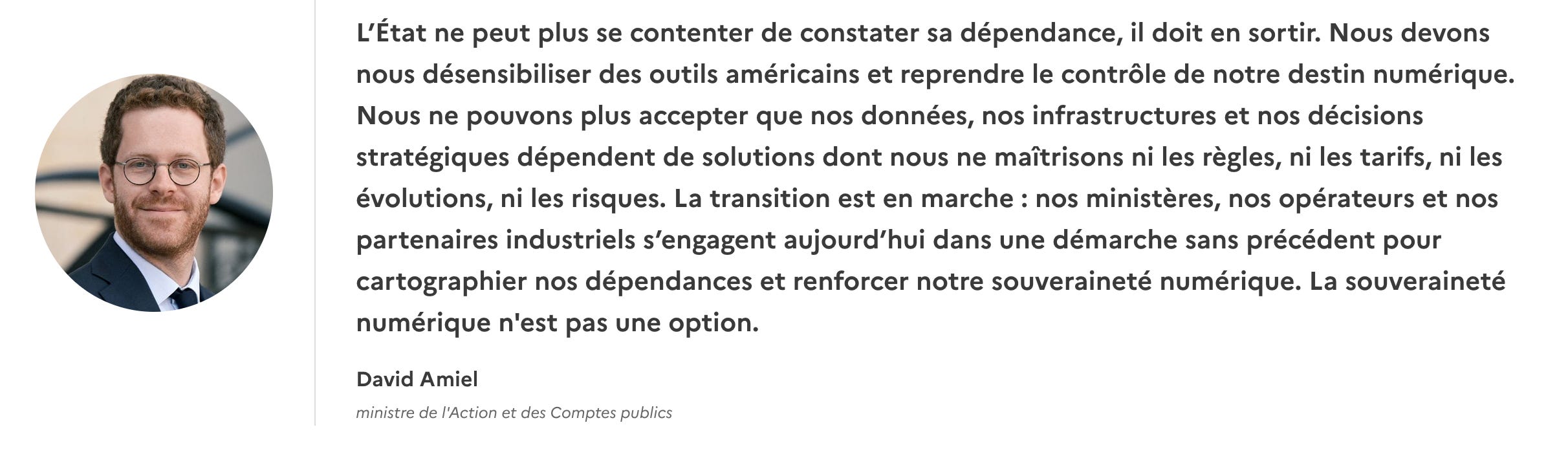
The State can no longer merely observe its dependency; it must break it. We must desensitize from American tools and reclaim our digital autonomy. We can no longer accept that our data, infrastructure, and strategic decisions rely on solutions where we have no control over regulations, pricing, technical roadmaps, or risks. The transition is underway: our ministries, agencies, and industrial partners are launching an unprecedented effort to map our dependencies and reinforce our digital sovereignty. Digital sovereignty is not optional. [emphasis added]. — David Amiel
“Desensitize” (désensibiliser) effectively means that decoupling from America is now official policy. But I think the literal translation works best for the political problem this poses for the United States. France and others view America’s digital reach as something that touches them where they are vulnerable. If America is not a trusted partner, you have to cut off contact.
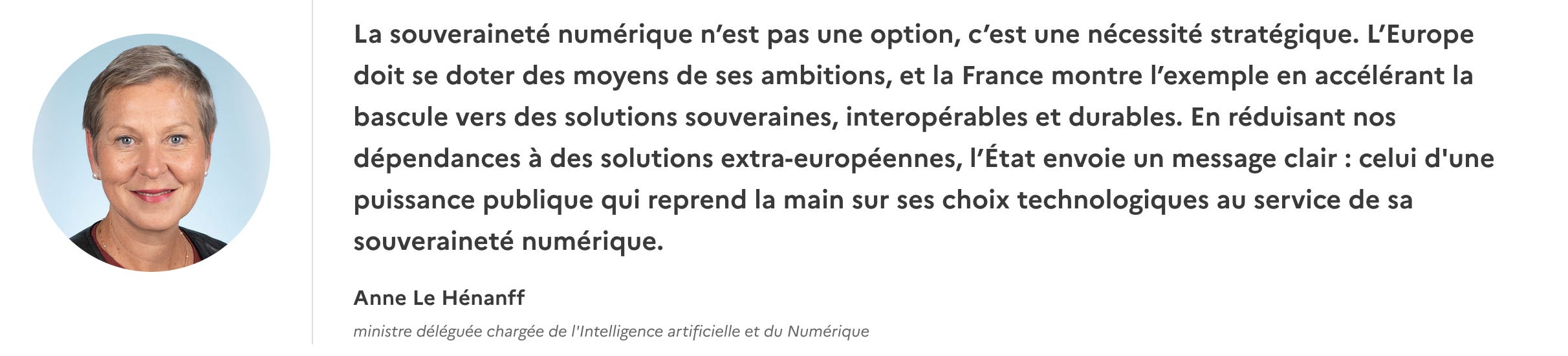
“Digital sovereignty is not an option; it is a strategic necessity. Europe must match its resources to its ambitions, and France is leading by example by accelerating the shift toward sovereign, interoperable, and sustainable solutions. By reducing our reliance on non-European technology, the State is sending a clear message: the government is reclaiming control over its technological choices to secure its digital sovereignty.”—Anne Le Hénanff
“TAKE BACK CONTROL” was the slogan of Brexit; it was also an implied subtext of “Make America Great Again.” Now it is France’s. Le Hénanff is stating plainly that Europe is reclaiming control over its technological future — and that American companies are not guaranteed a seat at the table. Europe is worth around half a trillion dollars to the US tech industry. Provoking it was an expensive mistake.
