

Dragon AI: China won’t fold like the USSR
The Future Must Be Won

The American stock market took a hit today because it got caught with its guard down. As they say, protect yourself at all times. Chinese artificial intelligence engineers surprised the American super corporations with their ingenuity, scalability, and low cost. I am not surprised, as I told my students at the beginning of my modern history courses when the United States created the world’s largest economy, it took the number one spot from China. Since the fall of the united Roman Empire, China has normally been the world‘s top economy, and they want their spot back. When analysts warn that if we’re not careful, the 21st century will be the Chinese century in the way the 20th century was the American century, they’re being not down on America; rather they're recognizing the fact that in the last thousand years, most centuries have been Chinese centuries.
Russia has had severe systemic problems for the last 400 years. The Soviet Union and its problems were Russian problems exacerbated by the contradictions of Marxist-Leninism and its additional tyrannies. The People’s Republic of China, however, unified and restored order to an ancient empire, with a tradition of commercial success, and a genius for invention. The tyranny of Mao was a disaster and delayed China becoming what it is now becoming, the greatest challenge to American hegemony since the decline of the British Empire.
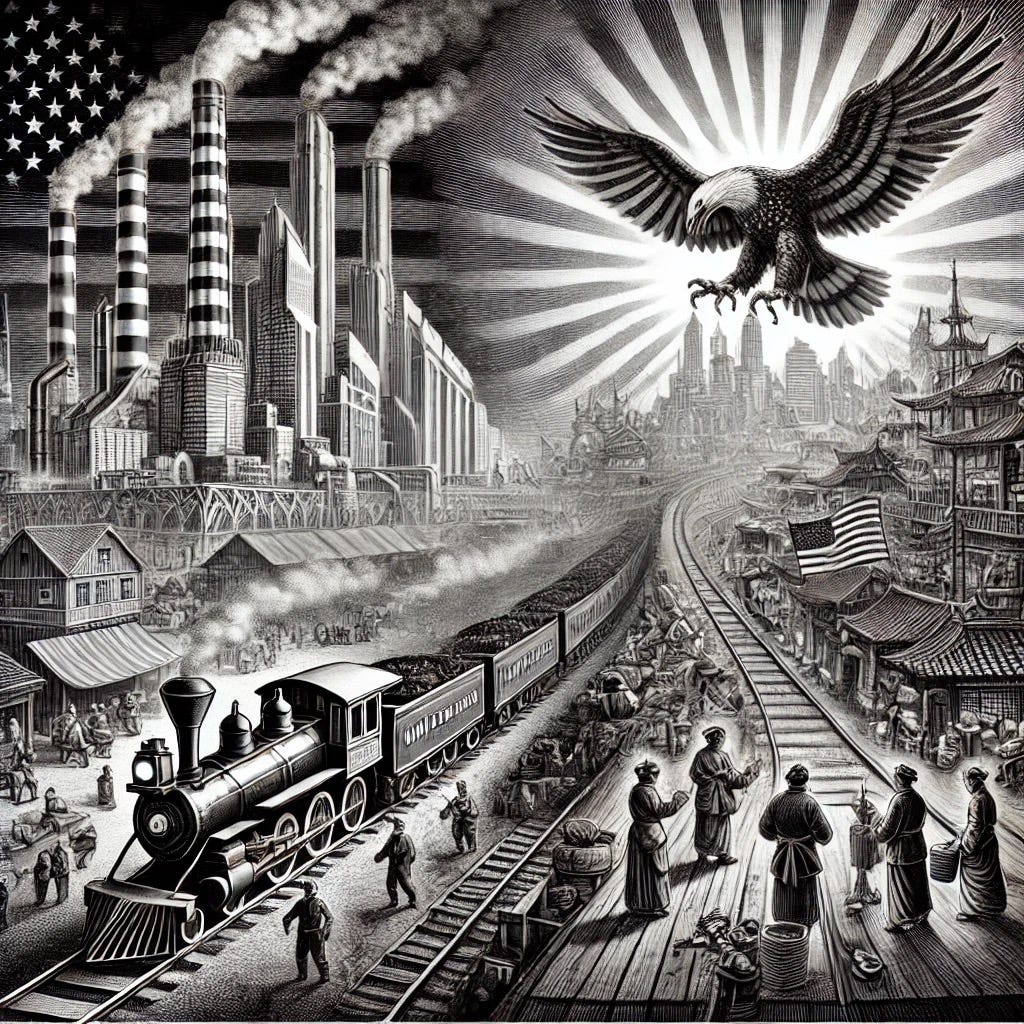
The United States first surpassed China as the world’s largest economy in the late 19th century, marking a turning point in global economic history. For the first time ever, the dominant economy was not in Eurasia. For centuries, China had dominated the world economy, leading in agriculture, manufacturing, and trade. However, with the advent of the Industrial Revolution, begun by Britain, Western nations, particularly the United States, Germany, and the United Kingdom, experienced unprecedented economic growth. By around 1894, the U.S. had overtaken China, establishing itself as the leading economic power. This shift was driven by industrialization, westward expansion, technological advancements, and a dynamic capitalist system that propelled innovation, while China remained reliant on traditional economic structures and fell prey to European colonialism and social dysfunction encouraged by the wicked trade in opium.
19th century China entered a century of humiliation. It was not always so. During the Tang and Song dynasties, China developed complex trade networks, paper money, and innovative industries such as silk and porcelain production. The Ming and early Qing dynasties further expanded China’s economic influence through extensive trade with Europe and Asia. The 1405 Indian Ocean fleet of Admiral Zheng He dwarfed anything Columbus could have imagined in 1492. The Chinese flagship measured 400 × 160 feet, while the Santa Maria was only 62 × 18 feet. In the 15th century, no European was silly enough to believe that they were inherently superior to the Chinese.
However, by the 18th and 19th centuries, China began to lag behind Western nations. Additionally, a series of internal conflicts, such as the Taiping Rebellion (1850-1864) and the Boxer Rebellion (1899-1901) weaken China. Tens of millions died. Political instability, corruption, and foreign interventions by Russia and Japan continued to keep the Chinese down.
Meanwhile, the American democracy was united by a sense of purpose that they were stewarding a new age of human development animated by a common Protestant social ethos among the elite who felt that their interests were tied to the greatness of the American Republic and people. These factors combined to propel the U.S. economy far ahead of China, and around 1910, the US surpassed the combined industrial might of France, the UK, and Germany.
America’s emergence as the top economy had profound global consequences throughout the 20th century. Its economic power translated into American might. American liberals used their geopolitical influence, enabling the U.S. to shape global affairs, particularly in the aftermath of World War II. America became not a, but the hub of technological and scientific innovation, leading in brand new industries such as aerospace and computing. Don’t let anyone tell you FDR didn’t put America first. The Second World War allowed us to crush our competitors, such as Germany and Japan, while our other competitors, Britain and France, were weakened to varying degrees. Either way, after 1945, they couldn’t touch us. The establishment of international financial institutions like the World Bank and the International Monetary Fund further reinforced American economic leadership. For much of the 20th century, the U.S. economy remained unmatched, while China continued to struggle with political and economic instability. This was a humiliation for a once proud people. When the Communists took over in 1949, a major part of their mandate was to reverse the decline. For the first eight decades of the 1900s, China remained hobbled by political turmoil, the fall of the Qing Dynasty led by Manchus, warlordism, Japanese invasion, the Chinese Civil War, and finally the disruptions caused by Mao Zedong’s policies, including the Great Leap Forward and the Cultural Revolution. However, the world turned again in 1978, nearly thirty years after the Communist takeover when new paramount leader, Deng Xiaoping introduced economic reforms that shifted China from a centralized economy to a market-driven one. These reforms led to rapid industrialization, re-urbanization, and global trade expansion. The Cold War ended, and the CCP could be more flexible in its ideological enforcement. Then, in a critically strategic mistake, Bill Clinton and the global capitalist, Republicans and Congress convinced themselves that trade and wealth would somehow magically make China democratic. Well, it made the Communists rich while America poured treasure into Iraq and Afghanistan and ran up its debt while choosing to bail out the instigators of the 2008 financial crisis.
According to some analysts, in 2014, China’s economy surpassed the United States in purchasing power parity, a metric that adjusts for cost-of-living differences. However, in terms of nominal GDP, which remains the most widely recognized measure of economic size, the United States continues to hold the top position. This should be little comfort to sober-minded Americans. The amount of global influence that Communist China has achieved through its wealth and investments surpasses the most paranoid imaginings of the Red Scare against Soviet infiltration. The Chinese are smarter than Lenin’s heirs.
Let there be no mistake: the leaders of the People’s Republic of China want the spot as a top country on the planet back. They are thrilled to see Americans divided on race and relitigating issues such as civil rights. They want Americans focused on owning the other side of the partisan divide instead of enacting serious structural reforms. A nation of 340 million people cannot afford such divisions when up against a juggernaut of over 1 billion people. Where Mao failed, his successors have not. In 2025, they can claim to have humiliated the US tech industry. Be wide awake.
Excellent written
love it