

Dec 31st, Prayerfully Watching and Waiting

December Thirty-first. Watch Night.
In 1862, they gathered in Churches in the North, and in the South and some other parts of the United States in secret, African Americans, slave and free, anticipating President Abraham Lincoln’s promise. If the rebels didn’t give up the fight against the American Government, Lincoln would set their property free, allowing the slaves to repossess themselves. The deadline was December 31, 1862. On New Year’s Day those slave held in territory still in rebellion would be free, forever free. So they watched. They waited. A tradition was made. Watch night.
Historically African Americans have excelled at making traditions. Many traditions from Africa were lost during slavery. We had to make more. So many family members lost, sold down the river never to been seen again. We had to find them and form new kinships. It is why many Africans, have a habit of asking folks where they are from. A holdover from the days of seeking for information, any sighting of lost family. It continued in the Great Migrations and looking for hometown folks to associate with as you moved around the country. “Where are your people from?”
Juneteenth is the most recent tradition to go national, made by Texas African Americans. Growing up in Virginia, I never celebrated it. Watch Night is a different thing, however.
Watch Night is more prominent within the Black community.
It is Freedom’s Eve.
Christianity was an avenue of resistance. Slaveholders tried to use Christianity to justify slavery, but they also feared that Christianity, because of the implied and explicit messages of equality and freedom in the Gospel, and the story of the Exodus would backfire and incite slaves to rebel. So slave religion was policed and monitored, and in some states they even limited how many African Americans could worship together at one time. Watch Night in Black churches today is a celebration, praise and worship service, starting in the evening normally after 7 p.m. and going on to midnight. But it is also the African-American passover.
It is a night unlike any other night. December 31st 1862 was a night different from all others.
Would the Civil War remain just a war against unlawful rebellion or be formally transformed into a crusade against slavery? Lincoln kept his promise, and gave his life.
It is this that distinguishes it from the European Americans’s version of watch night which began in the 18th century with immigrants from central Europe. And it became especially popular when it was Anglicized and promoted by the Anglican priest John Wesley, the progenitor of Methodism. Wesley’s Covenant Renewal Services spread the tradition, and it is fitting that the devout American Methodist layman, Frederick Douglas, was a major booster of the initial African American Watch Night in 1862, saying “It is a day for poetry and song, a new song.”
So to all my readers, may you have a Happy Freedom’s Eve and receive liberty in the new year. Freedom has come!
January 1, 1863
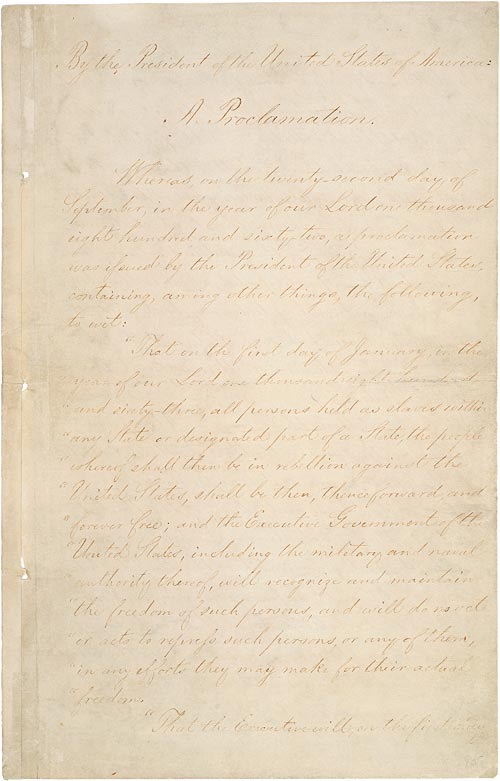
A Transcription
By the President of the United States of America:
A Proclamation.
Whereas, on the twenty-second day of September, in the year of our Lord one thousand eight hundred and sixty-two, a proclamation was issued by the President of the United States, containing, among other things, the following, to wit:
"That on the first day of January, in the year of our Lord one thousand eight hundred and sixty-three, all persons held as slaves within any State or designated part of a State, the people whereof shall then be in rebellion against the United States, shall be then, thenceforward, and forever free; and the Executive Government of the United States, including the military and naval authority thereof, will recognize and maintain the freedom of such persons, and will do no act or acts to repress such persons, or any of them, in any efforts they may make for their actual freedom.
"That the Executive will, on the first day of January aforesaid, by proclamation, designate the States and parts of States, if any, in which the people thereof, respectively, shall then be in rebellion against the United States; and the fact that any State, or the people thereof, shall on that day be, in good faith, represented in the Congress of the United States by members chosen thereto at elections wherein a majority of the qualified voters of such State shall have participated, shall, in the absence of strong countervailing testimony, be deemed conclusive evidence that such State, and the people thereof, are not then in rebellion against the United States."
Now, therefore I, Abraham Lincoln, President of the United States, by virtue of the power in me vested as Commander-in-Chief, of the Army and Navy of the United States in time of actual armed rebellion against the authority and government of the United States, and as a fit and necessary war measure for suppressing said rebellion, do, on this first day of January, in the year of our Lord one thousand eight hundred and sixty-three, and in accordance with my purpose so to do publicly proclaimed for the full period of one hundred days, from the day first above mentioned, order and designate as the States and parts of States wherein the people thereof respectively, are this day in rebellion against the United States, the following, to wit:
Arkansas, Texas, Louisiana, (except the Parishes of St. Bernard, Plaquemines, Jefferson, St. John, St. Charles, St. James Ascension, Assumption, Terrebonne, Lafourche, St. Mary, St. Martin, and Orleans, including the City of New Orleans) Mississippi, Alabama, Florida, Georgia, South Carolina, North Carolina, and Virginia, (except the forty-eight counties designated as West Virginia, and also the counties of Berkley, Accomac, Northampton, Elizabeth City, York, Princess Ann, and Norfolk, including the cities of Norfolk and Portsmouth[)], and which excepted parts, are for the present, left precisely as if this proclamation were not issued.
And by virtue of the power, and for the purpose aforesaid, I do order and declare that all persons held as slaves within said designated States, and parts of States, are, and henceforward shall be free; and that the Executive government of the United States, including the military and naval authorities thereof, will recognize and maintain the freedom of said persons.
And I hereby enjoin upon the people so declared to be free to abstain from all violence, unless in necessary self-defence; and I recommend to them that, in all cases when allowed, they labor faithfully for reasonable wages.
And I further declare and make known, that such persons of suitable condition, will be received into the armed service of the United States to garrison forts, positions, stations, and other places, and to man vessels of all sorts in said service.
And upon this act, sincerely believed to be an act of justice, warranted by the Constitution, upon military necessity, I invoke the considerate judgment of mankind, and the gracious favor of Almighty God.
In witness whereof, I have hereunto set my hand and caused the seal of the United States to be affixed.
Done at the City of Washington, this first day of January, in the year of our Lord one thousand eight hundred and sixty three, and of the Independence of the United States of America the eighty-seventh.
By the President: ABRAHAM LINCOLN WILLIAM H. SEWARD, Secretary of State.
OMG we did night watch every New Year's Eve growing up. Didn't understand until now why the Church lights were candles only, we held in glass holders. Back then the Church was careful about Night Watch in South. Service began at 11:00 pm over at 12. It was a solemn atmosphere.
This article is inspiring..