

Covid's History versus Our Memory, the Fauci Tragedy
Friday Flashpoint, July 31, AD2026

Welcome to Friday Flashpoint where I analyze and expose important historical and social developments impacting America’s place in the world.

Tragedy /ˈtrædʒ.ə.di/ noun
The downfall of an elevated figure whose error (hamartia) or pride (hubris) causes a swift reversal of fortune (peripeteia), evoking pity and fear.
It is too bad that history and memory are not the same thing.
If history is the truth of the past as we can verify it, and memory is the past we believe and act on, what happens when they do not line up?
What we call history and memory studies is a field that analyzes how societies recall and interpret their pasts, especially traumatic events. As a discipline, credit is given to Les cadres sociaux de la mémoire (The Social Frameworks of Memory), published in 1925 by French sociologist Maurice Halbwachs. Long academic story short, Halbwachs said that while individuals hold memory, memory itself depends on social frameworks like your family, the church, and class. Those social spheres create rituals and structures that shade, interpret, and often reconstruct the past, which then determines how you recall events you experienced and especially those you didn’t, such as pivotal heritage events. And often institutions will try to shape memory to fit their present needs, especially political movements for whom the truth is at best a frenemy.
Society from time to time obligates people not just to reproduce in thought previous events of their lives, but also to touch them up, to shorten them, or to complete them so that, however convinced we are that our memories are exact, we give them a prestige that reality did not possess. —Maurice Halbwachs, in Les cadres sociaux de la mémoire
Dr. Anthony Stephen Fauci, a graduate of the Cornell University Medical College who specialized in infectious diseases and ran the National Institute of Allergy and Infectious Diseases during the coronavirus pandemic, was summoned to the United States Senate Committee on Homeland Security and Governmental Affairs for a polarized grilling about the handling and mishandling of the American response to COVID-19. His opponent was Kentucky’s junior US Senator Dr. Randal Howard Paul, an ophthalmologist and graduate of the Duke University Medical School. Both men are graduates of top 10 medical schools in their fields, which is why the supporters of both men give them credence in the dispute.
There is a growing consensus that Dr. Fauci failed in his duty as a public servant to keep his behavior strictly professional. National emergencies are not the time to enjoy being a celebrity or to indulge ego. History is full of examples of how that ends badly. Fauci made unforced errors that confused the public, and I agree with Edward Luce, who writing in The Financial Times commented that the revelations from Fauci’s diary“…reminds me of the downsides to Fauci’s public epidemiology; he spoke too often, and too glibly, sometimes adding to the public’s confusion over how they should be acting.”1 My criticism is even harsher: Fauci worked for President Donald John Trump, a leader whose own ego is a well known constant impediment to good government, which meant that Fauci needed to be even more in control of his own ego and put the mission first.
Yet, while Americans remember Fauci, they forget the system under which he operated and where he was not the one in charge.
We have forgotten that when Trump created the Coronavirus Task Force, he put his then Vice President, Michael Richard Pence, in charge. Why was Pence not in the hot seat next to Fauci? It was Pence, for example, who ran the conference calls with the governors. The Task Force had 27 members, and Fauci was only the Director of the National Institute of Allergy and Infectious Diseases (NIAID); he was not the Director of the National Institutes of Health (NIH)—that was Dr. Francis Sellers Collins. Fauci did not run the Centers for Disease Control—that was Dr. Robert Ray Redfield Jr.
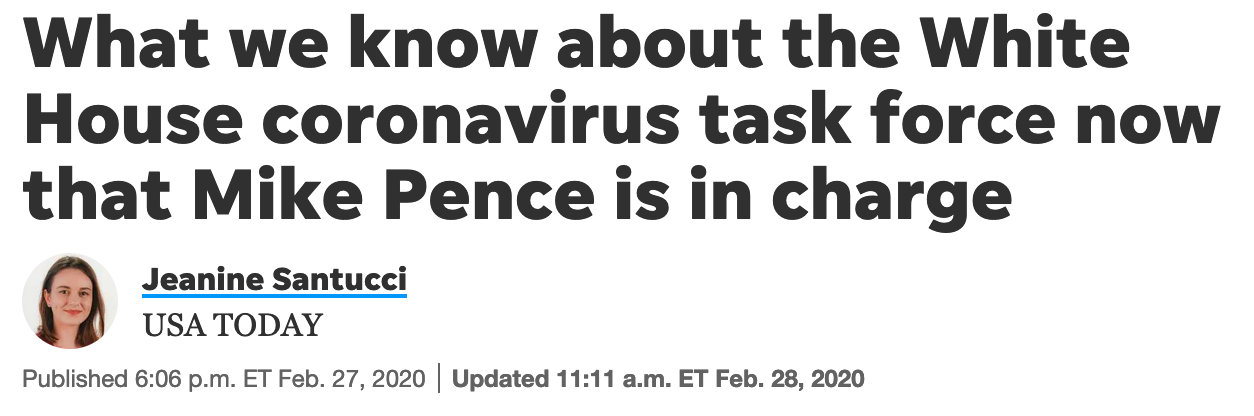
While Republicans complain about the impact of the federal COVID-19 response on the economy, the Task Force included the United States Secretary of the Treasury, the Director of the National Economic Council, and the United States Secretary of Labor. However, if they raised objections and were not heard, the person responsible would be the former vice president; he was the formal and authorized chair of the Task Force.
Furthermore, we have forgotten this headline:
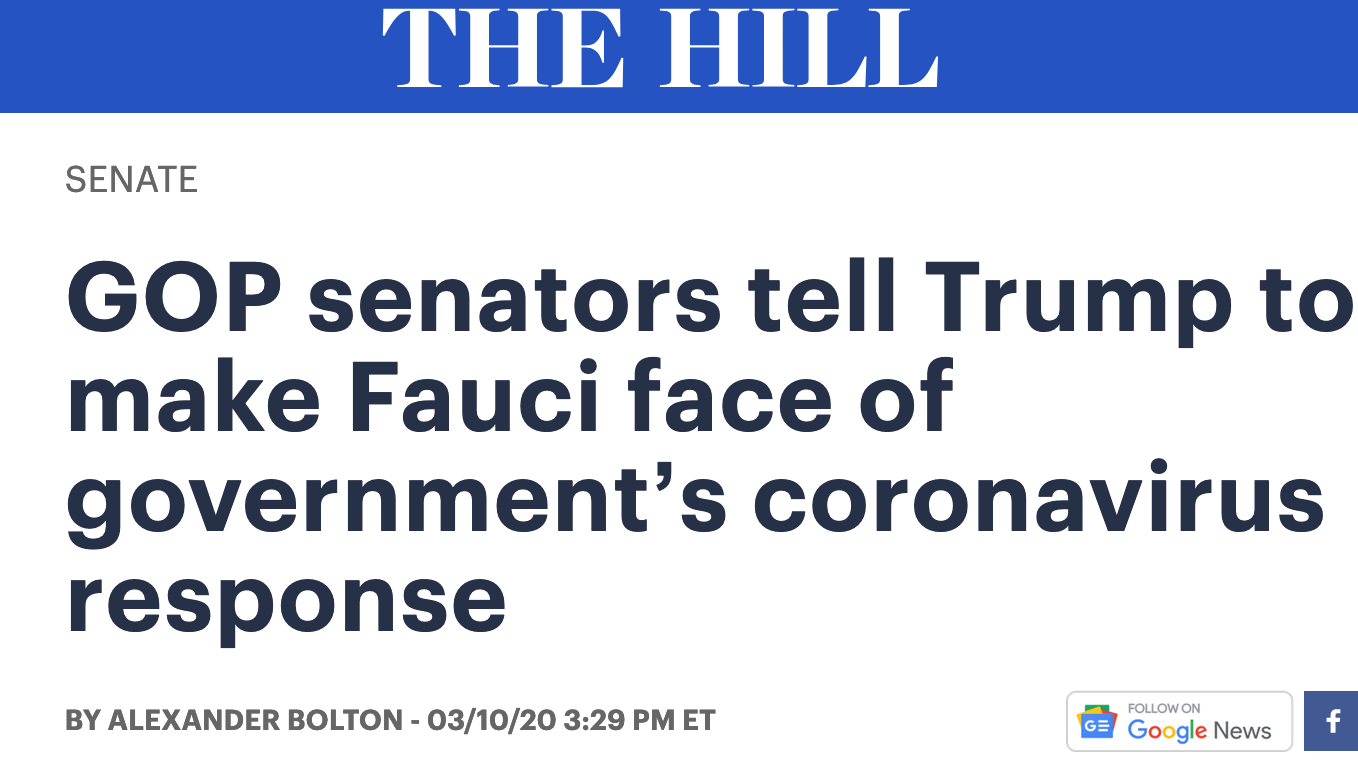
Given the facts, why are we focused almost exclusively on Tony Fauci?
Going back to history and memory studies and thinking along the lines of Halbwachs, I argue that the current American media landscape is not suited to helping people navigate and understand complex systemic issues, so memories become overly simplified almost in real time. That oversimplification plays out as the personification of complex structures: we condense a systemic response into a single person.
That is convenient for the GOP because holding a vast, diffuse government apparatus that they were in charge of accountable creates narrative friction. The president during the first year of COVID-19 is the same person who is president right now. To the point, Fauci was part of his administration, an employee if you will, and 45/47 could have removed him from the Task Force or sidelined him at any time. And finally, we could say that the attack on Fauci has become a political ritual rather than a meaningful tool to ensure that the government earns public trust and learns how to communicate more effectively before the next epidemic crisis turns into a pandemic.
But there is another reason that Americans have shortened and touched up their covidtide memories, one we need to reckon with: COVID-19 was traumatic. Beyond the deaths still grieved by families, people grieve their lost imagined futures. Careers were upended and many never recovered. Small businesses that were community pillars and the dreams of their owners were destroyed. Relationships were shattered, domestic abuse went up, youth suffered learning gaps, and never got their prom or their first year of college. It is satisfying to have someone to blame, and it is easier when it is clear that person enjoyed their fame too much.
Beyond the deaths still grieved by families, people grieve their futures. Careers were upended and many never recovered. Small businesses that were community pillars and the dreams of their owners were destroyed. Relationships were shattered, abuse went up, youth suffered learning gaps, and never got their prom or their first year of college. It is satisfying to have someone to blame and it is easier when it is clear that someone enjoyed their fame too much.
But this is not the same as fixing the failure of state capacity, repairing the damage to public trust, or resolving the distortions to the caused by the emergency.
It is a tragedy without the clarification of catharsis.
If this essay was worth your time, the heart button below costs nothing and means a lot. And if you’d like to support more writing like this, becoming a paid subscriber keeps it coming.
“The twilight of Dr Fauci” https://www.ft.com/content/570ecb5c-68de-4844-9e73-cf32463dbcac?syn-25a6b1a6=1