

Beyond An Gorta Mór: The Legitimacy of Irish Grievance Politics
World War Wednesday

In 2023 I presented a paper arguing that grievance politics were a good thing because grievances can be adjudicated. Resentment politics are bad because there is not much you can do with resentment. But grievances require a testable claim of harm and injustice. Americans do themselves no favors when they reject the idea of grievances out of hand and it is a sign of how our education system has failed us that too many Americans miss the importance of the last right promised in the First Amendment of the US Constitution.
Congress shall make no law respecting an establishment of religion, or prohibiting the free exercise thereof; or abridging the freedom of speech, or of the press; or the right of the people peaceably to assemble, and to petition the government for a redress of grievances.
Without this moral clarity, Ireland’s behavior for much of the 20th century seems inexplicable. But in context Irish policies are not that unexpected. The Irish truly suffered under the British Empire after the mid-17th century when the Puritan government dispossessed the Irish landholders and practically enslaved Irish POWs.

By the time we get to the period of World War One the Irish were both experiencing new prosperity and better able to resist the British. Britain was a Protestant state, which in and of itself is not a bad thing except they wished to rule Ireland rather than leaving Ireland to the Irish and allowing them to be a Catholic country. This chosen contradiction brought the British trouble because to maintain control of Ireland they had to disenfranchise Catholics and then later abolish the Irish Parliament altogether and force them to vote as part of the British Parliament in Westminster where they could always be outvoted by the English, Scottish, and Welsh who were overwhelmingly Protestants.
The 1800 Acts of Union created the “United Kingdom” and was the moment the British government decided that the “Irish problem” could be solved by simply erasing the Irish political identity. By dissolving the Parliament in Dublin and merging it into Westminster, the British ensured that Irish grievances were no longer a matter of local justice, but a footnote in an imperial ledger.
The lack of political independence caused the Great Hunger (an Gorta Mór). Phytophthora infestans is the mold that created the Potato Famine from 1845-49, but that is not why it was so devastating. The problem is that great a disaster usually requires organized responses which are most effectively managed by government authorities. Politics is the ultimate test of human organization. Because the British ruled Ireland, the force of government was directed to British priorities and not to Irish survival. The Irish understood this and hated it. If they had their own state, they could take care of themselves and make the laws and policies needed to facilitate relief. Consequently, Irish nationalism only grew as they watched loved ones die or emigrate.
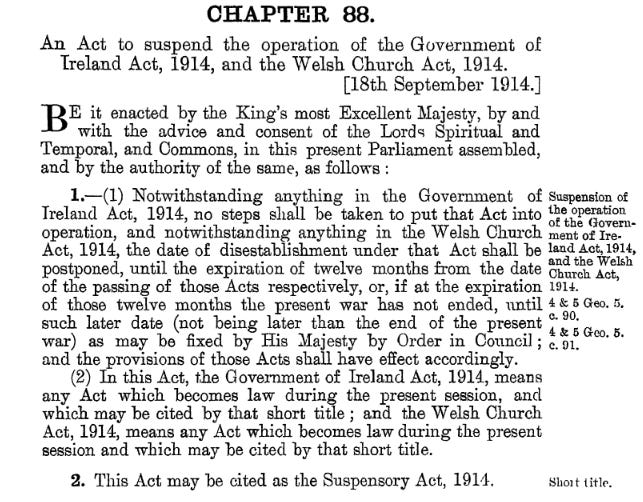
Belatedly, nearly 80 years later the British realized that abolishing the Irish Parliament did not and would never solve the root cause of their problem with the Irish. For decades a debate raged over granting the Irish home rule, meaning giving them a parliament, this time with democratic representation for Catholic men. The British finally came to their senses after a crisis in 1912 and the government was working on a bill for Irish Home Rule in the summer of 1914 when something in the Balkans stole their attention. The Great War broke out, and the British government suspended the implementation of Irish Home Rule if “this present war has not ended” meaning no Home Rule while the Great War was fought, but if you think the war will be over by Christmas, perhaps that was not such a big deal. This was not a good move when the other side did not trust you.
The Irish Americans watched and remembered. And when Britain went to war in 1914, many were ambivalent about the prospects of supporting the empire that had oppressed their grandparents and still denied liberty to their ancestral island.
On the one hand, many Irishmen fought in the British forces, and they wished their fellows well and a safe return home. On the other, many wondered if a victorious Britain would ever let Ireland have home rule, let alone independence. On both sides of the Atlantic the Irish had good reason to demand a redress of grievances from Britain.

Hmmm,how do we distinguish between legitimate grievances and resentment? That is the 800lb gorilla in the room.
Your local friendly Anglophiliac Irish Nationalist.....