Before we took to the stars we claimed the clouds
World War Wednesday: The double-edged sword of Artemis. Initiating Great War Air Combat

The launch of Artemis II is being sold as a triumph of the common good, but history suggests that discovery is merely the R&D phase of destruction. We are told that space is our next frontier for cooperation; in 1903, they said the same about the clouds.
Before we looked to the stars we voyaged into the blue skies, and the path of human flight followed a course of rapid, violent change. On December 17th 1903, the American brothers, Orville and Wilbur Wright were the first in powered flight, a feat of world-changing engineering driven by good old American curiosity and optimism. Barely a decade later, Europeans had repurposed this invention into the latest elite weapon of war: pilots became the new knights.
These new knights of the air were not explorers; they were eyes for the artillery, the first step in a process of fusing the weapon to the vehicle.
The excitement and eagerness for adventure that marked the outbreak of war in the Summer of 1914, gave way to the reality of brutal combat in the trenches. It became clear that the war would not be over before Christmas. Commanders needed something to break the deadlock and looked for knowledge of the enemy through aerial observation.
By late 1914, the initial novelty of flight gave way to tactical necessity. The evolution of aerial photography accelerated this shift by 1915. Air power evolved and became a cornerstone of land-based strategy, providing a view of the battlefield that was previously impossible. Much like our use of satellites today.
Additionally, as the war went on, loss of communication became a critical risk. The scale of the battlefield created too many opportunities for men to move out of range of communication from headquarters. Aircraft provided the solution, acting as a link between the front lines and the rear, supporting command and control. However, this utility created a new problem: if aircraft could provide advantages to you then the same idea worked for the enemy. That had to be stopped. You needed your airplanes to help stop their airplanes. Air combat and direct battlefield assistance, meaning close air support, were integrated into ground campaign planning.
It was no longer enough to fly; one had to rule the skies. This led to a cycle of technological progress, the most significant development of the first year of the air war was the German Fokker Eindecker. Designed by Anton Herman Gerard Fokker, it changed everything, the first monoplane built to be a killer. Its defining feature was the synchronization gear. This mechanism allowed a machine gun to fire through the propeller arc without hitting the blades…usually. While early versions required refinement, the principle was sound: it was this innovation that merged the man and the machine of war. The pilot no longer just flew a plane; he aimed it.
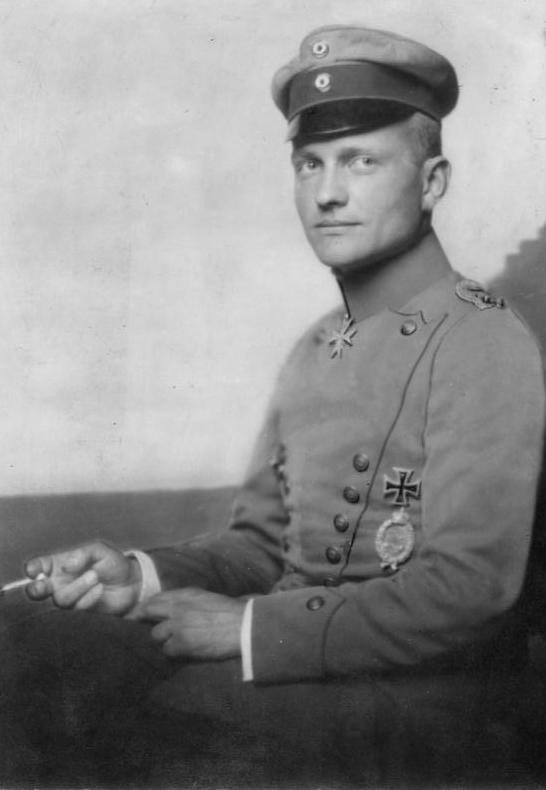
The soldiers on the ground, most of whom had never seen an airplane before the war, viewed these machines and their pilots as symbols of a glorious and terrifying new age, and those who mastered these weapons became its heroes and legends. None more so than the German fighter ace, the Red Baron, who like Achilles died young and remains the most famous warrior of his era: the first demigod of what would become the air-conditioned nightmare of modern war.
As we celebrate the Artemis Program, we must remain vigilant. The America that went to the moon in 1969 with Apollo Program was a more solid state, the lunar landing was the peak of American Cold War liberalism. Today, the system behind the Artemis II mission is shaky economically and morally confused politically. In such times societies make critical errors from hubris and vanity. History shows that the instruments of progress are often the first to be recruited for ruin; that the tools of the dreamers are never far from the hands of the monsters. We are going back to the moon: is it to lead and inspire humanity or to stake a claim on the high ground before the next Great War?