

Bad History, Worse Movie
The Viewer, Napoleon, Josephine and even Wellington Deserved Better From Ridley Scott


Ridley Scott’s Napoleon, produced by Apple, is emptier than the French imperial throne.
It is a big-budget film. Starring Joaquin Phoenix, who made his name as the bad, mad Emperor Commodus in Ridley Scott’s Gladiator opposite Russell Crowe. Gladiator made both men stars. This is not Gladiator, and it is not Mel Gibson’s Braveheart or Gibson’s The Patriot. That is a trio of films that are full of historical inaccuracies. But it doesn’t matter because the stories are right and well told. Braveheart focuses on Wallace as the inspiration for Scottish resistance to the English, the ruthless efficiency of the English King Edward I, and the fickleness of the quarrelsome Scottish nobility. You saw Braveheart and wanted to know more about William Wallace. It influenced British politics, becoming a cultural rallying point for Scottish Nationalists, and helped Tony Blair’s Labour Party win the 1997 general election and the following Scottish devolution referendum. That is what it means to have an impact. Braveheart is inaccurate and a great film.
Gladiator and The Patriot came out in 2000, the last full year before 9/11 traumatized our collective imagination and the film and arts industry. Both films got laughs from historians - more Gladiator than The Patriot - but they took the tale of the loyal war hero betrayed by a corrupt government and forced to avenge and defend their families and ran it into the endzone. Simple, straightforward, and clearly told in a narrative that the viewer doesn’t struggle to follow. You can watch Gladiator knowing nothing about Marcus Aurelius and get the point that a respected emperor was succeeded by a spoiled and petulant son who messed things up. Mel Gibson shows Carolina racism and slavery without giving you a lecture on the topic. You get it, and the aspirational motivation for Africans who fought for both sides in the American War of Independence. You understand that the Carolina backcountry was a guerilla and civil war with Loyalist American irregular troops and the Red Coats versus Patriot militias and the Continental Army. Because they were good films, historians had an interested public to educate. As far as I am concerned, I only need a film to be somewhere in the neighborhood of the history and to avoid modern politically correct anachronisms that don’t serve a good story. Just make it to the vicinity of the facts, and I’ll be happy. If it is a great and exciting story, I can overlook a lot because as a professor I can work with the public and students not knowing the history. It is not caring that is tough. A great movie will make people care, and that’s worth sacrificing some accuracy and even a bit of fantastical silliness for art.
That is not what happened when I caught an earlier showing of Napoleon on the evening of November the Twenty-First in the year of Our Lord Two Thousand Twenty-Three. It was a Dark and Storm Night. Ridley Scott did the impossible. He made a Napoleon film that was not exciting to me.
Scott’s response to historians’ complaints has been something along the lines of “Excuse me, mate were you there?” I’d say, “No, but chap, were you there awake on set, because I almost wasn’t in the theater.”
Ridley Scott did the impossible.
He made a Napoleon film that was not exciting to me.

Napoleonic battlefields were a clash of colors. Unit standards, national flags, royal heraldry, and a kaleidoscope of uniforms worn by men who still rode mighty steeds across green fields, whose stud ancestors carried knights to Agincourt. It is easy to make the battles aesthetically pleasing and hard to make the battles somewhat boring. Scott nailed the easy part and sought achievement in the wrong direction.
The film is a collection of snippets with little tying them together other than the presence of Joaquin Phoenix. The film's best part is the Siege of Toulon, the second part of the first act. War's brilliance, terror, and adrenaline are only felt in this battle. From there, it is downhill for the rest of the movie. But oddly, it is because the choices made to sacrifice history for art made the story less clear and less dramatic, the opposite effect one expects when a director decides to play fast and loose with the facts.
I’ll give a few examples where the decision to depart from history made the story less interesting. The film begins with the execution judicial murder of a heavily made-up and defiant Queen Marie Antoinette, witnessed by Napoleon, and followed immediately by a scene of the Revolutionary assembly justifying the murder by listing her crimes. Okay, so problems. One, she wasn’t wearing fab makeup with flowing blonde hair; the reality was far more dramatic. Stress had turned her hair white at the age of 37. The Revolutionaries cut her hair off before she left her cell. She was forced to wear plain white, not royal blue, as in the movie. They tied her hands brutally behind her back, put a rope leash on her, and carried her slowly to the place of execution in an open cart like an animal to slaughter. Scott produced a cinematic cliche. The history was horror, and it was one of many signs the Revolution was off the rails and no longer meaningfully about liberty. And Napoleon wasn't there; he was at Toulon, 500 miles away. To enhance the scene where the accusations against the ex-queen are repeated to justify why she is dead, you could have had the Revolutionaries repeat the accusations they forced her son, the prince, to make that she had abused him. All this made her a sad, despondent figure before her death, proof the age of chivalry was dead in France and the Revolution was broken and morally corrupt. She shouldn’t look like she is about to announce Katniss Everdeen’s return to the Hunger Games.
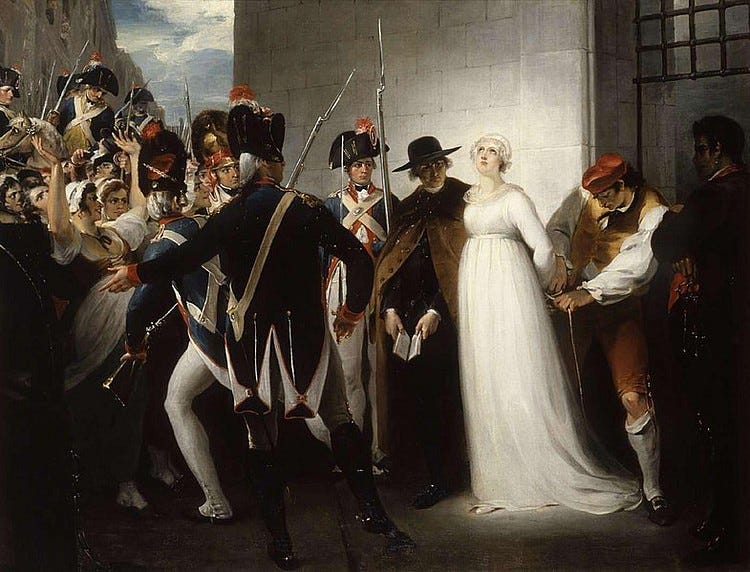
Marie Antoinette being taken to her Execution Painting by William Hamilton, 1794, oil on canvas.
Next, there is Josephine's age. Josephine was born in 1763. However, in the movie, they deliberately present her as being born in 1768, only one year older than Napoleon, who was born in 1769. So they threw away the tension in their marriage that came from Napoleon marrying a woman six years older than him. Monarchs require heirs; having an Empress six years older than the ruler is an automatic and easy source of conflict, stress, controversy, and family angst. And it has the benefit of being true. If you were going to make the story about Napoleon and Josephine, decreasing their age difference is not the way to go. Quick example: the Tudor king of England, Henry VIII, was six years younger than Catherine of Aragon. We know how that played out. If you want to do a callback story and create anxiety in the scenes between Josephine and Napoleon, have her be the historically accurate six years older. There is no reason to get her age wrong other than just not caring about the facts, but in this case, you hurt your story, so then again, what was the point, mate?
Finally, let’s talk about the failure to get all the drama and adventure out of the invasion of Egypt. The director of Kingdom of Heaven cut the Holy Land out of the story. Napoleon invaded Ottoman Palestine, now Israel, in 1799 after the British destroyed the French fleet in the 1798 Battle of the Nile. With his ships gone, Napoleon was semi-trapped and tried to expand the war to win it. He invaded the land of Canaan, took Gaza, and then marched to Jaffa, besieged and brutally took it too. But at Acre, the defending Ottomans beat him. Forced him back to Egypt. His defeat in the Siege of Acre lost the whole invasion and ended the Egyptian-Syrian campaign. He was attempting to be Alexander the Great and conquer the East. He failed and left his army to its fate. He didn’t run back to France because of Josephine‘s dalliances. He came back because he didn’t want to be associated with the defeat, and he heard that the government of France, the Directory, was ripe for an overthrow. Instead of the drama, we got a scene of Napoléon playing Mister Potato Head with a mummy.
The film missed every opportunity to make scenes hit harder. Each of my critical examples has a missed payoff. If you use Marie Antoinette to show why the Revolutionary government is corrupt and wicked, you explain why Napoleon is able to overthrow it and why he is seen as a source of stability and reasonableness. If you keep Josephine six years older, you can create the sense that she is running out of time to produce an heir, and you amp up the dread and anxiety in the audience as she nears her fate. You can even have courtiers whisper about the Tudor dynasty's troubles. Finally, if you do Egypt right by just showing the defeat at Acre or the Nile - you can’t show everything - and have Napoleon leave his men, you foreshadow similar behavior in Russia. But that would have required Ridley Scott and scriptwriter David Scarpa to have a coherent story. If a critic leaves the film believing that the Duke of Wellington - the famous soldier in British history - played by Rupert Everett, was an admiral, then the film has a problem.
I think the cast did what they could. Vanessa Kirby shone through bad lines and contrived scenes, and even Phoenix deserves credit for playing the part he was given. But their director shot a chaotic mess of snippets. Artistic choices managed to take the drama out of a naturally exciting epic. Music made the scenes less impactful. It earned its R rating for all the wrong reasons, with crass and discomforting scenes. The director and screenwriter didn’t know what story they were telling. If they didn’t care, there’s no reason the audience should either.
Napoleon was crowned Emperor of the French on December 2nd, 1804. This isn’t the movie to watch if you want to enjoy the anniversary.
Thumbs Down